Tag Archives: UVA Running Medicine

Ground-breaking news: runners who are faster than you have longer strides

This year, I got to present along an all-star cast at the USATF SPEED Summit in NJ. Basically, the goal is to breakdown the elements of coaching based on science, and then use this science to bolster what we do on track. Smarter plan = better results. Or maybe I should say smarter people help us develop better plans? This is the conference I was most looking forward to this year, and it did not disappoint.

So let’s get past the sarcasm in the title, and go straight to the big picture: if you run slow, you take short strides and your turn over isn’t that quick. The only way to run faster is to increase your turnover and your stride length. So it shouldn’t be a surprise when you hear that faster runners have a longer stride length than slower runners. But now we get into an interesting question…..is stride length the cause or the effect? Or more specifically, why do some runners appear to bound effortlessly over the ground?

Screen Shot 2013-06-10 at 12.41.43 AM

They are stronger. About 80% of the cost of running comes from holding your body up against gravity. If you have strength reserves, it’s easy to combat gravity and float from step to step.  This extra strength enables more “hang-time” which translates to a longer stride length with less effort. Take home here? Get stronger.

How can you develop running specific strength? You can run. Collegiate and sponsored athletes get two workouts a day, and are racking up big miles. You know what else they do? They lift weights to develop strength reserves. Its highly likely that you don’t have the time and energy to rack up monster miles each week. But take a look at your week. Can you examine your training program and budget 30 min 2x’s a week for some strength work? If the answer is no, take a look back at the Achievement Triangle post…..and ask yourself where you’d like to be.  And if you are over 40, this is not optional. Get strong to get faster.

Want more? Check out this reference: Weyand
Announcing the REP Triathlon Camp! – immerse yourself with the best, and achieve the best

Its just like the summer camp you went to as a kid. Except that……
Instead of eating hot dogs, we’ve got fully catered meals.
Instead of “being prepared” like a good Scout, we’ve got full sag on every workout.
Instead of dodgeball, we start each day with body work, strength training, or yoga. 
Instead of “trying harder” to make it through the obstacle course, we’ll coach you to “move smarter” through the most efficient mechanics for your sports.
Instead of a councilor that reads comic books, your camp leaders wrote the book on training, and teach nationally.
Instead of cheesy sing-alongs, we’ll show you all the secrets to training, equipment, and recovery for you are fully prepared for every race scenario.
Instead of fruit punch, you’ll be surrounded by the most thriving microbrew scene around. 
And we’ve even got a campfire for nightime chats with professional athletes and experts. 
So like we said, its just like summer camp when you were a kid.
 
 
The REP tri camp was born out of a simple idea. Build the best possible experience for our athletes. Period. 
Knowledge. Tools. Decades of and coaching and clinical experience. Passion. 
Thus summer, take your body to a whole different level. 

The MOST important single sentence you’ll ever read about training

I won’t keep you in suspense, here it is:

Instead of getting caught up in the latest fads, always make sure each workout is contributing to your long term goals.

I was in the airport yesterday and starring at the news stand. Every single issue has some variation of “the 5 workouts you must do this month” plastered across the cover. There are lots of great workouts out there, but only you can identify who you want to be.

Its pretty easy to work backwards. Define your goal, and ensure that each day’s heart beats, muscle contractions, nutrition intake, and rest schedules are target focused on that goal. Because we both want the same thing: for you to be able to cross your next challenge off your list.

Pace Maker: an interview with Today in PT

Today in PT is a magazine for the physical therapy profession. They wrote:

Americans are increasingly on the run, with Running USA’s 2012 State of the Sport report counting nearly 39 million runners. Runners spend nearly $2.5 billion annually on footwear, according to the report. But, unfortunately, new shoes don’t come with accurate information and proper training to safely and successfully pursue the activity. For that, Today in PT turned to Jay Dicharry, PT, MPT, SCS, author of “Anatomy for Runners: Unlocking Your Athletic Potential for Health, Speed, and Injury Prevention.” click here for the rest

They threw out 10 questions, and i threw out 10 answers. Check out the link if you’d like to see some of the reasons why i do what I do, a few lines on the book, and why i got into this aspect of athletic injury care in the first place.


Why does your achilles hurt, and how to fix it

I was contacted by Jason Fitzgerald at StrengthRunning.com to help clear up a lot of the mystery behind achilles issues. Even though this injury can be a major complicator for your training, the mechanics of it are actually quite simple.  If you’d like to check it out, check out this link.

UVA Running Medicine 2013: a recap

What happens when you get 220+ clinicians in the room and talk about running? It was a beautiful day. About 55 degrees and sunny. The remnants of the 10+ in snowstorm on the ground helped dampen the air and made the sun feel even stronger. It’s a beautiful day for a run….but instead,about 220 clinicians sat inside, on their glutes, so they can learn to help you use your glutes better.

The 10th anniversary of the longest running, running specific medical conference produced a host of content to help “us” help “you.” Do you ever wonder why running is as challenging as it is? How your running would change if you had no gravity to fight, arms to swing, or perhaps even legs to stand on? Dr Rodger Kram led us in 2 enlightening presentations on the energetics of gait. Talks like this completely shift how you think about running.

Dr. Eric Carson reviewed the current and future trends on cartilage repair. Take home: right now, cutting edge surgeons are able to offer some pretty incredible proceedures, and they’ll be even more magic to come in the future.

Brian Hoke, PT helped us think critically through our video gait analysis. Anyone can watch a video in slow motion, but learning what to look for is critical.

Your’s truly helped clinicians through their musculoskeletal exams as they relate to a runner’s needs. No one can tlak about “correct running form” unless you understand that each runner is an individual with unique needs and attributes. If you understand how a person’s body wants to work, you can understand how to help that person run. For those of you who read the screen’s in Anatomy for Runners, that 8-point exam just got a whole lot more thorough: 32-points to be exact.

Dr Sibohn Stattua reviewed the literature on the female athlete triad. Turns out that there is more to it than just low energy intake, menstrual irregularity, and poor bone remodeling…..the triad is turning into a square? That’s right, there is a 4th “leg” to the triad, and this one might be even more severe of a long term complication from this complex disorder.

Eric Magrum, PT discussed the current research on the #1 injury affecting runners: anterior knee pain. He told us why runners with chronic pain in the knee try to avoid their pain. The problem is that the compensations we adopt to avoid pain in the knee are just as much of a problem as the original cause itself.

Kyle Kiesel, PhD, PT helped us through an eval process to identify core imbalances that affect far more than just the core.

And finally, Dr Bob Wilder guided us through the process of guiding you back to your running in explaining the best return to run programs after an injury.

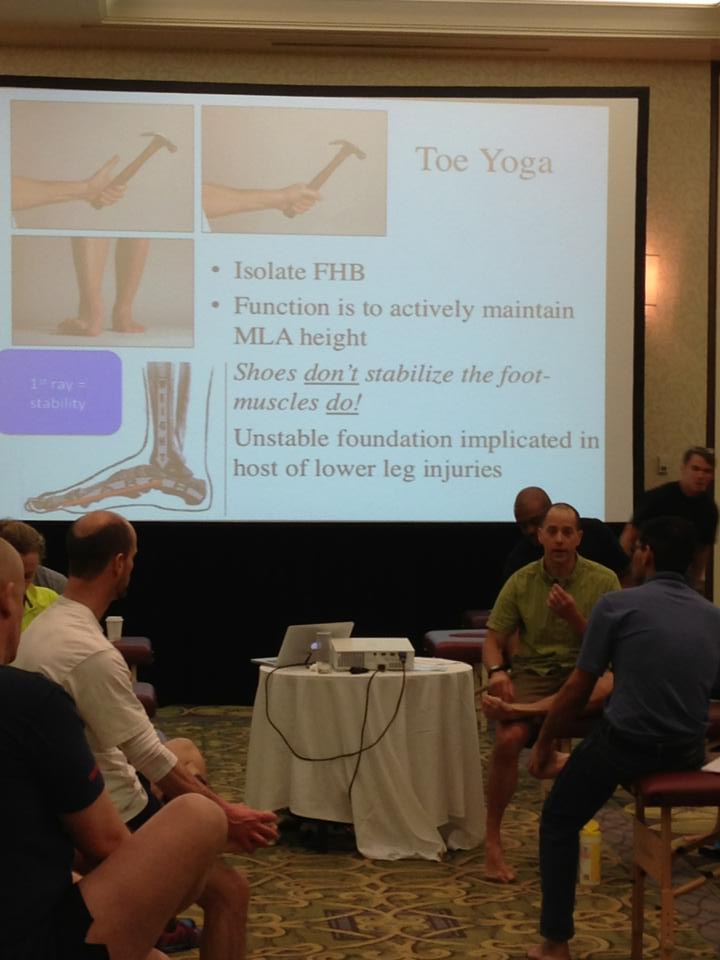
Clinicans getting to know their feet: a scene from our lab session

Clinicans getting to know their feet: a scene from our lab session

And that doesn’t even mention the incredible lab session on Saturday by Brian Hoke, Kyle Kiesel, Dr Mark Cuccuzzella, myself, and the amazing cookies that I ate at the afternoon break. Egos were dropped at the door, and we all got down to the same level to help runners do what they love: run.

As always, the conference returns next year……

UVA Running Medicine 2013 – join us!

Calling all MD’s, PT’s, ATC’s – the premier Clinical Education event for Running-specific education is coming around again. Come celebrate our 10th year at the University of Virginia in Charlottesville, this March 8th and 9th.

Although we’ve had many coaches and guru’s attend this event in the past, the aim is to enrich the minds of the clinicians who will be guiding your care as a runner. Dr Robert Wilder, Eric Magrum, and myself have been hard at work over the past ten – yes 10 years! – to assemble the brightest and most relevant content to help you perform.

This year’s keynote presentation features Dr. Rodger Kram from UC-Boulder. Dr Kram’s research, presentation style, and findings have made him a true authority. It’s tough to find a journal article on running that doesn’t cite his work. After seeing him speak many years ago, I had a paradigm shift in the way I thought about running injury and performance. And we’ve got a host of other excellent presentations from leaders in the field. You’ll be in for an exceptional treat. Brochure link is below – Hope to see you there!

RunMed2013