I was contacted by Jason Fitzgerald at StrengthRunning.com to help clear up a lot of the mystery behind achilles issues. Even though this injury can be a major complicator for your training, the mechanics of it are actually quite simple. If you’d like to check it out, check out this link.
Tag Archives: triathlon
Elevator Up? The Mindset Behind a Champion
A few weeks ago, I got to present along side Dr. Joe Vigil at a USA Track and Field conference in LA. For those of you who have to ask “who is Joe Vigil?”…..this man is to coaches as Rolex is to watches: the best.
Dr Vigil always has the uncanny ability to break down complex tasks and ask you the “right” introspective questions to help you reach your next milestone. We don’t just train the body in isolation. We’ve always heard that the body can handle more than the mind wants to give. So with that, I’m going to leave you with the following picture. Is it time to take the elevator up the “achievement triangle?” – What’s holding you back from reaching your goals? Change all starts with the desire to change.
In fact, lets move beyond kumbaya and start this process in motion right now. Turn the computer off. Get out a sheet of paper and make 3 columns. Write down your goals in column 1. Then write down the obstacles that stand in the way of each of your goals. Then make a 3rd column of exactly what you are going to do to beat each of those obstacles. Stick it on your fridge and remember your passion. When one of those obstacles seems like its standing in your way, make your tiger face and beat it down. Mental Tough = Body Tough.
And if you need help with your plan, give me a ring – I’ll help you find your tiger face.
UVA Running Medicine 2013: a recap
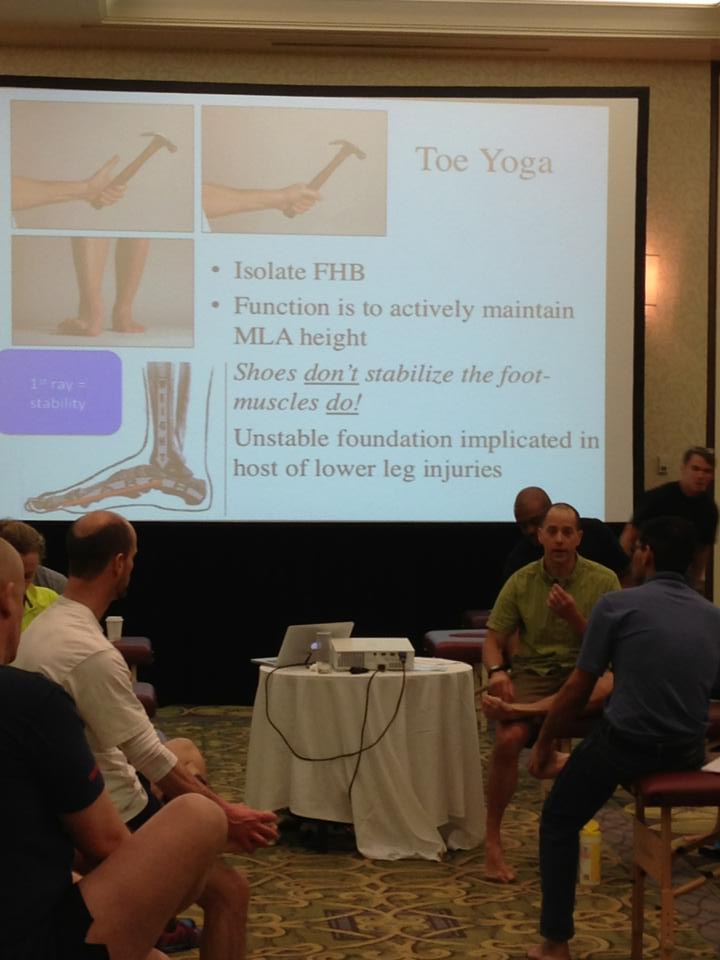
What happens when you get 220+ clinicians in the room and talk about running? It was a beautiful day. About 55 degrees and sunny. The remnants of the 10+ in snowstorm on the ground helped dampen the air and made the sun feel even stronger. It’s a beautiful day for a run….but instead,about 220 clinicians sat inside, on their glutes, so they can learn to help you use your glutes better.
The 10th anniversary of the longest running, running specific medical conference produced a host of content to help “us” help “you.” Do you ever wonder why running is as challenging as it is? How your running would change if you had no gravity to fight, arms to swing, or perhaps even legs to stand on? Dr Rodger Kram led us in 2 enlightening presentations on the energetics of gait. Talks like this completely shift how you think about running.
Dr. Eric Carson reviewed the current and future trends on cartilage repair. Take home: right now, cutting edge surgeons are able to offer some pretty incredible proceedures, and they’ll be even more magic to come in the future.
Brian Hoke, PT helped us think critically through our video gait analysis. Anyone can watch a video in slow motion, but learning what to look for is critical.
Your’s truly helped clinicians through their musculoskeletal exams as they relate to a runner’s needs. No one can tlak about “correct running form” unless you understand that each runner is an individual with unique needs and attributes. If you understand how a person’s body wants to work, you can understand how to help that person run. For those of you who read the screen’s in Anatomy for Runners, that 8-point exam just got a whole lot more thorough: 32-points to be exact.
Dr Sibohn Stattua reviewed the literature on the female athlete triad. Turns out that there is more to it than just low energy intake, menstrual irregularity, and poor bone remodeling…..the triad is turning into a square? That’s right, there is a 4th “leg” to the triad, and this one might be even more severe of a long term complication from this complex disorder.
Eric Magrum, PT discussed the current research on the #1 injury affecting runners: anterior knee pain. He told us why runners with chronic pain in the knee try to avoid their pain. The problem is that the compensations we adopt to avoid pain in the knee are just as much of a problem as the original cause itself.
Kyle Kiesel, PhD, PT helped us through an eval process to identify core imbalances that affect far more than just the core.
And finally, Dr Bob Wilder guided us through the process of guiding you back to your running in explaining the best return to run programs after an injury.
And that doesn’t even mention the incredible lab session on Saturday by Brian Hoke, Kyle Kiesel, Dr Mark Cuccuzzella, myself, and the amazing cookies that I ate at the afternoon break. Egos were dropped at the door, and we all got down to the same level to help runners do what they love: run.
As always, the conference returns next year……
Podcast with Jay Dicharry: A discussion with Healthynomics
I did an audio podcast with Mark Kennedy of Healthnomics.com yesterday. Check out the link, and you’ll get to hear some great discussion on runners as athletes, running form, and footwear. You can even listen to it while you run!
How a physical therapist and mega-technology can make you a better athlete
Got some amazing local press this week from The Source here in Bend. While I chose the use the sub-title as the heading for this post, the writer’s main title was pretty witty “Jay and his fancy treadmill”
Granted, I’ve been doing this stuff for quite a while, but I honestly think its pretty simple, and the “right” way to do things ,really. In comes the writer. His body has some issues that need to be cleared up. Why? well, we’ve always heard “(running) form follows function.” Improve the function of your body so you can further improve – and maintain – your form. We identified things for him to work on and established a plan of attack. As I’ve said over and over again, there are things you can do outside of running that will improve your running.
Next we used some fancy tools and some custom software I developed to identify where things broke down in his gait style. Then we used the toys in the lab to give him some biofeedback to improve specific aspects of his running form while he’s actually running. We worked with this for a bit, and then captured more baseline data. End result, The writer improved his economy by 11% and decreased the stress to his body (called “loading rate”) by just over 33%. Running easier, with less stress to the body? I call that a win. Give the office a call if you are interested in seeing yourself improve as well.
Learn how to run (better) from your couch!
Yes, I’m suggesting you actually spend about an hour on your bottom if you want to learn to run better. Join me on Tuesday, Feb 26th, I’ll be hosting a webinar for USA Triathlon. A quick summary and a registration link is right here.
Topic: Building the Perfect Runner: How Strength and Form Can Improve Your Performance (with Jay Dicharry)
What’s the best way to run? While often polarizing headlines read “everyone must land on their forefoot”, there is a lot more to efficient running form than a foot strike. In this webinar presentation, Jay Dicharry will use both scientific data and simple analogies to discuss what good running form is. Then, it’s on to the naked truth: There are things you can do outside of running that will improve your running economy. By the end of this presentation, you will understand:
•What defines proper running form, and how it plays a role in injury and performance.
•How to ensure that you are putting the best ingredients (your body!) into your running form.
•The mobility requirements for proper running
•How to optimize your strength training to ensure it directly transfers into better running.
•How to optimize posture and effectively integrate it into your daily activities and training.
Join Jay as he looks past the hype and shares the information you need to perform at your peak.
From General to Specific: thinking through your yearly training plan
OK. Gut check time. a few weeks ago, I asked you to take a look at your past, and identify your performance limiters. While both “Type A” and “Type B” training plans can be incredibly successful, even the most open minded Type B person takes a step back to look at their needs. After all, you’ll never reach your goal without a road map to guide you along the way.
To help you organize your road map, I’d like you to keep in mind a general plan: “from general to specific.” What does this mean? Well, if you are a cyclist, the best, most specific way to train leading up to your competition season is to pedal your bike…..often! But if you are 4 months out from your season, there are about a million other things you could be doing besides biking, that will still help you pedal well come competition season.
There’s no substitute for working hard, but there’s also no reason to work hard at the same thing. I know some of you say, “sure – I do this. I lift weights in the offseason.” Well, if you know anything about modern training theory, weights, plyometrics, and drills aren’t just for the off season (another topic for another time). When I say general, I’m not talking about all this kind of stuff. I’m talking about other kinds of stuff.
When you are 4 months out from race day, your body doesn’t really care if you did 2 hours on the trainer, or 2 hours XC skiing out in the woods. But your brain just might be a whole lot happier shushing though the snow covered trees instead of watching another 15 yr old Spinervals video. If you feel like going to a rock gym – go for it. The balance, coordination, and muscle stabilization you gain from rock climbing will improve areas of your body you never existed. And so what if you aren’t good at it? You aren’t a professional rock climber, its just something fun to do while you’ve got time, and all-cycling-all-the-time isn’t the sole focus of your day.
Me? I’m tackling my nemesis…..trying to ride my unicycle. Previously, its been successful at tacking me instead. But this is all supposed to be fun right? We do this stuff for a challenge. Repeat after me: “It’s January.” You know your friend who is putting in 20 hr training weeks right about now? He’s in for a massive blow-up come about June, and will be spending the peak of race season burt out and destroyed. So expand your skills and expand your mind. This winter, what are you doing to work on your “general?”
Think backwards to go forwards
So its the second week of the new year. Did your 19 New Year’s resolutions you had planned make it through week #1? This time of year, we all get caught in a trap: “Im going to do more base training, more speed work, more intervals, more weights, sleep more, eat healthier….the list goes on and on. While it would be great to have the luxury of time to make us all into training animals, we have this thing called life that gets in the way sometimes. And then a lot of us become discouraged when things don’t work out the way we planned, and we don’t achieve “more” of everything we set out to. Instead of doing “more” in 2013, let’s ask a simple question to help you do “better” in 2013.
Hard questions = best answers
When I work with a patient or athlete, I always discuss THEIR goals for the upcoming season. There really isn’t any right answer here – it may be to make the Olympic Trials, simply to PR at your half marathon, or just be able to get to the point where you can train consistently – your goals are your goals. My job is just to help you achieve them. After you tell me your goals, I ask one simple, but humbling question: “what’s the biggest thing that stood in the way of your goals the past season?”
Ouch. This is typically the point where eyes roll back in your head. Every day you hit snooze and didn’t get up to train is flashing before your eyes. Why you didn’t dig deep for a finishing kick in your last race becomes more painful now than it did when you got passed with 50 feet to go. However, this question is not meant to punish you, its to get the the root of the problem. You don’t drive to grandma’s house aimlessly, you have directions and a plan to get to your destination. Training is the same thing.
Think backwards form your previous season. What went well? What were the defining workouts for you? Were you rested properly going into big races? How was your pacing? Did you do a good job of timing your weight sessions in relation to the rest of your workweek? Was your total volume of training time realistic with everything else you have going on in life? Did you pick the right races? Did you start oyur intinse training at the right time of the season? Wish you would have done more basework in the off season? Wish you would have taken more time off in the off-season to avoid burnout? What things stand out that didn’t go well? Were your goals too ambitious given your current life situation? If so, can other things be altered to allow you to train appropriately? Did you have fun?

Note: this image is for figurative purposes only. If you see a lion in the mirror, you should probably run away.
This simple question can help you identify important things that often get lost in the shuffle. If you want to improve as an athlete, you need to train. Period. But your training should be focused for you, and “more” training is rarely the answer. Everyone wants to have some voice come along and say “just do this and you’ll achieve what you desire” Well, if you are honest with yourself, you’ll find that voice is you. With your limiters in front of you, you can now focus on specific ways to attack it. Looking backwards helps define where we need to move forward in 2013.
Class in session! Upcoming Talks for Runners, Coaches, and Clinicians
One of my favorite things is teaching. Sure I like the human body and what its capable of, but more importantly, I like the challenge of trying to teach average-Joe runner, their college coach, and their physicians and therapists. Each of these groups has a different education, different background, and different expectations, but they all want to learn to be better. Its my hope that I can offer some specific help to all of them.
I went to a class on teaching once, and learned a thing or 5000 about how we absorb and interpret information. To really enable someone to learn, you had to challenge the student to the point that their previous thought process is shattered. By poking holes in what we think, and replacing them with what we know, your and frame of understanding is shifted forever. Its my job to get you to think critically, so that you can think for yourself.
Since I get lots of people asking when my next talk is, I thought I’d share a few upcoming events in case folks were interested. Always good to cram more stuff in you brain.
Wed Dec 5th, 2013: The Running Event in Austin, TX – the annual conference for the Independent Running Retailer Association. Saucony is gracious enough to bring me in to discuss the mechanics of running. The more your local running retail staff knows about running the more they’ll be able to help you. I’ll also be doing book signings if anyone needs stocking stuffer.
Jan 20-21st, 2013: The Speed Summit in Morristown, NJ, an official USATF Level 3 Coaching Education Seminar. Want to save a few bucks? During checkout, type in “Dicharry” in the code box and you’ll save $10. Also if you print out the form and mail it in, you’ll also save an extra $9 dollar processing fee. I’ll be giving two talks: “How to prepare the body for optimal speed and strength training” and “How to screen for zebras in a field of horses.” But enough about me though….there are some major heavy hitters speaking. I’m really looking forward to this event.
Feb 23rd-24th, 2013: The Running Summit in Costa Mesa, CA, an official USATF Level 3 Coaching Education Seminar. And if you decide to attend, type in “Jay” in the code box during your checkout and you’ll save $10 dollars. An impressive weekend of discussion from some of the country’s most prominent coaches. As for me, I’ll be giving two talks: “Stretching, Strengthening, and Screening: Answers to questions to help your runners run” and “How shoes impact your form and how your form impact your shoes”
March 8-9th, 2013: The 10th Annual UVA Running Medicine Conference: From the Lab to the Clinic. This one really is near and dear to me. This started as a vision a decade ago when Founding-board members Dr. Robert Wilder, Eric Magrum, and myself came together to see what would happen if we had the first running-only medical education conference. Well, what began with 50 people mushroomed to over 240 of the most passionate running-specific healthcare providers in North America gathering to discuss better care for their patients. Its our 10th year! Thanks to all of you for your support over the years as we aim to give you the best experience possible. I’ll present “What to expect when you’re expecting: how clinical lab measures translate to gait.” But don’t come just for my talk! We’ve got a host of talented presenters, including the one and only Dr. Rodger Kram from CU-Boulder. Whenever I get some great brainwave creep into my head that I think is new, I’ll research it and sure enough, Dr Kram already found it out years ago. He’s brilliant and an amazing presenter that we are luck to have. And yes -there is a lab session yet again on Saturday and space is limited. Check out the link for full content.
April 19th and 20th: Care for the Injured Cyclist in Ann Arbor, MI. Yes, time to switch gears – literally. We’ll delve into the finer points of bike fit from both the performance and injury aspect, discuss how cycling contributes to chronic problems, and cover novel ways to improve on-the-bike stabilization and technique drills for efficiency. Don’t have the reg link for this one yet, but I’ll post it when I do.
Whew. that’s a lot for now. And somewhere in here, I need to fit in a ski trip!
Hope to see you in class.
Want a free copy of my book? School’s in session at a local running retailer.
There is a store called “Daddy Ultra Runs” down in Cocoa Beach, FL, and the owner, Hernan Garcia, is giving away my book with every shoe purchase from October through December…..at his own expense. Is this crazy? I don’t even know this guy. Why would a shop owner do something like this?
Let’s look at the reality here. 82% of runners sustain a running injury during their lifetime. Stats show that 42-62% of runners get hurt each and every year. Those numbers aren’t good! In fact some people would look at those numbers and say “running is dangerous – stay away!”
However, my experience treating runners daily for over a decade, and collecting objective information on their running stride in my lab has shown me that running isn’t really the problem. The problem has more to do with a) your body, or b) the way in which you run. While I spend my “day job” doing individual running assessments in my lab, I realize that I can’t see everyone, which is why I wrote the book, Anatomy for Runners. While its no substitute for a full one-on-one evaluation, its the best I can do until I’m able to successfully clone myself.
Let’s be honest, Your local running retailer is the first point of contact for runners. They see way more runners in a day than any local clinician does, and can take advantage of their exposure as educators. They can spread better information to both new and experienced runners, and together, we can work collectively to change those injury stats, and keep you running healthy into the future.
Thanks Hernan, and thanks to all of you who are spreading the word on the book!