Category Archives: Uncategorized

Chevy Tahoe or a Mini Cooper? A tip on running shoe selection.

You are about to leave your house and have the keys to both your cars in your hand. Which do you take?

Today, you have to drive through town town to get some groceries, and then to the mall. Its a slow drive on neighborhood streets to the freeway. Your SUV is comfortable, affords a good view of the road, and has lots of room for the stuff you are going to buy. Given the fact that SUV’s account for huge number of sales in the US, the public agrees this is a logical choice.

OK – its the weekend. You are going to flee the city and head up to the cabin. Its a really twisty backcountry mountain road. Turn after turn, its hard to even maintain the posted speed limit. Do you select the SUV that ensures you need to slow down due to body roll, or do you take the sports car? The sports car is lighter, lower, and has a firmer suspension. It was designed for these very conditions. While a stiffer suspension may be less comfortable driving through the burbs, the improved “road feel” you get with the sports car helps you drive better at speed through more challenging roads.

Image

Time to go shoe shopping! You ask the salesman to pull two pairs of shoes for you. The first feels like a cloud at first step. It feels like you could stand around in them for hours. Your quick run test on the sidewalk in front the shop confirms that same cushy marshmallow feel during your run. Going back inside, you slip on shoe #2. It feels comfortable, but is much firmer. It didn’t grab you at first step as you walked around the store, but when you repeated your short demo run outside, it felt pretty much like the shoe wasn’t even there. The firmer feel felt a bit more responsive.

What running shoe should you buy?

Well, the marketing research is clear. People buy shoes b/c of 1) color, and 2) “first feel”. First feel is that first step you take. You know that sense of walking on a cloud…..the same feeling that made you think you could stand around in them for hours? Well, that doesn’t have anything to do with running shoe selection. Running is not standing. When you stand, you have half your body weight split between each foot. The total load on each each leg is about half your body weight. When you walk, sometimes you have two feet on the ground, and sometimes you have one foot down on the ground. So at the most, you’d have your full body weight on one leg, and at the least, it would be split between both legs. And when you are walking, your feet are on the ground for a long time. If you need to “micro-correct” your muscles to stabilize your body, you’ve got time to do so.

Running isn’t standing. And its not walking. During running, your foot is only on the ground for a very short time: The average runner moving at 7.2 mph is on the ground for only .17 seconds. Decisions on stability need to happen very very quickly, faster than you can actually think about them. And when running, there is no double leg contact. You are either sailing through the air, or in contact with a single leg. That single leg must not only support your full body weight, but about 2.5x’s your body weight.

Image

So what “car” do you pick? Well, lets look at hundreds of research articles on foot and ankle balance. Almost every single article says that you have a harder time balancing and stabilizing when on a cushioned surface. On marshmallow-cushy surfaces, the muscles that control your foot and ankle kick on too late and not enough to keep things under control. So if you are going to rally around a twisty mountain mountain road, the stiffer suspension on the Mini Cooper gives you better traction and feel. When running, a firmer feeling shoe provides a stiffer surface for the muscles in your foot and ankle to support your body. Said very simply: the foot works better when on a firmer surface.

So do yourself a favor. Go to the store. Try on your shoes. Obviously you’ll stand, and then walk outside or over to the treadmill. But resist the urge to make an impression on the shoe until you are actually running. Of course you should buy a pair that feels comfortable! But most of us are in shoes too soft and squishy to be running fast. Pick the right car for your drive, and the right shoe for your run. Running comfort, not walking comfort, should be key.
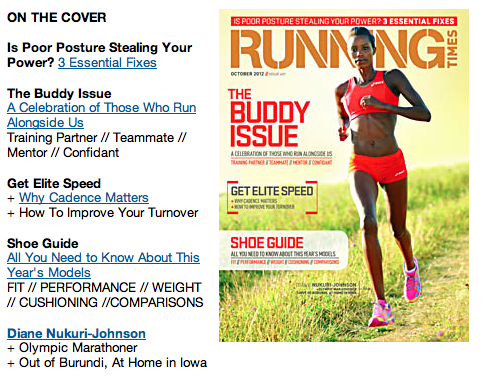
Is Poor Posture Stealing Your Power?

Are your shoulders slumped? Both Mom and your favorite drill sergeant don’t take kindly to poor posture. Outside of looks and respect, posture has a huge effect on your running form. If you ‘d like to know how it impacts you as a runner, and how you can fix it,  check out my article in this month’s October edition of Running Times – on news stands, or click here to view it now. Now stand up straight!

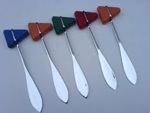
20121001-155217.jpgOK – you go to your doc or therapist. He/she gets a funny orange triangle thing (reflex hammer) and gently taps just below your knee. Instantly, you kick out your leg. You get a look of approval, and your doc moves onto to the next thing….. what just happened here? And what does this have to do with running surfaces I spoke of during my UROC video last week?

Your doc is testing your reflexes: an involuntary and nearly instantaneous movement in response to a stimulus. By nature, a reflex is not something you need to “think about” – it doesn’t require any processing in your brain. Basically, your body gets a signal (input), and it produces some type of response (output). So this very simple action of a tiny tap below your knee cap produces a contraction in your quad without your brain telling your quad to contract. Pretty useless right? Wrong.

Reflexes allow us to look at your neuromuscular system. The term “Neuromuscular system” is basically a fancy word to explain something very simple: muscles can’t do anything unless your nerves tell them to. Testing your reflexes let us see if the nerves are transmitting the right signals throughout your body. We know the INPUT is good because we both saw someone whack your knee. What we hope to see is the “right” amount of muscle contraction or OUTPUT. Poor output, such as too little contraction (called “low tone” or hypotonic) or too much contraction (hypertonic) is a sign that the neuromuscular system has a glitch. Little glitches means the system is unstable and produces less than optimal muscle contraction. The reasons for these glitches are a bit outside this blog post! Fortunately, most people will fall into the “normal range.” Performance in this “normal range” is a sign that the nerves do a good job of relaying information throughout your body, and that your muscles produce the “right” amount of contraction. These “smooth” reflexes mean your body has developed a very refined or organized way of moving when its given an input. OK – why are we wasting your time with this little lesson? Gait is pretty much a reflex.

Sure, you can make a conscious decision to walk or run backwards, or skip every third step if you want to. But for the most part, you don’t THINK about taking each and every step when walking and running. It happens sub-consciously at a fancy place in your nervous system called a “central pattern generator.” Over time you’ve learned to fine tune and coordinate this reflex. And spending time concentrating on your running form helps fine-tune this reflex pattern. Ever heard the term perfect practice makes perfect?

Interestingly, when we sprain ligaments, we tear nerves. I explain all this much more in my book, but the key aspect is: torn nerves = less input. Less INPUT = poor muscle control or OUTPUT. What do we do? In therapy we work to improve the INPUT to our body by doing lots of proprioception and balance training so we can get a better OUTPUT. You learn to refine your control, and develop alternate strategies to control your body. Do these gains translate over to running? Yes they do. You can improve your stability after an injury. But you know translates really well to running? Running….on different surfaces!

If you always give the exact same input, you’ll always get the exact same output. If you always run on a treadmill, at the exact same speed, and you never get tired, this strategy works pretty well. Except that isn’t the real world. Your body needs to know HOW to respond when you get a different INPUT. You run up hill, down hill, get tired, change your body weight from day to day, and encounter different surfaces. All these slight differences require slight changes in your technique.

Research shows similar trends for both walking and running gait. When things are always the same, you are more likely to get an injury. When things are out of control you are also more likely to get an injury. But people who have a range of comfortable walking and running patterns have multiple strategies to tap into.

So what’s the take home message here? If you give your body the same INPUT every time, you’ll always get the same response. If you expose your body to different surfaces, you learn to refine your reflexes to produce good quality muscle control on multiple surfaces, and improve control on your typical surface. The trail runners reading this already know, and can FEEL, these differences. However those of you who are stuck on the ribbon of asphault, its time to mix it up. Train on concrete. Train on asphault. And grass. And trail. And uphill. And if it feels weird, its sign that you need to do a bit more of it. Not all at once, maybe just a little bit in small doses. If you can’t take a 4 mile trail home, then maybe run the gravel alley. Jump onto the median and run in the grass for a bit. Exposure to varied surfaces can help you develop as a better runner.

Different input = smoother reflexes

Smoother reflexes = better muscle control

Better muscles control = better runners.


20121001-155822.jpg

Trail Running Tips and UROC

What’s different about trail running vs road running?

Is there anything you can do do better prepare your body for these differences?

Most all of the elite trail and ultra field is descending into the Blue Ridge Mountains this weekend for the Ultra Race of Champions. Should be one incredible race  – everything from smooth roads to the uber-technical flow of Torry Ridge will be laid out before them.

The team at UROC is trying to improve the visibility of Ultra-marathons, so they are going to broadcast content during the race on their site. Also they asked if I had any helpful tips or tricks for those who favor the rocky stuff and go longer than 26.2. If you’d like to know the answer to the above questions, check this video I made for Competitor and UROC. (you have to click on the link, not the picture) Enjoy!

Best of luck to all the racers!

Baby needs a new pair of shoes

It’s pretty tough for a lot of runners to make sense of all the changes in footwear these days. One key message is that shoes don’t run on their own. You are profoundly more important than the shoes on your feet. This being said, footwear construction can and does make a difference. And when we talk about kids shoes, it affects not only how they walk and run, but more importantly, how they develop.
Want to learn a bit more? Check out the “Shoes for Small Fry” article I wrote for Running Times. As a parent, we all try to give our kids an advantage. I’m well aware that there are a lot of things coming up in my kids life that I can’t control. But giving my kids the gift of strong feet is one I can control. Those little feet just might be passing you up on the race course sooner than you think!

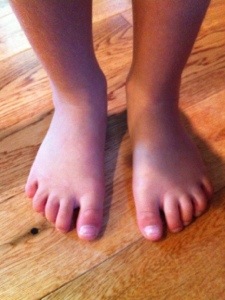
20120919-031622.jpg

My 4yr old’s feet: excellent alignment and strong for her scooter, soccer, and the playground. The right footwear will ensure they look this way as she ages through the big game of life.

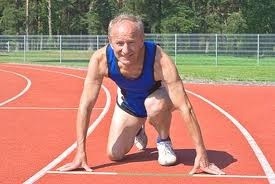
any pearls for the aging runner?

20120919-012247.jpg

Runner’s World asked for some key points to think about as we edge-up in years. It happens to all of us at some point right?

Check it out here

Disclaimer: the advice mentioned in this article is not meant to replace Botox

Anatomy for Runners – check out my book!

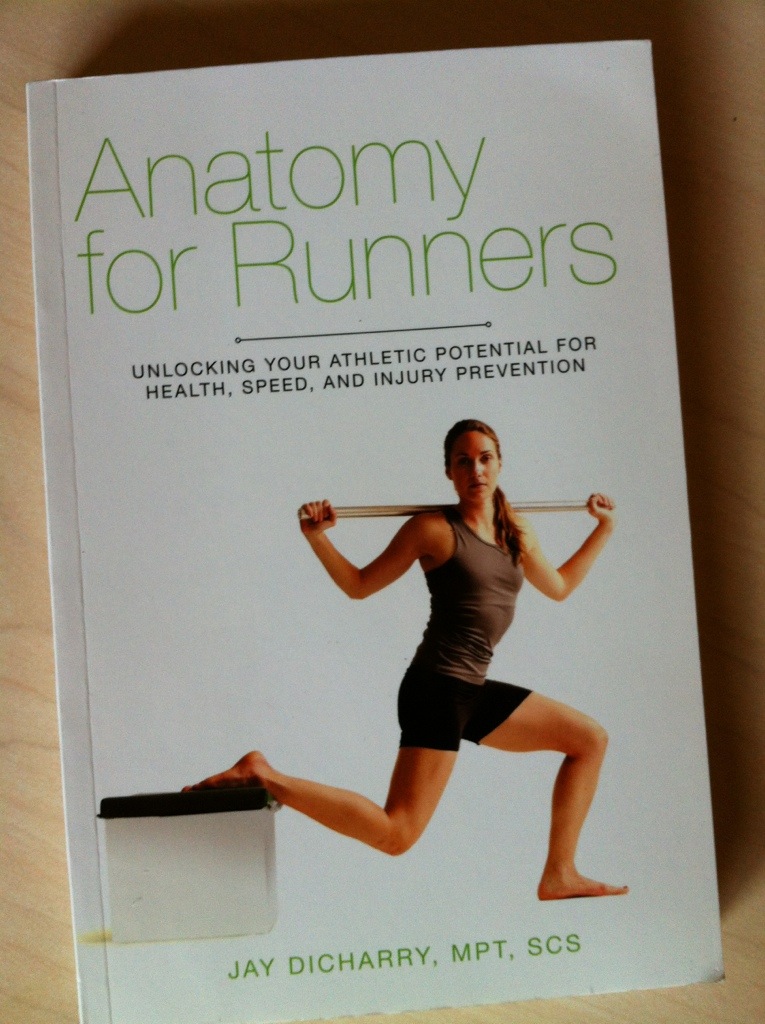
20120831-163101.jpg

Well, the formal announcement is finally here, gang. I’m proud to announce my book “Anatomy for Runners: unlocking your athletic potential for health, speed, and injury prevention” is out now!

After many months of late nights and weekends, its available at your neighborhood bookstore, amazon, and even in some of your favorite local running stores (ask your shop to carry it if they don’t).  I’ve gotten some great feedback from the press and on blog-o-sphere, but if you enjoy it, please do post a review on amazon as well.

This book is designed to help runners help themselves. It teaches you what running does to your body, and how to keep the chassis strong as the engine grows stronger. It’s the answer to the questions you always asked, and to those you’ll have in the future. Most of all, its a tool to help you succeed. Because, I’m happiest if I don’t have to see you for help –> I want you out there having fun!

Yes, the book in the photo looks like its been read, because it has. This is not a coffee table book folks. I hope you enjoy it, because it was written for you! Happy reading and even happier running!


Do runners with a ball “get it” more than runners?

The media at large has done a dis-service to you, the consumer. They love polarizing images. They love the battle between overly built-up clodd-hopper motion control shoes vs. naked feet. They try to instantly declare one “better” than the other. The reality is that the barefooot buzz has been incredible for ALL athletes. No matter which side of this polarizing topic you stand on, it has directed attention on form. And that’s one of the main things really.

Let’s clear out the sewer lines folks. Barefoot is very DIFFERENT from running in shoes. Sure a good number of folks switch their contact style from rearfoot to forefoot when going barefoot, but a lot DON’T. And while the media loves to harp on this one single factor, its like saying only one tree in the entire forrest is important. And that’s just not true.

Its not so much forefooot vs rearfoot here, its more about where the foot is in relation to the body that counts. Striding too far in front of the body results in bad things. Your feet were meant to be beneath you – not flying out in front. Imagine running over ice. Anyone feel safe over-striding on ice? Didn’t think so……But its not just “runners” who are beginning to take notice. Other “running athletes” are asking question too.

Recently, I had a conversation with basketball journalist Steve McPherson. He was asking me about the apparent rise of injuries in basketball, and wanted to know if anything from all this barefoot hoopla translates over to the hoop. Steve did an excellent job with this piece, “What can the NBA learn from barefoot running?” I recommend you take a look, whether you run with barefeet, wrapped feet, or a ball.

20120531-174049.jpg

Are you ready for minimal?

Looking to get into “less” shoe? Don’t understand why you need to make some changes in your body to help this process? Looking for some help moving towards something new? Check out this month’s issue of Running Times to check out an article I wrote with my colleague, Dr Mark Cucuzzella, on a smooth and successful transition to minimal running shoes.

And if you’d like to see the print word come to life, check out the video “are you ready for minimal” by yours truly on the www.runningtimes.com homepage. Also on their youtube channel here.