Tag Archives: technique

TONIGHT: Beyond Pink: Strong Women, Strong Athlete

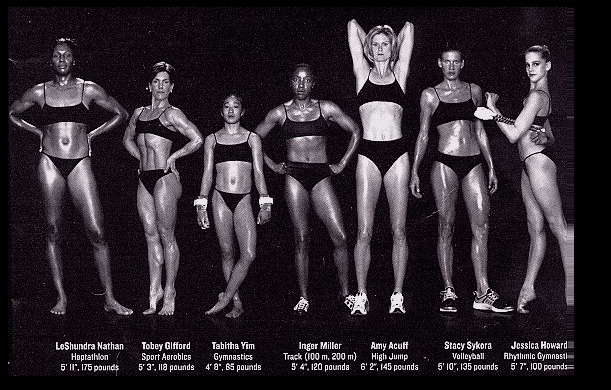
There's no "one look" for every woman, and no "one body" for every athlete

There’s no “one look” for every woman, and no “one body” for every athlete

Ladies – tonight its all about you!

Sports Illustrated ran a photo series years ago that is one of the most powerful collection athleticism.  Athletes come in all shapes and sizes, and one of them is YOUR size. And that’s the point of tonight’s talk. As the kick off to the REP Lecture series tonight in Bend, we are going to discuss “the unique needs of a woman.”

We’ll take a look beyond the marketing drivel and discuss what really is unique about your needs in pursuit of your goals. Come grab a seat and a beer, and find some tips that take you to the next level.  Hope to see you 7:00 tonight at Rebound Westside!

Elevator Up? The Mindset Behind a Champion

A few weeks ago, I got to present along side Dr. Joe Vigil at a USA Track and Field conference in LA. For those of you who have to ask “who is Joe Vigil?”…..this man is to coaches as Rolex is to watches: the best.

Dr Vigil always has the uncanny ability to break down complex tasks and ask you the “right” introspective questions to help you reach your next milestone. We don’t just train the body in isolation. We’ve always heard that the body can handle more than the mind wants to give. So with that, I’m going to leave you with the following picture. Is it time to take the elevator up the “achievement triangle?” – What’s holding you back from reaching your goals? Change all starts with the desire to change.

Slide1

In fact, lets move beyond kumbaya and start this process in motion right now. Turn the computer off. Get out a sheet of paper and make 3 columns. Write down your goals in column 1. Then write down the obstacles that stand in the way of each of your goals. Then make a 3rd column of exactly what you are going to do to beat each of those obstacles.  Stick it on your fridge and remember your passion. When one of those obstacles seems like its standing in your way, make your tiger face and beat it down. Mental Tough = Body Tough.

And if you need help with your plan, give me a ring – I’ll help you find your tiger face.

How a physical therapist and mega-technology can make you a better athlete

Got some amazing local press this week from The Source here in Bend. While I chose the use the sub-title as the heading for this post, the writer’s main title was pretty witty “Jay and his fancy treadmill”

Granted, I’ve been doing this stuff for quite a while, but I honestly think its pretty simple, and the “right” way to do things ,really.  In comes the writer. His body has some issues that need to be cleared up. Why? well, we’ve always heard “(running) form follows function.” Improve the function of your body so you can further improve – and maintain – your form. We identified things for him to work on and established a plan of attack. As I’ve said over and over again, there are things you can do outside of running that will improve your running.

Next we used some fancy tools and some custom software I developed to identify where things broke down in his gait style. Then we used the toys in the lab to give him some biofeedback to improve specific aspects of his running form while he’s actually running. We worked with this for a bit, and then captured more baseline data. End result, The writer improved his economy by 11% and decreased the stress to his body (called “loading rate”) by just over 33%. Running easier, with less stress to the body? I call that a win. Give the office a call if you are interested in seeing yourself improve as well.

From General to Specific: thinking through your yearly training plan

OK. Gut check time. a few weeks ago, I asked you to take a look at your past, and identify your performance limiters.  While both “Type A” and “Type B” training plans can be incredibly successful, even the most open minded Type B person takes a step back to look at their needs. After all, you’ll never reach your goal without a road map to guide you along the way.

To help you organize your road map, I’d like you to keep in mind a general plan: “from general to specific.” What does this mean? Well, if you are a cyclist, the best, most specific way to train leading up to your competition season is to pedal your bike…..often! But if you are 4 months out from your season, there are about a million other things you could be doing besides biking, that will still help you pedal well come competition season.

There’s no substitute for working hard, but there’s also no reason to work hard at the same thing. I know some of you say, “sure – I do this. I lift weights in the offseason.” Well, if you know anything about modern training theory, weights, plyometrics, and drills aren’t just for the off season (another topic for another time). When I say general, I’m not talking about all this kind of stuff. I’m talking about other kinds of stuff.

When you are 4 months out from race day, your body doesn’t really care if you did 2 hours on the trainer, or 2 hours XC skiing out in the woods. But your brain just might be a whole lot happier shushing though the snow covered trees instead of watching another 15 yr old Spinervals video. If you feel like going to a rock gym – go for it. The balance, coordination, and muscle stabilization you gain from rock climbing will improve areas of your body you never existed. And so what if you aren’t good at it? You aren’t a professional rock climber, its just something fun to do while you’ve got time, and all-cycling-all-the-time isn’t the sole focus of your day.

Me? I’m tackling my nemesis…..trying to ride my unicycle. Previously, its been successful at tacking me instead. But this is all supposed to be fun right? We do this stuff for a challenge. Repeat after me: “It’s January.” You know your friend who is putting in 20 hr training weeks right about now? He’s in for a massive blow-up come about June, and will be spending the peak of race season burt out and destroyed. So expand your skills and expand your mind. This winter, what are you doing to work on your “general?”

UVA Running Medicine 2013 – join us!

Calling all MD’s, PT’s, ATC’s – the premier Clinical Education event for Running-specific education is coming around again. Come celebrate our 10th year at the University of Virginia in Charlottesville, this March 8th and 9th.

Although we’ve had many coaches and guru’s attend this event in the past, the aim is to enrich the minds of the clinicians who will be guiding your care as a runner. Dr Robert Wilder, Eric Magrum, and myself have been hard at work over the past ten – yes 10 years! – to assemble the brightest and most relevant content to help you perform.

This year’s keynote presentation features Dr. Rodger Kram from UC-Boulder. Dr Kram’s research, presentation style, and findings have made him a true authority. It’s tough to find a journal article on running that doesn’t cite his work. After seeing him speak many years ago, I had a paradigm shift in the way I thought about running injury and performance. And we’ve got a host of other excellent presentations from leaders in the field. You’ll be in for an exceptional treat. Brochure link is below – Hope to see you there!

RunMed2013


Bodybuilding Looks at Running

So I got a call from Nick Collias, a writer for Bodybuilding.com a few weeks ago. He was reading Anatomy for Runners, and was impressed with the way that I stressed the importance of comprehensive athlete development. He asked a bunch of questions, and put together a very nice feature article called Strength Training for Runners, How to Do It Right that you can check out here.

Sure, some of the models in their stock photos can lift you and your entire running group while squatting, but don’t be put off. The insights of a group of folks who aren’t first foremost runners is pretty refreshing. I should note that some of the pics and videos in here aren’t mine, and a few are a bit different that the correct form…..I recommend referring to your copy of Anatomy for Runners for the correct form explanations and pics.

In addition to some very insightful Q & A from bodybuilding.com, I wrote a basic strength progression that I highly recommend checking out!

Merry Merry Everyone!

More free books on the east coast, from Two Rivers Treads

The good folks at Two Rivers Treads are stepping up to help you this holiday season, with a free copy of my book, Anatomy for Runners. So if you need a pair of shoes, why not help those who are making an effort to help you as well. Here’s their email below.

Community Runners,
My friend Jay Dicharry is considered by most in the running world to be THE guru on gait mechanics and running injuries. He spent the better part of 2 years writing a book “Anatomy for Runners”. Jay and I have collaborated on many projects and much of what I have discovered I have Jay to thank for.

So our gift to you is his book with any shoe purchase or 50 dollar gift certificate. This includes closeout or current models. This special extends while our book supply lasts….we have enough books to hopefully get us through the holidays.

Dr Mark Cucuzzella
Two Rivers Treads

Is Poor Posture Stealing Your Power?

Are your shoulders slumped? Both Mom and your favorite drill sergeant don’t take kindly to poor posture. Outside of looks and respect, posture has a huge effect on your running form. If you ‘d like to know how it impacts you as a runner, and how you can fix it,  check out my article in this month’s October edition of Running Times – on news stands, or click here to view it now. Now stand up straight!

What can you learn from a frustrated bird?

Here at UVA, I teach a course called Neuro-muscular Basis of Human Movement, and today we are speaking of all things running mechanics. One of my students made an analogy that actually tells us a lot about running. Well, the analogy doesn’t really tell us that much, but a host of really angry and pissed off birds will….. Yes–> those angry birds!

Angry Birds is a simple game ( if it’s so simple, why has our country’s gross national product dropped since its launch????) that forces us to abide by the laws physics. Your goal, of course, is to knock out those smirky smiling pigs at various locations. You learn very quickly that aiming too high blasts your bird up to the clouds, at the expense of sacrificing distance. Aiming too low also compromises distance. Aiming just right produces the greatest distance covered with a pull of the slingshot….. The fancy name for this would be the optimum trajectory

While you don’t have to land on a pig when running, you do try to cover a given amount of distance per stride. In fact, the definition of running economy would be to cover a given distance with as little energy as possible. Too much up and down motion while running wastes a lot of energy. Actually about 80% of the energy required to run comes from raising and lowering the body against gravity. So “aiming too high”- too much vertical rise an fall- is not a smart move.

A lot of people get this. The problem is that they take it to the opposite extreme. They tell us that we need to minimize the rise and fall of our body. Does this play out? Go play angry birds again, and aim your bird dead flat. Pull back all the way and watch your bird take flight….. It won’t go very far. Limiting the up and down motion of the body when running not only ensures you won’t go far with each stride, it also costs a lot of energy! Go for a run and try to keep your head as still as possible- you won’t be able to do this for long- its tough!

So what is best? If you try to get maximum distance per fire on angry birds, you’ll find that about 45 degrees gives you the greatest distance. So does this mean that you should aim for this when running? Well, not exactly. The body isn’t a bird, a cannon ball, or any other type of projectile. It’s an actively controlled spring that actually stores and releases elastic energy to help you move forward. Some amount of vertical rise and fall is actually beneficial to “load the slingshot” and store and release this elastic energy. Exactly how much depends on your body weight, your leg length, and your pace, and your contact time. A sort of nice number is around 4-6 cm of vertical rise and fall of the body typically produces optimal results. In labs like ours at UVA, we study this kind of stuff to tweak your economy.

The take home message is that some rise and fall is necessary, even advantageous, when running.* So when someone tells you that a runner is efficient because their head stays perfectly still when running, maybe you should hand them your smartphone and tell them to play a little game.

* note- excessive rise and fall of your phone, as in when you throw it against the wall after not beating a level for the 37th time, isn’t recommended.

20120405-104247.jpg

South by SouthWest Festival: When Biomechanics Attack

Check out the report WIRED magazine did of my talk with ESPN writer Henry Abbott at SXSW music festival. Likely the only time I’ll get to say I presented at the same conference as Al Gore, Bruce Springsteen, Seth MacFarlane, Jay-Z, and Jeffery Tambor (unfortunately not on the same stage at the same time!)

Nice summary, except they didn’t really get one critical point across. You CAN improve your hip flexibility and your hip strength!

Check out the WIRED article here and check out this link I did for Runner’s World a while ago on improving hip mobility