
I was at a conference recently where someone asked me – “With all the fancy equipment and data you’ve got access to, what it the biggest thing you’ve noticed and how has it made you change your personal running style?”
Easy! I’ve learned through the years, that it’s critical to minimize loading rate. Loading rate is the speed at which you apply forces to the body. While running, you aren’t going to change your body mass during a run (OK –I know you do slightly due to hydration issues, by let’s ignore this for a moment). Your total mass stays relatively the same. However, how you move your body’s mass forward when running does play a major role in the way your body is affected by the forces we see in running.
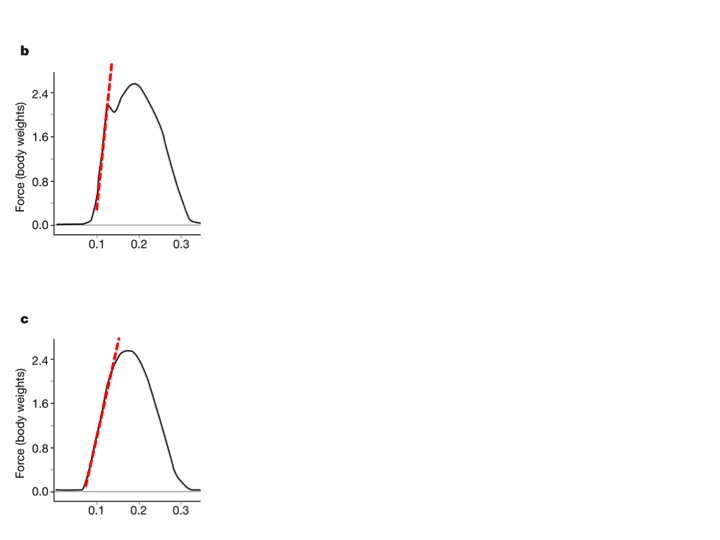 In the lab, loading rate can be objectively measured. Some labs use accelerometers to determine peak values and rates, some use the slope of the ground reaction force. Both have been investigated as viable ways to assess loading rate. We’ll use slope of the ground reaction force (GRF) since it’s a bit more visual to help get the concept across. If you look at the graphs, you’ll see that the one graph has a steeper slope to it than the other. The steeper slope (top graph) means that the forces applied to the runner occur quicker than that of the forces applied to the less steep slope (bottom). Why does this matter?
Imagine running 50 miles a week. Think of the amount of wear and tear that occurs on the body. Now imagine running 50 miles a week with a gait pattern that causes the mechanical loading of the body to occur less quickly. Decreasing the loading rate applied to tissues will minimize tissue stress to the runner, minimizing the effects of the micro-trauma of endurance training. The rate at which structures are loaded has been implicated in both stress fractures and soft tissue dysfunction (1, 2)
Now – full disclaimer here, there is some discrepancy in the literature on whether or not the “impact peak” actually causes injury. This post is not going to debate the presence of the impact peak itself, only the difference between running with a high loading rate (not good) or a lower loading rate (better). Should everyone go lower and lower? There is a point at which the metabolic cost of lowering the rate of loading to the tissues is more expensive from a metabolic standpoint. Further, there is likely a lower limit to what one’s loading rate can be. These are questions that need to be answered individually with a lab analysis, as it is speed and mass dependent and not one-size-fits-all.
There are 3 primary ways you can affect the rate at which you load the body:
1.Contact pattern
2.Postural alignment
3. Limb stiffness
Tomorrow we’ll discuss how these 3 factors impact the loading rate of a runner….including directly addressing a lot of the hype around fore/mid/rear foot contact styles – Stay tuned!
References:
1. Milner, C.E., R. Ferber, C.D. Pollard, J. Hamill, and I.S. Davis. February 2006. Biomechanical factors associated with tibial stress fracture in female runners. Med Sci Sports Exerc. 38(2):323-8.
2. Milner, C.E., J. Hamil, and I. Davis. July 2007. Are knee mechanics during early stance related to tibial stress fracture in runners? Clin Biomech. 22(6):697-703.



 Jay Dicharry's Website, An Athlete's Body