Tag Archives: running form

Loading Rate: Part 1: What does it mean for you?

I was at a conference recently where someone asked me –  “With all the fancy equipment and data you’ve got access to, what it the biggest thing you’ve noticed and how has it made you change your personal running style?”

Easy! I’ve learned through the years, that it’s critical to minimize loading rate. Loading rate is the speed at which you apply forces to the body. While running, you aren’t going to change your body mass during a run  (OK –I know you do slightly due to hydration issues, by let’s ignore this for a moment). Your total mass stays relatively the same. However, how you move your body’s mass forward when running does play a major role in the way your body is affected by the forces we see in running.
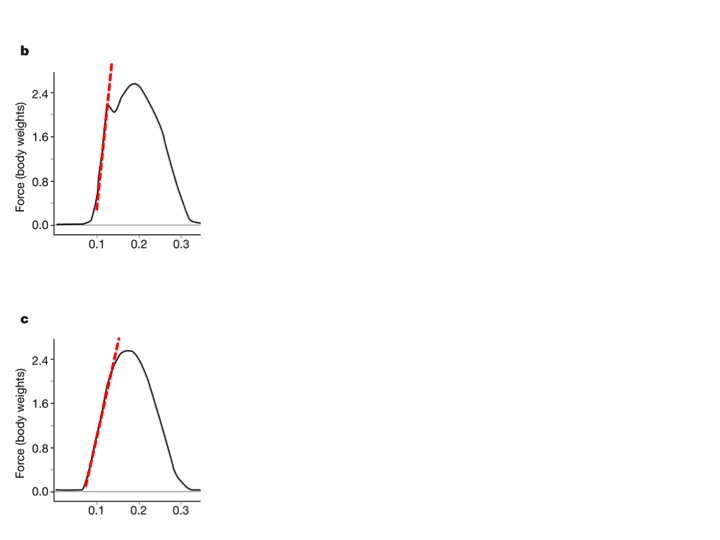
In the lab, loading rate can be objectively measured. Some labs use accelerometers to determine peak values and rates, some use the slope of the ground reaction force. Both have been investigated as viable ways to assess loading rate. We’ll use slope of the ground reaction force (GRF) since it’s a bit more visual to help get the concept across. If you look at the graphs, you’ll see that the one graph has a steeper slope to it than the other. The steeper slope (top graph) means that the forces applied to the runner occur quicker than that of the forces applied to the less steep slope (bottom). Why does this matter?

Imagine running 50 miles a week. Think of the amount of wear and tear that occurs on the body. Now imagine running 50 miles a week with a gait pattern that causes the mechanical loading of the body to occur less quickly. Decreasing the loading rate applied to tissues will minimize tissue stress to the runner, minimizing the effects of the micro-trauma of endurance training. The rate at which structures are loaded has been implicated in both stress fractures and soft tissue dysfunction (1, 2)

Now  – full disclaimer here, there is some discrepancy in the literature on whether or not the “impact peak” actually causes injury. This post is not going to debate the presence of the impact peak itself, only the difference between running with a high loading rate (not good) or a lower loading rate (better). Should everyone go lower and lower? There is a point at which the metabolic cost of lowering the rate of loading to the tissues is more expensive from a metabolic standpoint. Further, there is likely a lower limit to what one’s loading rate can be. These are questions that need to be answered individually with a lab analysis, as it is speed and mass dependent and not one-size-fits-all.

There are 3 primary ways you can affect the rate at which you load the body:

1.Contact pattern
2.Postural alignment
3. Limb stiffness

Tomorrow we’ll discuss how these 3 factors impact the loading rate of a runner….including directly addressing a lot of the hype around fore/mid/rear foot contact styles – Stay tuned!

References:

1. Milner, C.E., R. Ferber, C.D. Pollard, J. Hamill, and I.S. Davis.  February 2006.  Biomechanical factors associated with tibial stress fracture in female runners. Med Sci Sports Exerc.  38(2):323-8.

2. Milner, C.E., J. Hamil, and I. Davis.  July 2007.  Are knee mechanics during early stance related to tibial stress fracture in runners? Clin Biomech.  22(6):697-703.
Shoe Study – Free shoes!

Hey Runners –

We are currently looks for 10 runners to volunteer for a study. The study will look at the effects of longer distance runs. If you are chosen, you’ll need to come into the lab to run 3 times. Basically, you’ll do a long training run at your typical training pace indoors on our treadmill. You are welcome to watch a movie while you run to keep your attention! As you run, we’ll be collecting data on your gait to see how things change during a long run.

Each run will be for 1.5 hours. On the first run, you’ll be given a pair of shoes in your size to run in. You’ll take them home to put 400 miles on them. After you’ve hit 400 miles, you’ll come back in and run again. Somewhere in between the first and second run, you’ll come into the lab and run in second pair of shoes. The runs will be spaced several weeks apart, depending on how long it takes you to hit 400 miles on the shoes. You’ll get to keep a pair of shoes for participating in this study.

Here are the criteria.

  • currently training for a ½ or full marathon
  • having already completed a ½ or full marathon within the past year
  • max weekly run volume of 50 miles a week
  • someone who typically runs in a “cushioned” or “neutral” type running shoe (you were likely told you have a “higher” arch)

If you meet all of the above criteria and are local in Charlottesville (or close enough that you could easily get here for the 3 running sessions) please give us a call at 434-982-1422.

Thanks!

They said I’ve got pronation….How long do I have doc?

So you went to the “insert giant athletic store here”, and the 16 yr old kid who works part time for the summer, who is the “expert” on running watches you for about 30 seconds, and decides to tell you that you in fact, pronate. Or worse…..maybe you even over-pronate. Never fear though, they say! They’ll just go in the back and grab some of those big mutha shoes to totally stop you from pronating and be your personal savior.

Before you plunk down your hard earned cash, we should probably come to terms with a few things.

  1. What is pronation?
  2. When does it occur?
  3. Can you stop it, or should you stop it?

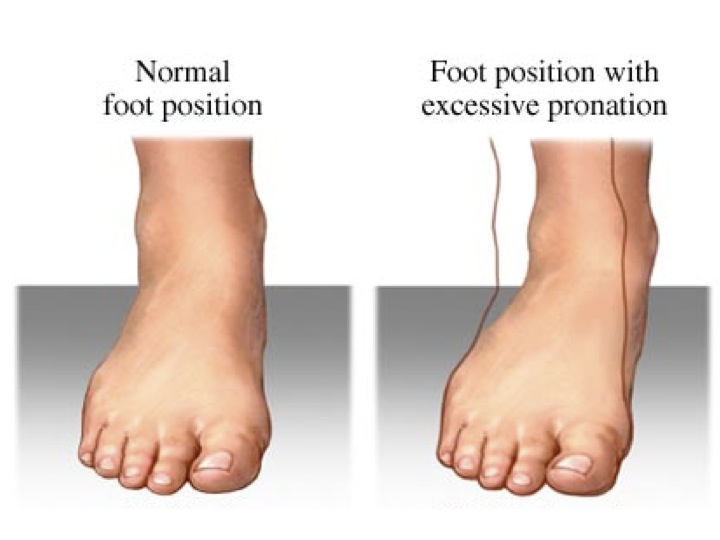
1 – First, let’s re-cap what this pronation stuff is all about. Pronation is not bad; in fact, it’s the body’s natural shock absorption mechanism. When the foot moves into pronation, it becomes like a loose bag of bones. Everyone pronates to some extent. Some more than others.  If you didn’t pronate, you’d have problems with- you guessed it- shock absorption. The opposite of pronation is supination. In supination the bones of the foot become more congruent (increased contact between the surfaces of the joints). This increased contact produces a rigid lever for push off in gait. So we should land in a supinated position, and move to a more pronated position during stance to decrease shock, and then move to a supinated position to achieve a rigid lever for push off.

Let’s re-cap this again using America’s favorite national pastime, Tetris. When the pieces fall from the top of the screen, we can move them about and rotate them freely. They can move. This is how the 26 bones in your foot function in the shock absorption or pronation phase. They should move about to dissipate force. Now imagine those same Tetris pieces once you’ve placed them in the stack. They can’t move right? They become congruent and are locked in place. This is similar to the foot when you are in supination.

2- Now that we understand pronation as something that is not really bad; let’s talk about when it occurs. As evidenced in a study carried out in our lab and published in the Journal of Orthopedic and Sports Physical Therapy, maximum pronation of the foot occurs after the heel has left the ground. Why does this matter?  Remember that 16 yr old kid? He’s going to grab a shoe off the rack that is a motion control shoe –designed or should I say marketed, to stop pronation.  A shoe like this features a higher density material on the inside of the shoe. The claim is that this different density material acts to stop the pronation from taking place, thus fixing your issues. If you’d like to see if your shoe has this, just look at the inner side of the midsole (marsh mellow stuff between the fabric upper and tread). If some of the inside of the shoe is a darker color than the rest, it’s likely a “dual density midsole design”.

OK – so let’s get back to timing of pronation. Shoe companies put this increased density material to “stop the foot from pronating”. Well, we found out that maximum pronation occurs after the heel is off of the ground. So guess what? – All that higher density material in the shoe isn’t even touching the ground to try and stop the foot from moving at the time when the foot is moving the most! Hmmmmm……makes you think doesn’t it?

3- We know what pronation is, and when it occurs, and now we should address the question of stopping pronation. Pronation is necessary. I’ll even say in the right amounts and at the right time, its good. I’ve seen PLENTY of runners who have problems because they don’t pronate enough. However, stopping pronation isn’t really in our best interests. It’s better to learn to stabilize the amount of pronation. The thing is that no shoe can do this- you need to learn to use the muscles in the foot and the muscles in the hip to stabilize the rotational motion that naturally occurs in your legs. Can you do this? How good are you at stabilizing your pronation? A visit to the SPEED Clinic can help you pin point your issues and fix them for good.

Parting thought –please don’t read this and think that we are saying that shoes don’t make a difference. They do. The objective research we do combined with our clinical experience has proven to us that they make a huge difference. We view footwear as part of an intervention to help you perform at your best. Shoes are very different. How much of a shoe you need, or weather you even need a shoe at all (barefoot running anyone?) are all part of a comprehensive assessment here at the University of Virginia.

Deep Thoughts: Do your muscles really have a memory?

You can run quarters on the track in 80 seconds. Maybe you can even do them in 60 seconds. Maybe you hit a PR for sustained power on the bike. You can drive your golf ball 250 yards down the fairway. Does this mean you are really performing at your potential?

Every time we practice a movement, we are reinforcing a particular movement in our brain. This is commonly referred to as “muscle memory”. Training technique is an often overlooked aspect in endurance world. Each joint in your body has an axis around which it moves, with muscles controlling the movement. These tissues are engineered to move a specific way. If we learn good muscle memory, we continually re-enforce good habits – and come competition day – we perform at our potential.

Competition to you might be a round of golf with friends on Sunday or qualifying for the 10,000 meter at the Olympics. At every level, focusing on your form can improve your performance.  Our body and mind strive to get the job done – at all costs. Often, this can mean we learn an incorrect strategy to get the job done. And even if your form is better than most, we all suffer form alterations when we fatigue. When these form changes occur, we have a decrease in efficiency. Since we are performing “different” than we normally do, we put more strain through our body’s tissues and are more likely to become injured. Understanding the stages of motor learning will shed some light on why we need to work on our form in the first place:

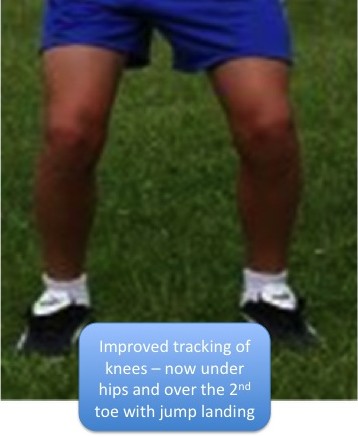
  1. Unconscious Incompetence – this means we have no idea that we are doing something with incorrect form. Most of us fall in this category. Look at the picture of the woman landing from a jump. The joints of the lower body are designed so that the knee tracks over the second toe when we land from a jump. The goal is to preserve proper alignment when we move. This athlete has no idea that her knees crashing to the inside are a problem. She doesn’t know that it significantly increases her risk for an ACL tear, patellofemoral syndrome, hip impingement, or a host of other issues. She doesn’t know that this landing technique will hurt her running, jumping, and cutting performance.
  2. Conscious Incompetence – We reviewed this athlete’s form issues with her. We showed her that the jump landing technique she uses can lead to injury and compromises her performance. She is now aware of it and understands the issue. This is the point where specific corrective exercises, cues, and drills are prescribed to her to correct this muscle memory. The more she practices these correctly, the more she re-enforces correct motion – however this stage requires a lot of conscious thought to perform the movement correctly . Because of the increased cognition or thought that this stage requires, the athlete may in fact be less efficient at their particular sport because they are “thinking” so much about the way in which they move. This is why drills often seem challenging.
  3. Conscious Competence – The athlete understands that there was an issue, knows correct technique, and now is able to perform correctly without thinking about it. She has removed the stresses from a flawed technique, and can perform correctly in sports-specific drills and in competition. The is the stage we want to be at! Think about some of the best performances you’ve ever done. What were you thinking about? Most successful athletes can’t even remember what they were focusing on. They were in “the zone” and just let their bodies perform using the skills they learned through a lot of practice.

In our quest to improve, we often focus on adding intensity or training volume thinking it to be the magic fix to take us to the next level. We’ve often heard the phrase “train smarter, not harder.” Adding time and focus to alter your technique pays off in spades. So let’s expand that saying to “move smarter, not harder”. The focus of the biomechanical analysis done in the SPEED Clinic @ the UVA Center for Endurance Sport is identify your unique compensations and make those muscles smarter!