Tag Archives: Dicharry

Running Injury Management on Therapedia

Fresh off teaching this past weekend at University of Michigan – a great group of folks joind together for a course called “Putting the Athlete Back in Triathlete: a clinician’s role in care of the endurance athlete.” …….and more content to come.

I’ve been invited to be a part of Therapedia’s webcast series, and its airing Thursday this week. And yes, it will be available to view after the course as well. Check out this link for what looks to be an interesting discussion!

Link

Coffee Talk: TrailRunner Nation Podcast

The guys at Trail Runner Nation podcast gave me a call, and asked a few questions. If you’d like to hear some inside scoop on what you can do to keep healthy and happy on the way to your next PR, grab some of your favorite brew, and tune in here.

We’ll debunk some myths, babble about footwear, talk about why we don’t treat injuries by treating symptoms, and discuss some cutting-edge approaches on strength training for endurance athletes. Its a long hour of conversation, but all this talk is aimed at ways to help make running fun. Because that why we do this stuff. And more fun is, well,  just more fun.

Do you treat triathletes? Join me @ U of Michigan

Multisport athletes have a lot of challenges in their training,  but the training demands of 3 sports seem to creep up on all of us. Athletes spend so much time trying to fit in their volume that the body often gets ignored.

Well, this all ends now. Join me at the University of Michigan April 20-21st where we discuss “Putting the Athlete in Triathlete: a clinician’s role in endurance sports.” During this 13 hrs course, we’ll lay the ground work and discuss how endurance training impacts the tissues of the body, and then move on to detailed descriptions of the mechanics of each sport. You’ll learn how to correlate your musculoskeletal evaluation of the body with a runner’s swim, bike, and running performance. We’ll discuss why swimmers aren’t your typical overhead athletes, you’ll learn how to do bike fits (how to fit the bike to the rider, and more importantly how to fit the rider to the bike) with hands on practice, learn how to identify common gait patterns and cue them out of problems that overload the body, and understand the role of complimentary training and strengthening. At the end of the weekend, you’ll understand how to help your athletes make training easier on their body, and improve their efficiency.

for registration information, click here, and for a hourly breakdown of the course, click here. See you there!

Running Footwear: A critical look at what we know about footwear and how to select the best fit for your athlete

The media likes to spin things to make headlines. I’m not too big on spinning, I’d rather just help educate. If you’d like to clear the air and see what we know, what we don’t know, and what’s been spun, you can check out this webinar I’m doing for USA Track and Field next week on Mar 26th. Coaches will get CEU’s from their couch.

The make of running shoes have historically gone from one side (thin and flexible) to the other (stiff and bulky) and are now moving toward the middle of the road. Which is best? And how do you match running shoes to an individual runner? In this webinar presentation, Jay Dicharry will comb through relevant research and clinical experience to help you approach your running retailer with the knowledge of selecting the right tool for the job. Learn how to ensure that you are running in your shoes rather than your shoes running you! By the end of this webinar you’ll be able to understand:

  •                 the evolution of footwear
  •                 how footwear has been classically prescribed
  •                 proof that this fit model is ineffective
  •                 how shoes impact your running form
  •                 how barefoot running impacts your form
  •                 how shoe wear impacts your form
  •                 how to select shoes for you
  •                 what minimal shoes are, and if you are ready to make the transition

Why does your achilles hurt, and how to fix it

I was contacted by Jason Fitzgerald at StrengthRunning.com to help clear up a lot of the mystery behind achilles issues. Even though this injury can be a major complicator for your training, the mechanics of it are actually quite simple.  If you’d like to check it out, check out this link.

Elevator Up? The Mindset Behind a Champion

A few weeks ago, I got to present along side Dr. Joe Vigil at a USA Track and Field conference in LA. For those of you who have to ask “who is Joe Vigil?”…..this man is to coaches as Rolex is to watches: the best.

Dr Vigil always has the uncanny ability to break down complex tasks and ask you the “right” introspective questions to help you reach your next milestone. We don’t just train the body in isolation. We’ve always heard that the body can handle more than the mind wants to give. So with that, I’m going to leave you with the following picture. Is it time to take the elevator up the “achievement triangle?” – What’s holding you back from reaching your goals? Change all starts with the desire to change.

Slide1

In fact, lets move beyond kumbaya and start this process in motion right now. Turn the computer off. Get out a sheet of paper and make 3 columns. Write down your goals in column 1. Then write down the obstacles that stand in the way of each of your goals. Then make a 3rd column of exactly what you are going to do to beat each of those obstacles.  Stick it on your fridge and remember your passion. When one of those obstacles seems like its standing in your way, make your tiger face and beat it down. Mental Tough = Body Tough.

And if you need help with your plan, give me a ring – I’ll help you find your tiger face.

UVA Running Medicine 2013: a recap

What happens when you get 220+ clinicians in the room and talk about running? It was a beautiful day. About 55 degrees and sunny. The remnants of the 10+ in snowstorm on the ground helped dampen the air and made the sun feel even stronger. It’s a beautiful day for a run….but instead,about 220 clinicians sat inside, on their glutes, so they can learn to help you use your glutes better.

The 10th anniversary of the longest running, running specific medical conference produced a host of content to help “us” help “you.” Do you ever wonder why running is as challenging as it is? How your running would change if you had no gravity to fight, arms to swing, or perhaps even legs to stand on? Dr Rodger Kram led us in 2 enlightening presentations on the energetics of gait. Talks like this completely shift how you think about running.

Dr. Eric Carson reviewed the current and future trends on cartilage repair. Take home: right now, cutting edge surgeons are able to offer some pretty incredible proceedures, and they’ll be even more magic to come in the future.

Brian Hoke, PT helped us think critically through our video gait analysis. Anyone can watch a video in slow motion, but learning what to look for is critical.

Your’s truly helped clinicians through their musculoskeletal exams as they relate to a runner’s needs. No one can tlak about “correct running form” unless you understand that each runner is an individual with unique needs and attributes. If you understand how a person’s body wants to work, you can understand how to help that person run. For those of you who read the screen’s in Anatomy for Runners, that 8-point exam just got a whole lot more thorough: 32-points to be exact.

Dr Sibohn Stattua reviewed the literature on the female athlete triad. Turns out that there is more to it than just low energy intake, menstrual irregularity, and poor bone remodeling…..the triad is turning into a square? That’s right, there is a 4th “leg” to the triad, and this one might be even more severe of a long term complication from this complex disorder.

Eric Magrum, PT discussed the current research on the #1 injury affecting runners: anterior knee pain. He told us why runners with chronic pain in the knee try to avoid their pain. The problem is that the compensations we adopt to avoid pain in the knee are just as much of a problem as the original cause itself.

Kyle Kiesel, PhD, PT helped us through an eval process to identify core imbalances that affect far more than just the core.

And finally, Dr Bob Wilder guided us through the process of guiding you back to your running in explaining the best return to run programs after an injury.
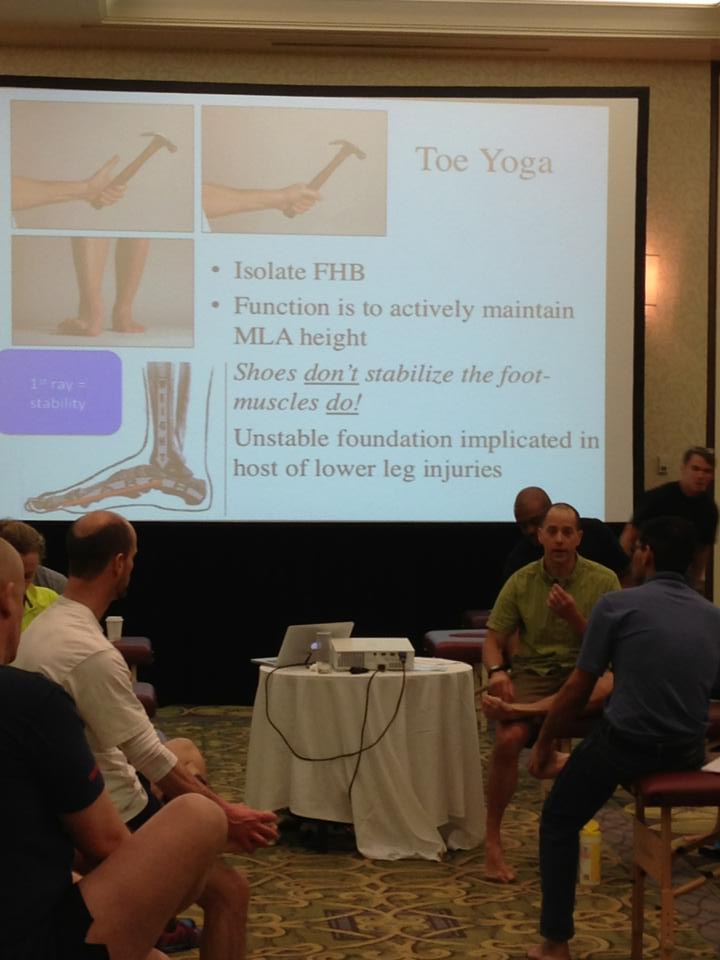
Clinicans getting to know their feet: a scene from our lab session

Clinicans getting to know their feet: a scene from our lab session

And that doesn’t even mention the incredible lab session on Saturday by Brian Hoke, Kyle Kiesel, Dr Mark Cuccuzzella, myself, and the amazing cookies that I ate at the afternoon break. Egos were dropped at the door, and we all got down to the same level to help runners do what they love: run.

As always, the conference returns next year……

Podcast with Jay Dicharry: A discussion with Healthynomics

I did an audio podcast with Mark Kennedy of Healthnomics.com yesterday. Check out the link, and you’ll get to hear some great discussion on runners as athletes, running form, and footwear. You can even listen to it while you run!

Reminder: webinar on running form, mobility, and strength -Feb 26th!

Hey gang – Just got back from speaking at a great USATF Level 3 conference in Costa Mesa, CA, this weekend. I’ll have some highlights to post from that event later on. But for today, I  wanted to send out a reminder about the USA Triathlon webinar I’ll be conducting tomorrow, Tuesday Feb 26th.

If you’d like to register, please see this link. And yes, we’ll have some Q and A time.

Hope to see you on the web!