Category Archives: running

Less From Your Shoes, More From Your Feet

There has been a lot of interest lately in the transition to minimal footwear. Am I going to get hurt? How long does this transition take? Is this really better for me? Will my old shoes take it personally? Last year at this time, there were 6 minimal shoes on the market. This year there are 64. It’s a hot market, and folks are taking notice. While shoes are nice to talk about, let’s not forget that it’s the runner in the shoe that plays an active role in this equation. Shoes don’t run by themselves!

The recent article by Giuliani et. al. has raised some concerns.2 They highlight 2 cases of stress fractures in 2 different runners who transition to minimal footwear. The switch to minimal footwear can be dramatic. You get more “feel” since the squishy midsole is reduced or gone. You get a lower differential from your rear foot to your forefoot. These 2 factors change a) the position of the foot (Heel isn’t higher than the forefoot in full contact) and, b) the demand of the runner to stabilize the foot inside the shoe. In short, with less “stuff” in between you and the ground, you need your body to do a bit more, and get accommodate to a bit more as well.

Ever hear about the experiment with pre-K kids with the cookies? They put a kid in a room with cookie on the table and tell him/her that they can eat the cookie and they’ll get one cookie. BUT, if they don’t eat the cookie, they’ll get 2 cookies later (yea!). The tester walks out of the room and the kids go into panic mode when sitting in front of this stellar, delicious cookie. Most eat the single cookie for instant gratification.  They fail to see the merits of waiting patiently for a better result.

What in the world do cookies have to do with running shoes? A lot. The switch to minimal footwear can pay off in the long run, but you need ensure you’ve got what it takes for a successful transition. Obviously any time you make a change to your body, there is an adaptation period that needs to occur.  A lot of “experts” say that it will take 6 months to a year to fully transition to a minimal shoe. I’d like to think that this is overly cautious, and like to discuss why using the anatomy. We’ve found great success using the following 3 criteria for runners looking to run with “less”.

1. Mobility: Traditional running shoes have about a 10-13mm drop from the heel to the forefoot. This creates a “rocker” effect in the shoe. Take a look at a shoe from the side and you’ll see that the curve from the ball of the foot to the tip of the toe rises up. Since your foot is flat, you need to ensure that you have enough mobility (called dorsiflexion) of the big toe to allow the foot to roll over. Additionally, since the heel is higher in a traditional running shoe (think a small high heel) the heel chords are used to operating in a shortened position. You need to ensure that you’ve got the mobility needed to allow the heel chords to operate form their slightly lengthened position. So what to you test?

    • Ankle mobility (heel chords) – you need to be able to dorsiflex (cock the foot up towards the shin) about 25 degrees. Lack of mobility here means you’ll need to stretch the calf and Achilles.
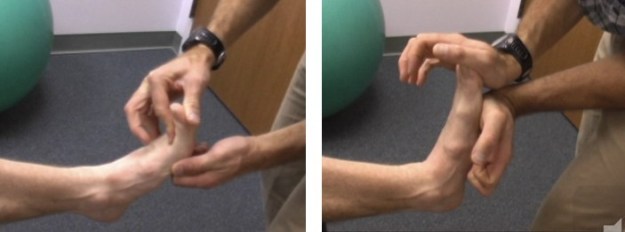
    • Plantar facsia mobility – with the ankle in about 5 degrees of dorsiflexion, you need to have 30 degrees of dorsiflexion at the big toe. If you don’t have this, you can’t roll over the toes, and will be forced to spin off of the forefoot.
2. Single-leg Standing Balance: normal balance has been identified as standing on single leg for 30 seconds
with a still upper body and full foot contact. Since the midstance phase of running is essentially a single leg squat, it is essential that the runner is able to maintain the foot in contact. A triangle between the inside ball of the foot (1st MTP), end of the big toe (distal phalanx of the 1st ray), and outside ball of the foot (5th MTP) should be seen. When in single leg stance, the muscles in the foot need to be “pro-active” not “re-active”. If you are wobbling your foot back and forth when standing on one foot, you’ve got some room to improve your “proprioception” – or sense of where and what you’re your foot is doing during contact. The most successful way to improve single leg balance is to perform it frequently (15-20 times a day) for small doses (30 seconds each).

3. Ability to isolate the Flexor Hallucis Brevis: a key factor that distinguishes humans from primates is our medial longitudinal arch. This arch is actively stabilized by the flexor hallicus brevius (FHB). While standing, try to drive the big toe (1st MTP) into the ground (plantar flexion) while slightly elevating (dorsiflexing) the lesser toes. Make sure not to roll the ankle in or out. This test enables screening of muscles inside the foot that stabilize the arch. The FHB can be easily distinguished from the longus (FHL), as the FHL crosses another joint in your big toe (1st IP joint), resulting in your big toe curling. Spend some time getting to know your foot. Aim to drive the big toe down while lifting the little toes (without curling the big toe!), and lift the big toe up while driving the little toes down. It’s the best way to work on coordination of muscles that actively stabilize the foot in stance. It’s your foot – control it! If you can do this, it’s a sign that you can keep the rear foot stable on the forefoot when the body sees the greatest amount of pronation (which is just slightly after midstance and AFTER the heel is off of the ground by the way.)1 Midstance is when forces are highest throughout the body- about 2.5x’s your body weight. You need the internal strength to be able to respond to these forces to keep things in alignment.

When your foot “works” it can actively stabilize the transfer of forces through the foot. If you don’t pass these 3 tests, no worry  -get to work on improving your limitations. Pay a visit to your local PT if you need help with specific exercises and stretches to improve.  If you lack mobility, research shows it takes 10-12 weeks to gain significant improvements. So stretching for 2 weeks likely won’t be enough for most folks. Improving tissue length can take some time. If your limitations are in the balance aspect, you’ll be amazed how quickly this improves if you simply practice practice practice. Typically, about 2 weeks yields a significant improvement. Finally, strength gains take about 6-8 weeks to achieve. So if you really have trouble isolating your foot muscles, this could take a bit to get them stronger – but you can always improve the strength of your muscles!  Passing these 3 tests doesn’t mean that you should go run a marathon in your new minimal shoes on day 1, but we’ve seen that folks who master these have little to no problem making the transition. I’ll note here that these tests are not new in my mind. I’d like all runners  – even those who run in traditional shoes – to pass these tests. Its that when the “stuff” under your foot is less, these traits are that much more important.

So invest some time to improve your foot – Because it’s always better to have 2 cookies instead of one!  Shoes make a difference, but it’s the runner in the shoe that you’ve got control over.

References:

Dicharry, JM., Franz, JR., Della Croce, U., Wilder, RP., O’Riley, P., Kerrigan, DC. Differences in Static and Dynamic Measures in Evaluation of Talonavicular Mobility in Gait. J Orthop Sport Phys Ther 2009;39(8):628-634

Giuliani J, Masini B, Alitz C, Owens BD. Barefoot-simulating Footwear Associated With Metatarsal Stress Injury in 2 Runners. Orthopedics. 2011 Jul 7;34(7)

Do shoes have feelings ?

Let’s say you are out for a night on the town. Your significant other turns to you and says how do you like my outfit? Unless you answer this question perfectly (still not sure how to answer this even after many years of marriage!) you may notice that your significant other withdraws for a while to cool off. Could be a few minutes, could be for the night, but this time away allows things to mellow and return to a state of bliss yet again. What does this have to do with shoes?

It’s common practice for a lot of runners to have multiple pairs of shoes at one time. This though process behind this has been that running in a shoe breaks down the cushioning properties of the shoe, and it takes time for it to rebound before your next run.

Well, Let’s look at some objective information on this subject. This is not going to turn into a discussion of minimal shoes vs. traditional construction. We are simply going to look at what happens to the properties of the midsole itself. The midsole is the squishy part of the shoe that lies between your foot and the tread. Its commonly made of a chemical compound called ethyl-vinyl acetate (EVA). Shoe manufacturers manipulate properties of the midsole to get their shoe to perform a certain way. Obviously a minimal shoe has less of this midsole material in it then a traditionally constructed shoe, but they both have some type of cushioning material between the foot and the shoe tread.

As you run, you are applying mechanical forces to the shoe itself. These forces physically break down the midsole. In fact, lets look at this at the microscopic level. The following picture is from a study (1) that looked at the state of the midsole at various points in the shoe’s lifespan. In fig A, you are looking at an electron micrograph cross section of a brand new shoe. It’s easy to see the outline of the well defined air pockets in the midsole. This intact formation allows the midsole to perform as it was designed. Fig B shows a cross section of the midsole after 500 kilometers (310 mi). This type of magnification allows you to see that the edges of the former well defined air pockets are now frayed and weakened. Finally, Fig C shows the midsole after 750 Kilometers (466 mi). It is now possible to see that the majority of the air pores are frayed, and in fact some of them have actually deformed enough to create holes. Thus, the structural properties of this midsole material are now very different from what they originally were when new. While your body can repair tissues that have been affected from mechanical stresses in running, your shoes cannot. Resting your shoes by the front door between runs won’t reverse these changes.

While it’s probably a good thing to be nice to your shoes (running in wet environments with no chance to dry out may accelerate breakdown of the midsole), they don’t have feelings. You can pound on them day in and day out  – even 2 runs in the same day. The breakdown of the material in your shoe is cumulative. So what happens to our gait as shoes breakdown?

A 2009 article (2) revealed that running in worn shoes caused the runner to increase their stance time (time spent on the leg) and alter their lower leg range of motion in order to keep forces on the body somewhat constant. What does this mean? As your shoes break down, the body will slightly alter its gait style adapt to the gradual changes that occur in the shoe itself.  When do these gait alterations reach critical mass (causing injury if you don’t buy new shoes)? Shoe breakdown is variable depending on the runner’s mass, running surfaces, and gait style. I know runners who note that they become injured if they put more than 250 miles on their shoes, and I know runners that put well over 1200 miles on a single pair. The old school rule of thumb states 400-500 miles, and is likely a good starting point based on the research stated above.

Happy Running!

  1. Verdejo, R. , Mills NJ. Heel-shoe interactions and the durability of EVA foam running-shoe midsoles. J Biomech. 2004. Sept; 37(9):1379-86.
  2. Kong, PW., Candelaria, NG., Smith, DR. Running in new and worn shoes: a comparison of three types of cushioning footwear. Br J Sports Med 2009 43: 745-749

Loading Rate: Part 2: Forefoot, midfoot, rearfoot……..Who cares?

Yesterday we briefly discussed the idea of loading rate, and why it matters to you as a runner. Today we’ll talk of the 3 primary ways runners can change loading rate, and likely dispel some myths while doing so. If I ruffle some feathers while doing this, don’t get frustrated. Its good to stretch you brain.  Let’s look at what we do know about loading rate, and what is a bit fuzzy.

Methods to decrease loading rate involve a combination of:

  1. A foot contact style closer to the body’s center of mass
  2. Minimizing excessive lumbar extension (which shifts the body’s center of mass posterior in relation to foot contact)
  3. Changing limb stiffness through feedback training.

****Warning – some of this gets a bit tedious, but there has been a lot of request for this information lately, so lets dive in shall we?

Let’s get right to the hot topic. Should you land on you forefoot, midfoot, or rearfoot?

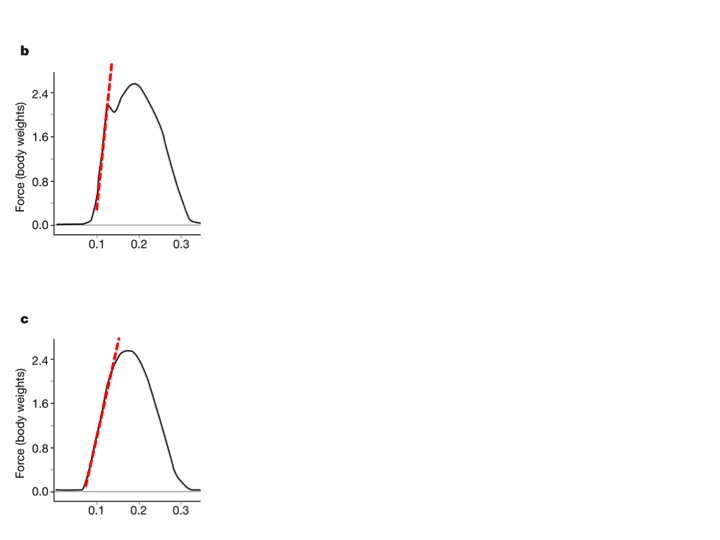
Right below, is a graph of a runner landing with a midfoot gait. You’ll notice a very distinct impact peak (first bump) and a larger active peak (second bump). You’ll also notice that the slope of the first bump (from the x-axis to the top of the first bump) is quite steep.

What kind of foot contact pattern made this graph? Nope – not a heel striker – but a midfoot striker. In fact this woman is about as midfoot as possible – her foot came down completely flat down at contact. I know ….this runs counter to a lot you’ve been told right? Hold on – let’s keep going.

Now look at runner #2’s graph. Notice the single mountain (or peak). Notice that the slope of the line from contact to peak is quite less steep than that of Runner #1. A LOWER loading rate! Guess what kind of contact style this runner utilized? A heel-strike. Yes. You read that right. A heel striker had a lower loading rate than a midfoot striker …..in this situation.

What gives? The media tries to make things simple. They say that “mid-foot” or “forefoot” is better than rearfoot. I love reading running forums where people with way too much time on their hands armchair quarterback running styles. They look at a picture or video of a contact pattern of some guy running across the screen and say “wow – nice midfoot strike –that runner is efficient.” They don’t know who the runner is, or what his time was for the race. They just saw a foot strike and proclaimed him efficient. Then they’ll scroll down and see some picture or video of some guy heel striking and proclaim that he/she is an “in-efficient” runner based on the heel strike. This “in-efficient” runner might be an in-efficient runner. Or it might be Meb Keflezighi (a runner who is just a bit faster and more efficient and than most of your reading this post).  You see, these arm chair-quarterbacks aren’t very good at identifying efficient gait. Fancy force plates are. I do this for a living and still need data from my lab to give me the answer because no one can actually see forces. So what have we learned from these fancy force plates?  Its NOT rear-foot or midfoot or forefoot that matters – its where the foot contacts in relation to the body’s center of mass.

As I stated above, I picked some outliers just to make a point. It is true that for MOST runners, adopting a midfoot or forefoot gait style will lead to decreased loading rates. However, its not because the foot lands differently, its because a rear-foot style typically allows you to land with the foot farther in front of the body’s center of mass (over-striding). Switching to a contact style that moves the foot closer to the body’s center of mass usually means that we land closer to the font of the foot. But not always. Let’s look at the elite runners to dig a bit deeper.

To run really fast, it’s very simple. You either increase your stride rate or your stride length. Simple right?

  • Stride rate- this is also referred to as cadence. Cadence ranges in cycling are pretty variable. Cyclists use anywhere from 45 – 140 rpm in competition, depending on the event and terrain. When we look at running, you’ll notice that cadence for middle distance through marathon distance typically ranges from 88-96 rpm. This is a much narrower effective window than cycling. We’ll look more in depth at cadence in a later post, but for right now, its safe to say at the elite level, there isn’t a huge difference in cadence values.
  • Stride length –if cadence values are held fairly consistent, the only other way to run faster is to adopt a longer stride length. The stride length of someone running 4:30 miles is significantly longer than running 7:45 miles. What we see is that a number of the elites land on the rearfoot, but their center of mass is still very high up at the time of contact. When running, you are a projectile in the air with your center of mass following a parabolic curve. So even though the elites often “contact” on their rearfoot, they don’t really have much pressure (force) on it until their center of mass lowers to the ground.  This effect produces a low loading rate with a heel contact, and is exactly what occurred in runner #2 above.

So let’s summarize what we’ve said about contact foot contact style. For most runners, landing closer to the body’s center of mass is an effective tool to lower loading rates. Barefoot running, minimalist running, and increasing cadence (faster cadence means you don’t have time for your foot to reach out far in front of the body) are all effective tools to accomplish the end goal of decreasing loading rate.  This being said, contact style is NOT the only way to decrease loading rate. Its possible to have lower loading rates with multiple foot contact styles, and other factors as well.

***Note: Unless the person is accelerating, it is not possible to have the foot contact directly under the center of mass. At steady state, the foot does (and should) contact in front of the center of mass.

The effect of posture

We said that, in general, a foot contact closer to the center of mass would decrease loading rate. On the flipside, posture can be utilized to alter the center of mass in relation to the foot. Most of us stand, walk, run, etc with poor posture. Take a look at the runner below. The runner is in exactly the same phase of gait, except for a more arched low back on the right than on the left. The posture on the right is typical to most runners. We hang out in the “back seat” with lots of arch in the low back. This change in lumbar position moves our center of mass backwards thus causing our foot to land further in front of the center of mass.  Therefore, keeping a neutral lumbar spine (not arched) is essential to keep our center of mass over our foot when running – and has the effect of minimizing loading rate.

Lastly – gait cueing and limb stiffness. Here’s where things come together, but also show need for additional research. In our lab, when we get someone with high loading rates, we show them their ground reaction force plots in real-time as they run, and ask them to change it. Normally, we don’t tell them how, we ask them to “play” with their graph shape as they run. Most runners figure out how to minimize their loading rates by getting visual cues, or feedback. This is the best way since the runner is aware of the conscious modifications they are doing to alter their loading rates and can see instant feedback to observe success – thus learning! If they don’t “get it”, we guide them through the technique modification so they can see the effects of their form changes as they run. Again – the goal is to get the runner to retain this sensation so they can alter their gait to make long-term changes to decrease tissue stress.  On the simpler side, research has been done that simply told runners to “run soft”. These individuals were found to decrease their loading rates. Gait cueing works. How does it work? People modify their contact style, posture, and their limb stiffness to achieve a desired result. Limb stiffness relates to how compliant the runner maintains the knee to modulate the rise and fall of the center of mass. There is more work to be done here to dig deeper, but this should hopefully answer the bulk of questions for now.

Summary:

What does this mean for you as a runner?

There is mounting evidence that minimizing loading rate has vast implications for a number of injury prevention strategies. There is also mounting work to show links to performance, though this is inconclusive at this time. There is additional work to be done to show how the gait style changes observed with decreased loading rate correspond to improved performance. Another topic for another day……

If you want to try to decrease your loading rate, you need to get your foot to land closer to the body. Barefoot running is a good drill for this since it “forces” you to avoid over-striding.  There is evidence that a properly constructed minimal shoe should also lead to minimal loading rates (although no one can say all minimal shoes since the definition of this market sector is so vague). Keep your torso centered over your lower body and avoid the temptation to run in the “back seat”, especially as you fatigue.

Run Tall! Run Soft!

Yup…. Less (loading rate) = More.

Loading Rate: Part 1: What does it mean for you?

I was at a conference recently where someone asked me –  “With all the fancy equipment and data you’ve got access to, what it the biggest thing you’ve noticed and how has it made you change your personal running style?”

Easy! I’ve learned through the years, that it’s critical to minimize loading rate. Loading rate is the speed at which you apply forces to the body. While running, you aren’t going to change your body mass during a run  (OK –I know you do slightly due to hydration issues, by let’s ignore this for a moment). Your total mass stays relatively the same. However, how you move your body’s mass forward when running does play a major role in the way your body is affected by the forces we see in running.

In the lab, loading rate can be objectively measured. Some labs use accelerometers to determine peak values and rates, some use the slope of the ground reaction force. Both have been investigated as viable ways to assess loading rate. We’ll use slope of the ground reaction force (GRF) since it’s a bit more visual to help get the concept across. If you look at the graphs, you’ll see that the one graph has a steeper slope to it than the other. The steeper slope (top graph) means that the forces applied to the runner occur quicker than that of the forces applied to the less steep slope (bottom). Why does this matter?

Imagine running 50 miles a week. Think of the amount of wear and tear that occurs on the body. Now imagine running 50 miles a week with a gait pattern that causes the mechanical loading of the body to occur less quickly. Decreasing the loading rate applied to tissues will minimize tissue stress to the runner, minimizing the effects of the micro-trauma of endurance training. The rate at which structures are loaded has been implicated in both stress fractures and soft tissue dysfunction (1, 2)

Now  – full disclaimer here, there is some discrepancy in the literature on whether or not the “impact peak” actually causes injury. This post is not going to debate the presence of the impact peak itself, only the difference between running with a high loading rate (not good) or a lower loading rate (better). Should everyone go lower and lower? There is a point at which the metabolic cost of lowering the rate of loading to the tissues is more expensive from a metabolic standpoint. Further, there is likely a lower limit to what one’s loading rate can be. These are questions that need to be answered individually with a lab analysis, as it is speed and mass dependent and not one-size-fits-all.

There are 3 primary ways you can affect the rate at which you load the body:

1.Contact pattern
2.Postural alignment
3. Limb stiffness

Tomorrow we’ll discuss how these 3 factors impact the loading rate of a runner….including directly addressing a lot of the hype around fore/mid/rear foot contact styles – Stay tuned!

References:

1. Milner, C.E., R. Ferber, C.D. Pollard, J. Hamill, and I.S. Davis.  February 2006.  Biomechanical factors associated with tibial stress fracture in female runners. Med Sci Sports Exerc.  38(2):323-8.

2. Milner, C.E., J. Hamil, and I. Davis.  July 2007.  Are knee mechanics during early stance related to tibial stress fracture in runners? Clin Biomech.  22(6):697-703.

Shoe Study – Free shoes!

Hey Runners –

We are currently looks for 10 runners to volunteer for a study. The study will look at the effects of longer distance runs. If you are chosen, you’ll need to come into the lab to run 3 times. Basically, you’ll do a long training run at your typical training pace indoors on our treadmill. You are welcome to watch a movie while you run to keep your attention! As you run, we’ll be collecting data on your gait to see how things change during a long run.

Each run will be for 1.5 hours. On the first run, you’ll be given a pair of shoes in your size to run in. You’ll take them home to put 400 miles on them. After you’ve hit 400 miles, you’ll come back in and run again. Somewhere in between the first and second run, you’ll come into the lab and run in second pair of shoes. The runs will be spaced several weeks apart, depending on how long it takes you to hit 400 miles on the shoes. You’ll get to keep a pair of shoes for participating in this study.

Here are the criteria.

  • currently training for a ½ or full marathon
  • having already completed a ½ or full marathon within the past year
  • max weekly run volume of 50 miles a week
  • someone who typically runs in a “cushioned” or “neutral” type running shoe (you were likely told you have a “higher” arch)

If you meet all of the above criteria and are local in Charlottesville (or close enough that you could easily get here for the 3 running sessions) please give us a call at 434-982-1422.

Thanks!

They said I’ve got pronation….How long do I have doc?

So you went to the “insert giant athletic store here”, and the 16 yr old kid who works part time for the summer, who is the “expert” on running watches you for about 30 seconds, and decides to tell you that you in fact, pronate. Or worse…..maybe you even over-pronate. Never fear though, they say! They’ll just go in the back and grab some of those big mutha shoes to totally stop you from pronating and be your personal savior.

Before you plunk down your hard earned cash, we should probably come to terms with a few things.

  1. What is pronation?
  2. When does it occur?
  3. Can you stop it, or should you stop it?

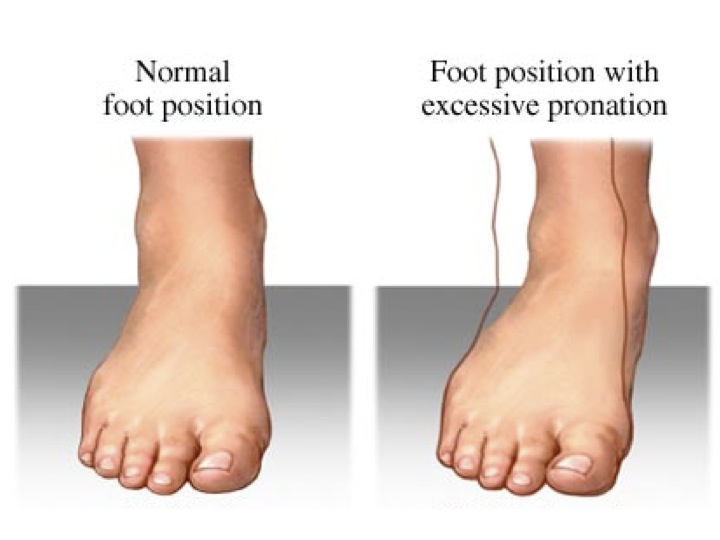
1 – First, let’s re-cap what this pronation stuff is all about. Pronation is not bad; in fact, it’s the body’s natural shock absorption mechanism. When the foot moves into pronation, it becomes like a loose bag of bones. Everyone pronates to some extent. Some more than others.  If you didn’t pronate, you’d have problems with- you guessed it- shock absorption. The opposite of pronation is supination. In supination the bones of the foot become more congruent (increased contact between the surfaces of the joints). This increased contact produces a rigid lever for push off in gait. So we should land in a supinated position, and move to a more pronated position during stance to decrease shock, and then move to a supinated position to achieve a rigid lever for push off.

Let’s re-cap this again using America’s favorite national pastime, Tetris. When the pieces fall from the top of the screen, we can move them about and rotate them freely. They can move. This is how the 26 bones in your foot function in the shock absorption or pronation phase. They should move about to dissipate force. Now imagine those same Tetris pieces once you’ve placed them in the stack. They can’t move right? They become congruent and are locked in place. This is similar to the foot when you are in supination.

2- Now that we understand pronation as something that is not really bad; let’s talk about when it occurs. As evidenced in a study carried out in our lab and published in the Journal of Orthopedic and Sports Physical Therapy, maximum pronation of the foot occurs after the heel has left the ground. Why does this matter?  Remember that 16 yr old kid? He’s going to grab a shoe off the rack that is a motion control shoe –designed or should I say marketed, to stop pronation.  A shoe like this features a higher density material on the inside of the shoe. The claim is that this different density material acts to stop the pronation from taking place, thus fixing your issues. If you’d like to see if your shoe has this, just look at the inner side of the midsole (marsh mellow stuff between the fabric upper and tread). If some of the inside of the shoe is a darker color than the rest, it’s likely a “dual density midsole design”.

OK – so let’s get back to timing of pronation. Shoe companies put this increased density material to “stop the foot from pronating”. Well, we found out that maximum pronation occurs after the heel is off of the ground. So guess what? – All that higher density material in the shoe isn’t even touching the ground to try and stop the foot from moving at the time when the foot is moving the most! Hmmmmm……makes you think doesn’t it?

3- We know what pronation is, and when it occurs, and now we should address the question of stopping pronation. Pronation is necessary. I’ll even say in the right amounts and at the right time, its good. I’ve seen PLENTY of runners who have problems because they don’t pronate enough. However, stopping pronation isn’t really in our best interests. It’s better to learn to stabilize the amount of pronation. The thing is that no shoe can do this- you need to learn to use the muscles in the foot and the muscles in the hip to stabilize the rotational motion that naturally occurs in your legs. Can you do this? How good are you at stabilizing your pronation? A visit to the SPEED Clinic can help you pin point your issues and fix them for good.

Parting thought –please don’t read this and think that we are saying that shoes don’t make a difference. They do. The objective research we do combined with our clinical experience has proven to us that they make a huge difference. We view footwear as part of an intervention to help you perform at your best. Shoes are very different. How much of a shoe you need, or weather you even need a shoe at all (barefoot running anyone?) are all part of a comprehensive assessment here at the University of Virginia.

Adjust your thermostat, adjust your expectations

Wow. If you are on the east coast like we are, we don’t have to tell anyone that its been H.O.T.
“But wait……..don’t the weather gods know I supposed to be training for the ___ championship in __weeks ….not to mention the ___ race I’m doing this winter. My workout today was slow, and I felt bad on my long workout this weekend. I’m getting slower and this heat is killing my training!!!!!”
If you guys want some tips on running in the heat, there are some great words of wisdom on this blog if you scroll down. Let’s re-cap: – hydrate, run in the morning, hydrate, loose fitting and light colored clothing, and hydrate. OK fine – but lets get real on this summer’s weather and why we need to take it into consideration.
Last year in C’ville, we had 7 days above 90 degrees and they were scattered about the summer. Except for a small 2 week heat wave in the middle of the summer, it wasn’t all that hot all the time. You had the luxury of moving workouts a day or 2 ahead or behind in the week based on the heat. This summer, we’ve had 45 days above 90 degrees. We’ve had 7 above 100. And let’s be honest, its not really cooling off all that much at PM or in the AM (Friday night was 96 degrees at 9:00 PM!). Its been so hot that all outdoor high school and collegiate practices would be completely cancelled in weather like this. National and State sports governing bodies have established these regulations to protect the athletes. I know – you are tougher than them and need to get your speed work session in today though…….stay with me.
Dealing with this heat is all about adjusting your expectations. Let’s  re-state this point to be absolutely clear: Trying to train at your same intensity and volume (or increasing it) in this type of weather is NOT a smart thing.

If you don’t agree with me, let’s look at it from your body’s perspective. When you exercise, you ask your body to metabolize fuel stores, regulate energy balance, and produce mechanical work so that you can move from point A to point B. All this effort produces heat. Your body has a lot of internal mechanisms to regulate body temperature, and they work pretty well. But your body has limits as to how rapidly it can cool itself off. Did you know that your body actually begins to compromise its ability to perform at around 72 degrees? Now think about how much challenge a 95 degrees environment places on that body.

Still not convinced? Let’s say that your typical Wednesday morning track work out is 12x 90 second 400 repeats, with 45 seconds between each. Think about how much stress that places on the body under normal conditions. Now let’s consider our weather reality. Its now 10-15 degrees hotter than usual and more humid. Trying to run that same workout under these conditions is significantly more stressful than typical. You may notice that you can’t make the 90 second split without taking more rest between reps. You may even notice that under these conditions, 90 seconds is not even possible. Let’s say that your triathlon training schedule has you doing a 5 hr ride on Sunday AM. However, the heat has slowed your pace down significantly after 2.5 hrs, and all you want to do is jump off the bike into a cool pool. Its OK to back off the workload to match the change in conditions – you’ll STILL GET THE BENEFIT OF THE WORKOUT. Shorten the ride. Increase your rest. Take longer breaks between intervals. Do whatever it takes to be consistent with your training, but realize that extreme weather requires some modifications to ensure we aren’t just pounding ourselves into the ground. Remember- you’re body doesn’t really know exactly how fast its going or how long a rest you are taking; it just knows that you are pushing it harder than you have in the past and with all this heat, it just might push back.

This post is written in memory of a local high school runner who died of heat illness during a summer training run.


Runner’s World asked us: What’s the single biggest problem in running?

When most runners, coaches, running shops think of the single biggest problem that affects runners- the answer usually points to the most feared word in running – “over-pronation.” However, we told Amby Burfoot  (link here) that our years of experience quantifying running mechanics through the use of 3D gait analysis has shown us otherwise.

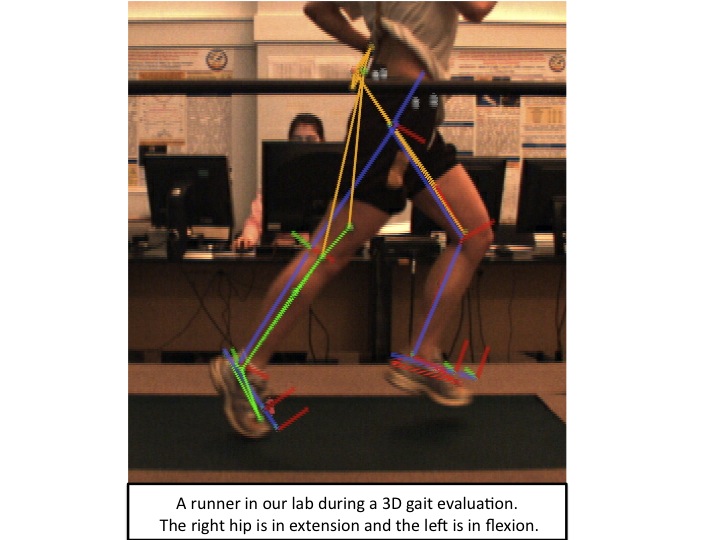
While it’s true that some of us out there may pronate more than others, it isn’t exactly what we’d call an epidemic problem in America. We’ll estimate that less than 30% of runners truly over-pronate (excess motion in the foot) their feet while running. To find the real answer, we need to move up eyes up and look at the hips.  About 80-90% of runners don’t extend their hips.

What is hip extension anyway?

Lifting one knee up to the chest moves the hip into flexion. If you extend the hip the opposite direction (past vertical) that is hip extension. The goal is to do this without extending your back. Stretching your hip flexors to get more motion is the key

So why don’t most runners extend their hips?

We tend to sit. A lot. We sit in class. We sit at work. We sit in our cars. Cyclists, you spend all your time on the bike sitting in hip flexion. When we continually sit in hip flexion, the hip flexor muscles become tight. So tight that the overwhelming majority of runners can’t extend the hips. “Now wait a minute” – you might say –“I see all my friends and their leg does get behind them when they run – so they must be extending their hip right?”

Tight hip flexor muscles cause you to get your leg behind you not from extending your hip – but by arching your lower back. This can cause injury since an arched lumbar spine compromises our ability to use core muscles while we run. This sets us up for a host of leg injuries and also is the most common cause of low back pain in runners. Further, lack of hip extension compromises your running efficiency.  As we increase speed, the bulk of the work supplied to the legs need to come from the hips. Well, if you can’t extend the hips, you are missing out on critical force to move your body forward.

So how do I get hip extension and is it really that simple?

You’ve got improve your range of motion of the hip, and your ability to control the new motion. The best hip stretch is a kneeling hip flexor stretch. Beware though, a lot of the videos on-line show incorrect form for this stretch and you don’t actually wind up extending your hip flexors at all (they stretch the quads).  Check out the July 2010 issue of Runner’s World for an article we helped them put together. It shows correct technique to stretch the hips, and some simple exercises to learn to use your new range of motion.

Deep Thoughts: Do your muscles really have a memory?

You can run quarters on the track in 80 seconds. Maybe you can even do them in 60 seconds. Maybe you hit a PR for sustained power on the bike. You can drive your golf ball 250 yards down the fairway. Does this mean you are really performing at your potential?

Every time we practice a movement, we are reinforcing a particular movement in our brain. This is commonly referred to as “muscle memory”. Training technique is an often overlooked aspect in endurance world. Each joint in your body has an axis around which it moves, with muscles controlling the movement. These tissues are engineered to move a specific way. If we learn good muscle memory, we continually re-enforce good habits – and come competition day – we perform at our potential.

Competition to you might be a round of golf with friends on Sunday or qualifying for the 10,000 meter at the Olympics. At every level, focusing on your form can improve your performance.  Our body and mind strive to get the job done – at all costs. Often, this can mean we learn an incorrect strategy to get the job done. And even if your form is better than most, we all suffer form alterations when we fatigue. When these form changes occur, we have a decrease in efficiency. Since we are performing “different” than we normally do, we put more strain through our body’s tissues and are more likely to become injured. Understanding the stages of motor learning will shed some light on why we need to work on our form in the first place:

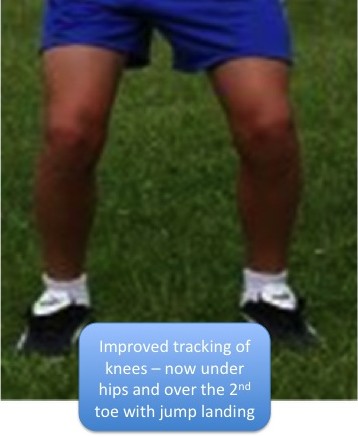
  1. Unconscious Incompetence – this means we have no idea that we are doing something with incorrect form. Most of us fall in this category. Look at the picture of the woman landing from a jump. The joints of the lower body are designed so that the knee tracks over the second toe when we land from a jump. The goal is to preserve proper alignment when we move. This athlete has no idea that her knees crashing to the inside are a problem. She doesn’t know that it significantly increases her risk for an ACL tear, patellofemoral syndrome, hip impingement, or a host of other issues. She doesn’t know that this landing technique will hurt her running, jumping, and cutting performance.
  2. Conscious Incompetence – We reviewed this athlete’s form issues with her. We showed her that the jump landing technique she uses can lead to injury and compromises her performance. She is now aware of it and understands the issue. This is the point where specific corrective exercises, cues, and drills are prescribed to her to correct this muscle memory. The more she practices these correctly, the more she re-enforces correct motion – however this stage requires a lot of conscious thought to perform the movement correctly . Because of the increased cognition or thought that this stage requires, the athlete may in fact be less efficient at their particular sport because they are “thinking” so much about the way in which they move. This is why drills often seem challenging.
  3. Conscious Competence – The athlete understands that there was an issue, knows correct technique, and now is able to perform correctly without thinking about it. She has removed the stresses from a flawed technique, and can perform correctly in sports-specific drills and in competition. The is the stage we want to be at! Think about some of the best performances you’ve ever done. What were you thinking about? Most successful athletes can’t even remember what they were focusing on. They were in “the zone” and just let their bodies perform using the skills they learned through a lot of practice.

In our quest to improve, we often focus on adding intensity or training volume thinking it to be the magic fix to take us to the next level. We’ve often heard the phrase “train smarter, not harder.” Adding time and focus to alter your technique pays off in spades. So let’s expand that saying to “move smarter, not harder”. The focus of the biomechanical analysis done in the SPEED Clinic @ the UVA Center for Endurance Sport is identify your unique compensations and make those muscles smarter!

Is stretching right for you?

Should I stretch? Should I stretch before or after? Will stretching make me a better athlete? Will stretching make me a more confident public speaker? We get these questions a lot. Don’t worry, we are happy to help and the confusion is not your fault. Seems every media outlet out there wants the BIG STORY. The headlines read  “best new stretch”, “best way to stretch”, or maybe even “stretching is killing you” –they really want you to by their magazine! So should you stretch or not? Is it OK to be tight? Is it a benefit? Is it possible to be too flexible?

Muscles, tendons, and ligaments shorten and lengthen as our joints move. Therefore, the amount of mobility you need in these tissues is pretty simple to define. You need enough for the tasks and sports you do, and nothing more. Is it really that simple? Yes – and let’s look at what happens when structures around our joints are too tight.

  1. Tightness in the muscles, tendons, and ligaments around a joint causes increased strain in the tissues. Think about a rubber band. You can stretch a rubber band back and forth from slack to fairly taught all day and it will be OK. Think about how much tension is in the rubber band as you shorten and lengthen it. Now imagine pulling he rubber band taught to 80% and then pulling it as far as you can. Do this for a while and look at the rubber band. If it hasn’t popped yet, you’ll notice that the rubber band actually begins to fray a bit – the increased tension inside the band causes damage. This increased tightness inside soft tissues limits our ability to withstand chronic strain inside our muscles – and leads to muscle strain and tears.
  2. The attachment points of your muscles, tendons, and ligaments form a bag of connective tissue around each and every joint called a capsule. Tightness in these structures can change the way the joint moves. Think about door pivoting open and closed on its hinge  – there is an axis on which the door moves. The door has no problem opening and shutting. Now imagine a force trying the twist the door as it opens and closes. This twisting force tries to move the door in a way that the hinges are not set up to pivot around. If you keep trying to open and shut the door, something will fail (the hinges will loosen, the door will warp)  – the point is that trying to move a joint in a manner that does not use its normal axis will cause pre-mature wear on structures. Tight soft tissues change the axis of mobility through the joint and cause excess wear on he surfaces of the joints  – the is the mechanism for the development of arthritis.

So now that we know the problems associated with tight tissues, all of us should stretch right?…. because the magazines say that stretching causes you to be more agile, stronger, recover faster, and warm up the tissues? Not a single one of these claims has ever been substantiated. You need “enough” mobility around a joint for the sports you perform. A runner and a gymnast have entirely different needs for mobility. Having more flexibility than needed for your sport has never been proven to be an advantage. In fact, we see just as many injuries to people that are hyper-mobile (have tissues that are too loose) as people who are tight.

Stretching a muscle is tearing tissue. Do I advocate stretching? Breaking down the structural integrity of our body is not something we should do unless its needed. Would you tear holes in your clothes for the fun of it? When an individual needs to stretch areas of their body that compromise their ability to perform, stretching is 100% part of their plan. But if there is no restriction on soft tissue mobility, there is no evidence that stretching will provide any benefit at all. In our next post, we’ll tackle the different types of stretching. For now, “enough” is enough.