Category Archives: cycling

Link

Coffee Talk: TrailRunner Nation Podcast

The guys at Trail Runner Nation podcast gave me a call, and asked a few questions. If you’d like to hear some inside scoop on what you can do to keep healthy and happy on the way to your next PR, grab some of your favorite brew, and tune in here.

We’ll debunk some myths, babble about footwear, talk about why we don’t treat injuries by treating symptoms, and discuss some cutting-edge approaches on strength training for endurance athletes. Its a long hour of conversation, but all this talk is aimed at ways to help make running fun. Because that why we do this stuff. And more fun is, well,  just more fun.

Do you treat triathletes? Join me @ U of Michigan

Multisport athletes have a lot of challenges in their training,  but the training demands of 3 sports seem to creep up on all of us. Athletes spend so much time trying to fit in their volume that the body often gets ignored.

Well, this all ends now. Join me at the University of Michigan April 20-21st where we discuss “Putting the Athlete in Triathlete: a clinician’s role in endurance sports.” During this 13 hrs course, we’ll lay the ground work and discuss how endurance training impacts the tissues of the body, and then move on to detailed descriptions of the mechanics of each sport. You’ll learn how to correlate your musculoskeletal evaluation of the body with a runner’s swim, bike, and running performance. We’ll discuss why swimmers aren’t your typical overhead athletes, you’ll learn how to do bike fits (how to fit the bike to the rider, and more importantly how to fit the rider to the bike) with hands on practice, learn how to identify common gait patterns and cue them out of problems that overload the body, and understand the role of complimentary training and strengthening. At the end of the weekend, you’ll understand how to help your athletes make training easier on their body, and improve their efficiency.

for registration information, click here, and for a hourly breakdown of the course, click here. See you there!

Elevator Up? The Mindset Behind a Champion

A few weeks ago, I got to present along side Dr. Joe Vigil at a USA Track and Field conference in LA. For those of you who have to ask “who is Joe Vigil?”…..this man is to coaches as Rolex is to watches: the best.

Dr Vigil always has the uncanny ability to break down complex tasks and ask you the “right” introspective questions to help you reach your next milestone. We don’t just train the body in isolation. We’ve always heard that the body can handle more than the mind wants to give. So with that, I’m going to leave you with the following picture. Is it time to take the elevator up the “achievement triangle?” – What’s holding you back from reaching your goals? Change all starts with the desire to change.

Slide1

In fact, lets move beyond kumbaya and start this process in motion right now. Turn the computer off. Get out a sheet of paper and make 3 columns. Write down your goals in column 1. Then write down the obstacles that stand in the way of each of your goals. Then make a 3rd column of exactly what you are going to do to beat each of those obstacles.  Stick it on your fridge and remember your passion. When one of those obstacles seems like its standing in your way, make your tiger face and beat it down. Mental Tough = Body Tough.

And if you need help with your plan, give me a ring – I’ll help you find your tiger face.

UVA Running Medicine 2013: a recap

What happens when you get 220+ clinicians in the room and talk about running? It was a beautiful day. About 55 degrees and sunny. The remnants of the 10+ in snowstorm on the ground helped dampen the air and made the sun feel even stronger. It’s a beautiful day for a run….but instead,about 220 clinicians sat inside, on their glutes, so they can learn to help you use your glutes better.

The 10th anniversary of the longest running, running specific medical conference produced a host of content to help “us” help “you.” Do you ever wonder why running is as challenging as it is? How your running would change if you had no gravity to fight, arms to swing, or perhaps even legs to stand on? Dr Rodger Kram led us in 2 enlightening presentations on the energetics of gait. Talks like this completely shift how you think about running.

Dr. Eric Carson reviewed the current and future trends on cartilage repair. Take home: right now, cutting edge surgeons are able to offer some pretty incredible proceedures, and they’ll be even more magic to come in the future.

Brian Hoke, PT helped us think critically through our video gait analysis. Anyone can watch a video in slow motion, but learning what to look for is critical.

Your’s truly helped clinicians through their musculoskeletal exams as they relate to a runner’s needs. No one can tlak about “correct running form” unless you understand that each runner is an individual with unique needs and attributes. If you understand how a person’s body wants to work, you can understand how to help that person run. For those of you who read the screen’s in Anatomy for Runners, that 8-point exam just got a whole lot more thorough: 32-points to be exact.

Dr Sibohn Stattua reviewed the literature on the female athlete triad. Turns out that there is more to it than just low energy intake, menstrual irregularity, and poor bone remodeling…..the triad is turning into a square? That’s right, there is a 4th “leg” to the triad, and this one might be even more severe of a long term complication from this complex disorder.

Eric Magrum, PT discussed the current research on the #1 injury affecting runners: anterior knee pain. He told us why runners with chronic pain in the knee try to avoid their pain. The problem is that the compensations we adopt to avoid pain in the knee are just as much of a problem as the original cause itself.

Kyle Kiesel, PhD, PT helped us through an eval process to identify core imbalances that affect far more than just the core.

And finally, Dr Bob Wilder guided us through the process of guiding you back to your running in explaining the best return to run programs after an injury.

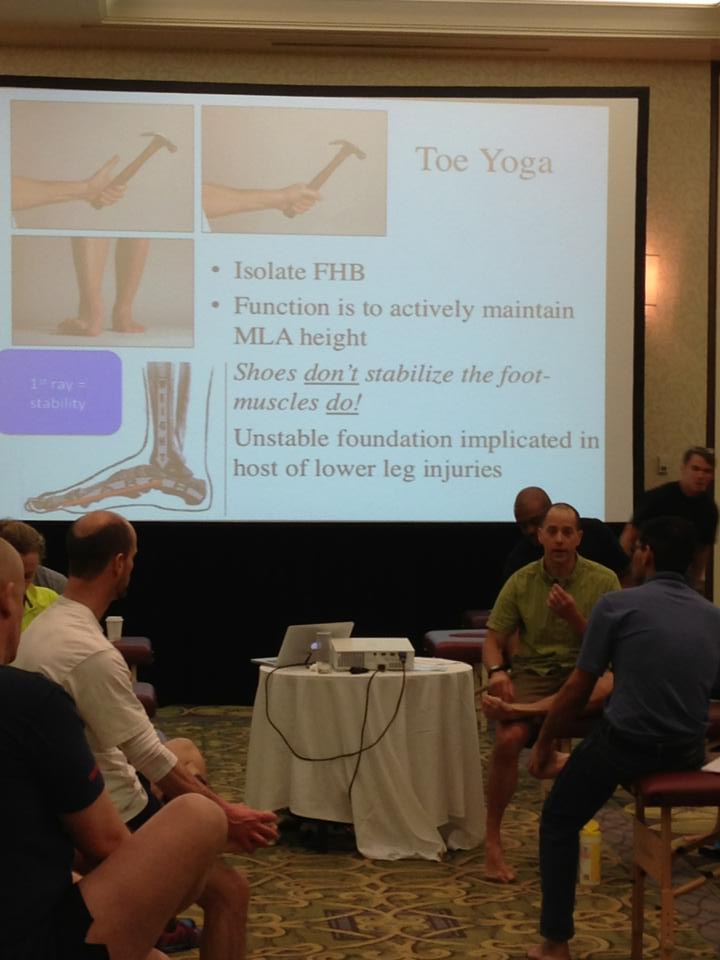
Clinicans getting to know their feet: a scene from our lab session

Clinicans getting to know their feet: a scene from our lab session

And that doesn’t even mention the incredible lab session on Saturday by Brian Hoke, Kyle Kiesel, Dr Mark Cuccuzzella, myself, and the amazing cookies that I ate at the afternoon break. Egos were dropped at the door, and we all got down to the same level to help runners do what they love: run.

As always, the conference returns next year……

Learn how to run (better) from your couch!

Yes, I’m suggesting you actually spend about an hour on your bottom if you want to learn to run better. Join me on Tuesday, Feb 26th, I’ll be hosting a webinar for USA Triathlon. A quick summary and a registration link is right here.

Topic: Building the Perfect Runner: How Strength and Form Can Improve Your Performance (with Jay Dicharry)

What’s the best way to run? While often polarizing headlines read “everyone must land on their forefoot”, there is a lot more to efficient running form than a foot strike. In this webinar presentation, Jay Dicharry will use both scientific data and simple analogies to discuss what good running form is. Then, it’s on to the naked truth: There are things you can do outside of running that will improve your running economy. By the end of this presentation, you will understand:

•What defines proper running form, and how it plays a role in injury and performance.

•How to ensure that you are putting the best ingredients (your body!) into your running form.

•The mobility requirements for proper running

•How to optimize your strength training to ensure it directly transfers into better running.

•How to optimize posture and effectively integrate it into your daily activities and training.

Join Jay as he looks past the hype and shares the information you need to perform at your peak.

“black box” training = grey answers

The black box training model that most of us follow is pretty much like a blender.

Its time for breakfast, and you want a smoothie. You scrummage through the kitchen and try to find anything resembling fresh or frozen fruit. The blender is loaded up, and spinning loudly as the morning sun crests through the window. You take a sip……its good. But why isn’t as good as the smoothie you made a few days prior. What specific things made the other smoothie better?

Most of us put as much forward thinking into smoothies as we put into our training plan. We throw a bunch of training hours in, and based on our success, we arrive at conclusions. Well, what really happened? Some of you may have gotten faster. But could you have gone faster yet? Some of you may have plateaued…..why? And a few of you may have even gotten slower…..a lot of people really want to know the answer to this!

Wouldn’t it be nice to know more than just “effort in = race performance out?” What if you could actually see inside the black box?

Screen Shot 2013-02-12 at 1.13.38 AMWhen athletes come to me for an analysis, my goal is to find their limiters. Everyone has them, but not everyone knows how to find them. Over the past decade, I’ve blurred the lines between sports medicine, lab analysis, and performance training. And I’ve done it by being specific. I take a hard look at the state of your body, and a hard look at your sport performance. My lab has fancy tools like force platforms and instrumented treadmills, and a real knack for understanding how these values actually impact your sport’s performance. I can see into your body in ways that no “trained eye” could ever hope to capture.  Specific measures = specific answers. I call it “opening the box.” It works. 

Over the next few posts, we are going to go through some examples on how this approach has helped others in the past. But if you want to know how it helps you, and want to look inside your own box, give me a call!

From General to Specific: thinking through your yearly training plan

OK. Gut check time. a few weeks ago, I asked you to take a look at your past, and identify your performance limiters.  While both “Type A” and “Type B” training plans can be incredibly successful, even the most open minded Type B person takes a step back to look at their needs. After all, you’ll never reach your goal without a road map to guide you along the way.

To help you organize your road map, I’d like you to keep in mind a general plan: “from general to specific.” What does this mean? Well, if you are a cyclist, the best, most specific way to train leading up to your competition season is to pedal your bike…..often! But if you are 4 months out from your season, there are about a million other things you could be doing besides biking, that will still help you pedal well come competition season.

There’s no substitute for working hard, but there’s also no reason to work hard at the same thing. I know some of you say, “sure – I do this. I lift weights in the offseason.” Well, if you know anything about modern training theory, weights, plyometrics, and drills aren’t just for the off season (another topic for another time). When I say general, I’m not talking about all this kind of stuff. I’m talking about other kinds of stuff.

When you are 4 months out from race day, your body doesn’t really care if you did 2 hours on the trainer, or 2 hours XC skiing out in the woods. But your brain just might be a whole lot happier shushing though the snow covered trees instead of watching another 15 yr old Spinervals video. If you feel like going to a rock gym – go for it. The balance, coordination, and muscle stabilization you gain from rock climbing will improve areas of your body you never existed. And so what if you aren’t good at it? You aren’t a professional rock climber, its just something fun to do while you’ve got time, and all-cycling-all-the-time isn’t the sole focus of your day.

Me? I’m tackling my nemesis…..trying to ride my unicycle. Previously, its been successful at tacking me instead. But this is all supposed to be fun right? We do this stuff for a challenge. Repeat after me: “It’s January.” You know your friend who is putting in 20 hr training weeks right about now? He’s in for a massive blow-up come about June, and will be spending the peak of race season burt out and destroyed. So expand your skills and expand your mind. This winter, what are you doing to work on your “general?”

Think backwards to go forwards

So its the second week of the new year. Did your 19 New Year’s resolutions you had planned make it through week #1? This time of year, we all get caught in a trap: “Im going to do more base training, more speed work, more intervals, more weights, sleep more, eat healthier….the list goes on and on. While it would be great to have the luxury of time to make us all into training animals, we have this thing called life that gets in the way sometimes. And then a lot of us become discouraged when things don’t work out the way we planned, and we don’t achieve “more” of everything we set out to. Instead of doing “more” in 2013, let’s ask a simple question to help you do “better” in 2013.

Hard questions = best answers

When I work with a patient or athlete, I always discuss THEIR goals for the upcoming season. There really isn’t any right answer here – it may be to make the Olympic Trials, simply to PR at your half marathon, or just be able to get to the point where you can train consistently – your goals are your goals. My job is just to help you achieve them. After you tell me your goals, I ask one simple, but humbling question:  “what’s the biggest thing that stood in the way of your goals the past season?”

Ouch. This is typically the point where eyes roll back in your head. Every day you hit snooze and didn’t get up to train is flashing before your eyes. Why you didn’t dig deep for a finishing kick in your last race becomes more painful now than it did when you got passed with 50 feet to go. However, this question is not meant to punish you, its to get the the root of the problem. You don’t drive to grandma’s house aimlessly, you have directions and a plan to get to your destination. Training is the same thing.

Think backwards form your previous season. What went well? What were the defining workouts for you? Were you rested properly going into big races? How was your pacing? Did you do a good job of timing your weight sessions in relation to the rest of your workweek? Was your total volume of training time realistic with everything else you have going on in life? Did you pick the right races? Did you start oyur intinse training at the right time of the season? Wish you would have done more basework in the off season? Wish you would have taken more time off in the off-season to avoid burnout? What things stand out that didn’t go well? Were your goals too ambitious given your current life situation? If so, can other things be altered to allow you to train appropriately? Did you have fun?

Image

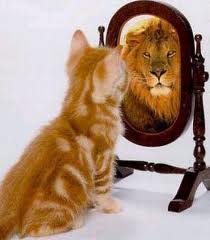
Note: this image is for figurative purposes only. If you see a lion in the mirror, you should probably run away.

This simple question can help you identify important things that often get lost in the shuffle. If you want to improve as an athlete, you need to train. Period. But your training should be focused for you, and “more” training is rarely the answer. Everyone wants to have some voice come along and say “just do this and you’ll achieve what you desire” Well, if you are honest with yourself, you’ll find that voice is you. With your limiters in front of you, you can now focus on specific ways to attack it. Looking backwards helps define where we need to move forward in 2013.

Looking ahead to 2013

20130102-135706.jpgSo it’s the New Year. As a reader, you’ve seen every blog out there flaunt their “top posts for 2012!”   Well, since there are less than 50 posts on this blog, making a “top 10 posts” post is a little ridiculous.

For writers, wordpress sends us these snazzy year end reports to see how you are fairing in the e-world. And one thing is interesting in my summary. While the reader base is still growing, the most popular posts on this blog aren’t new. In fact some of the most popular content on here is from last year. This means that people are coming to this site as a reference for quality information. Or it could mean that the “tight pants” video I linked from Jimmy Fallon turned everyone off…..

In any case, I’m not going to discuss the past, because there’s a search engine for that. But looking forward, what’s planned for 2013? More help for you.

  • Expanded Focus on Athletic skill: My book has been embraced by runners, but its also been embraced by non-runners. Every athlete needs to know how to keep their chassis in tune as they train their engine. Well rounded athletes recover faster from training stress, better prevent injury, and slow the effects of aging on your body. Better foundation = better performance. And a lot of it is just plain fun!
  • More content on other sports: Guess what? No one knows everything. Looking at other sports can help you learn more about other training strategies and tricks that may help you. And if you are a cyclist or swimmer, you’re really going to be happy looking forward. And we are even going to discuss weights, strength, speed, and power. We are going to make you better.
  • Current information: I’m speaking at 10 different conferences between now and August. I believe that knowledge shouldn’t stay in the hands of the teacher. I’ll be looking to post relevant new findings being spread around the conference circuit to help us all enrich our exchange of information.

Video: A word is a word. A picture is apparently worth a thousand. Well, sometimes words and pictures still aren;t worth as much as seeing something in realtime. Expect to see more video content on here.

So it’s the New Year. As a reader, you’ve seen every blog out there flaunt their “top posts for 2012!” Well, since there are less than 50 posts on this blog, making a “top 10 posts” post is a little ridiculous. But wordpress sends out these snazzy year end reports to authors letting them know how they are doing. And one thing is interesting in my summary. The most popular posts on this blog aren’t new. In fact some of the most popular content on here is from last year. This means that people are coming to this site as a reference for quality information. Or it could mean that the “tight pants” video I linked from Jimmy Fallon recently turned everyone off…..

In any case, I’m not going to discuss the past, because there’s a search engine for that. But looking forward, what’s planned for 2013? More help for you.

  • Expanded Focus on Athletic skill: My book has been embraced by runners, but its also been embraced by non-runners. Every athlete needs to know how to keep their chassis in tune as they train their engine. Well rounded athletes recover faster from training stress, better prevent injury, and slow the effects of aging on your body. Better foundation = better performance. And a lot of it is just plain fun!
  • More content on other sports: Guess what? No one knows everything. Looking at other sports can help you learn more about other training strategies and tricks that may help you. And if you are a cyclist or swimmer, you’re really going to be happy looking forward. We are even going to discuss weights, strength, speed, and power. We are going to make you better.
  • Current information: I’m speaking at 10 different conferences between now and August. I believe that knowledge shouldn’t stay in the hands of the teacher. I’ll be looking to post relevant new findings being spread around the conference circuit to help us all enrich our exchange of information.
  • Video: A word is a word. A picture is apparently worth a thousand. Well, sometimes words and pictures still aren;t worth as much as seeing something in realtime. Expect to see more video content on here. Warning: hair and make-up budget is zero dollars.

Here’s to getting out of your rut, and exploring your world – Happy New Year!!!

Christmas gifts for the athlete you love (or yourself!)

So we are officially past one of the coolest days ever (12-12-12) and now 11 days away from when the man in the red suit flops down your chimney to bring joy to all the good little boys and girls. Those of you much better than I are likely done your Christmas shopping. But if you are like me, and still haven’t picked out any presents for your wife (or other person you care about), I’d like to offer a few suggestions. If someone you love is looking for an edge, wants to improve their skills, and is looking to blow their inner athlete wide open – then look no further……

#1 – Rocker Board.
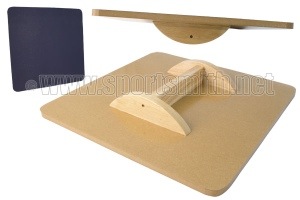
20121214-101308.jpgYou’ll notice a common theme here. All of the tools (toys) listed here are designed to help you improve balance and proprioception. These skills carry over in spades to all your athletic persuits: running, cycling, skiing, surfing, climbing, kiteboarding, football, basketball, tennis,  and possibly even bowling. Rocker boards are a great tool to teach you how to stabilize your foot and ankle. Hard unstable surfaces provide an optimal training environment to improve you. You should look for a board that only rocks in one direction (thus the name rocker board). Many folks also make boards that wobble and spin in all directions (called wobble boards). Both have their place, but when it comes to training the foot and lower leg, I’m a big fan of the former. These are sold in many places. If you are looking for suggestions, I typically direct people over to sportssmith.net because they have the cheapest one I’ve found: $29.99.

#2: Surfing in your living room – meet the Si-Board.
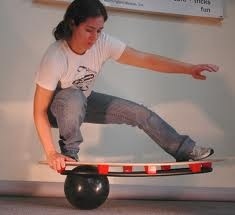
20121214-101324.jpgSo you’ve mastered basic balance skills, and are looking to quite possibly have as much fun as possible while under your roof? Look no further than the Si-Board. Sure the Indo Board is cool, but this thing is in a class by itself. I have one and absolutely love it. Its so much fun! Its not one of those things you’ll say “oh I have to make time to work on my balance……” Its so engaging that you may find yourself taking time away from other things! Your feet and hip stabilizers will get a workout like nothing else. They are pretty $$$$. I bought the DIY creator kit for cheap, and in 45 min was “surfing” in my living room.  In my mind, if you are an athlete, you should have one of these. Period.

#3: Surfing down the pavement –> Longboard.
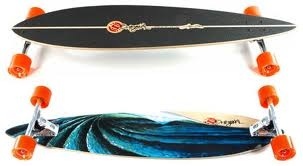
20121214-101339.jpgPresents are all about fun right? Buying a long board was one of the best decisions I made. Its not like hucking off the loading docks like we all did when we were 12. This is all about the flow. It’s great to carve slalom turns down the hill – almost as much fun as skiing or snowboarding. And once you learn to “pump it” you can fly. I can roll miles down the road without pushing at all. I guess some people might say its a great workout, but its so much fun I’d do it even if balance skills didn’t translate into other sports. What board to get? wow – there are hundreds of options out there. Personally, I’ve got a Original Pintail 40. I bought it because it has springs instead of bushings. This makes it easy to rail turns at low speed and a bit tougher to control at high speeds, but lets’ face it: Most of us aren’t looking to hit 50 mph down a mountain while slamming a RedBull.  Only warning I’d offer is this: you may find yourself longboarding more and doing your typical sport a bit less!

#4: a book? Maybe a book called Anatomy for Runners! Its by far the cheapest thing on this list, and quite possibly the most valuable. I’ve spent many years of my life teaching. I’ve taught at UVA and continue to teach around the US. You’ll be surprised what people are capable of when you give them the knowledge to succeed. That was the goal behind my book. Its a way to give you information to help you hit your goals this season and beyond. Sure its slanted towards runners, but about 80% of the information in there applies to other endurance and strength and power sports as well.

If you are looking at the equipment above and thinking “that’s a bit high level for me-  no way”……let’s put something out there. Blowing past your comfort zone is the only way you’ll ever make jumps to the next level in your performance. And yes, I’ve put “old folks” on these with tons of success. Sure you should be careful when you are learning, but I will caution you that liberal use of #2 and 3 above just might result in fun!

Disclaimer for the people who think I’m funding my retirement with these recommendations. I personally bought the Si-board starter kit and my Original Longboard (in fact I bought a second one too!), and my clinic purchased the rocker board form Sports Smith. These folks have no idea that I am writing this, and I’m getting absolutely nothing in return.

Well, with the legal mumbo jumbo out of the way, Happy Shopping, and Happy Holidaze!!!

And if you’d like to re-live a little Christmas story from last year, check out how Climate change is impacting reindeer training.