Tag Archives: triathlon

South by SouthWest Festival: When Biomechanics Attack

Check out the report WIRED magazine did of my talk with ESPN writer Henry Abbott at SXSW music festival. Likely the only time I’ll get to say I presented at the same conference as Al Gore, Bruce Springsteen, Seth MacFarlane, Jay-Z, and Jeffery Tambor (unfortunately not on the same stage at the same time!)

Nice summary, except they didn’t really get one critical point across. You CAN improve your hip flexibility and your hip strength!

Check out the WIRED article here and check out this link I did for Runner’s World a while ago on improving hip mobility


Proprio-what? a deeper look at balance and stability

Yesterday’s post got lots of comments; I’d like to post a bit more here to help folks understand this concept a bit deeper. Why does this idea about balance matter at all to runners? Midstance is basically single leg standing balance. However there is a difference between “reactive balance” and “proprioceptive control.”

Let’s define a few terms here:

Strength – relates to the cross-sectional area of a given tissue. This is related to the muscle’s ability to generate force. Bigger muscle, bigger force. Simple.

Proprioception: there are 3 primary things we use for balance.

  1. Vestibular  (inner ear) – If you are standing still, inner fluid is still. If you turn your head suddenly, the inner ear fluid swirls and this information goes to your brain to help determine acceleration and change in position.
  2. Somatosensory – You “feel” the ground. You have sensory receptors in your skin which allow you to feel something – light and deep pressure, vibration, heat, cold, etc. This sensation goes a long way to improve your tactile feedback to help you remain stable.
  3. Vision – We use our eyes to orient our head and trunk and let us know which way is “up”.

Note- you do have other reflexes that play a role here, but these are the primary ones that have the greatest effect.

If these 3 systems “agree” then you are using your body as best you can to achieve control in stance. So let’s look at examples of how these can change. If you are on a merry go round, your eyes see you are spinning, your somatosensory feels the body turning, and your vestibular system says you are spinning. Everything is fine. If you stop, your eyes and somatosensory system say you have stopped, but your inner ear fluid is still swirling – signals don’t agree….. and you become dizzy.

So why is it harder to close your eyes in single leg balance? Most folks are visual dominant. They rely highly on their eyes to find their position in space. The problem with this is that it’s “slow.” You need to see information, process it in the visual part of your brain, then send a signal to the part of your brain that control motion (motor cortex) to make a correction. Somatosensory information is very very fast. There is a direct relay between the sensory and motor reflexes both inside and outside the brain – resulting in fast rapid “micro-corrections” of position. Let’s use an example.

If you look at skiers, surfers, skateboarders, white water paddlers – they all have something in common – they need to make positional corrections VERY quickly – faster than they can see visually and adjust. They get good feedback about the position of their body from their hard ski edge (transferred up through a very stiff plastic boot), or the rail of the surf board (transferred through their bare feet). Each and every time they practice their sport they are refining their position sense by “feeling” where the body is. They consistently train and improve their somatosensory system.

Research shows that the somatosensory system is highly trainable. Its best done frequently in small doses. Instead of trying to balance on one leg for 10 min each night, its better to do it 20x’s a day for 30 seconds. Yes, you CAN improve your balance….by practicing.  Not your “I’m-rocking-back-and-forth-like-a-weeble-wobble” re-active balance, but your “proactive balance.” Proactive balance means “I know what to do to keep my body stable – I can micro-correct to improve my stability.” Think about spreading your toes out wide to maximize the width of your foot. Try to push your big toe down – not curling, just down as you keep it straight. This will improve your muscles firing inside your foot. I’ll make a deal with you – if you work on your single leg balance every day, you’ll find not only will you be able to stand with eyes closed, but also be able to begin to rotate left and right with your eyes closed. The goal is to reduce your dominance on vision and improve your use and perception of “feel.” It works!

OK – so let’s now look at this with respect to running. I’m going somewhere with this I promise – I’m building a case for you. There is a ton of research that supports the idea that firm surfaces offer better “feel” to the individual and thus better balance control. Soft surfaces mute the feedback to the person and result in poor stability in stance. The goal is to maximize your level of active stability control that your body can produce.

If I am in the clinic working with a patient, I always work them in barefoot, and will use all kinds of rocker/wobble/rolling boards to do this. All of these are FIRM and HARD surfaces. Even though the foot is moving, the contact between the ground and the foot is solid. The person gets good feel for what is happening. I am not a proponent of foam pads to work on balance. Why? Foam pads let you cheat and roll off to the outside of the foot. They don’t mandate that you activate the big toe. They don’t train “pro-active control.”

Let’s take this idea and now apply is to footwear and the entire rationale for you reading this post. What is traditional footwear? – It’s got an elevated heel, a wider lever arm than your foot, and a big marshmellow stuck underneath. This marshmallow allows your weight to shift to the outside of the foot. The heel-higher-than-the-forefoot provides a “rocker” in front of the shoe that you can simply roll off of. It lets you “cheat” by conforming to your foot. A lot of runners have gotten used to this.  Their feet have become weaker as the shoe does more of the work.

When we look at minimal footwear or barefoot running, this foam pad is gone completely or reduced significantly.  Suddenly, you can’t cheat. You have to actively use the muscles inside the foot to stabilize. The absence or reduced cushioning in the shoe allows you to get better “feel”  – why do so many proponents of barefoot and minimalist running claim that they feel “free” or like they’ve “been released”…….? It’s simple – your foot gets more information from the surface you are on when you don’t have a big piece of compressible foam in the between. More information  = better muscle activation.

I see a hand up in the audience.

Q: So I’ve been running for years and I still can’t stabilize with my eyes closed. What gives?

A: closing eyes might be slightly overkill, but you know what? – Almost every standardized assessment for balance testing has an eyes-closed component to assess just what we mentioned above (the 3 things that impact proprioception). So if you have good balance with eyes closed, I know that you are good in this regard and not going to ask you to add this into your training program. It allows the examiner to differentiate how well you use different skills that affect balance. If the eyes closed part is the issue, and this is connected to faulty foot and ankle mechanics during running, it give me more information as to what your limiters are as a runner.

Q:  So I’ve been running for years, and I still can’t stand on one leg – even with my eyes open. What gives?

A:  There is no research to show that your poor balance will result in injury, but there is research to show that those with a number of lower extremity injuries do have poor balance. Further, I’ll be happy to say that those with poor single leg balance almost always have some very interesting finding in our lab – they usually have altered forces around the ankles which results in abnormal stresses to the lower leg and foot. Improving your single leg balance is a way work on prevention. I’d much rather you not get hurt and keep enjoying your runs, than not. Maybe you are one of the lucky ones who has run for years without injury – awesome! However, research shows that 82% of you runners will be hurt at some point. Both personally and professionally, I’d rather see you in the 18% of those who are not.

Loading Rate: Part 1: What does it mean for you?

I was at a conference recently where someone asked me –  “With all the fancy equipment and data you’ve got access to, what it the biggest thing you’ve noticed and how has it made you change your personal running style?”

Easy! I’ve learned through the years, that it’s critical to minimize loading rate. Loading rate is the speed at which you apply forces to the body. While running, you aren’t going to change your body mass during a run  (OK –I know you do slightly due to hydration issues, by let’s ignore this for a moment). Your total mass stays relatively the same. However, how you move your body’s mass forward when running does play a major role in the way your body is affected by the forces we see in running.

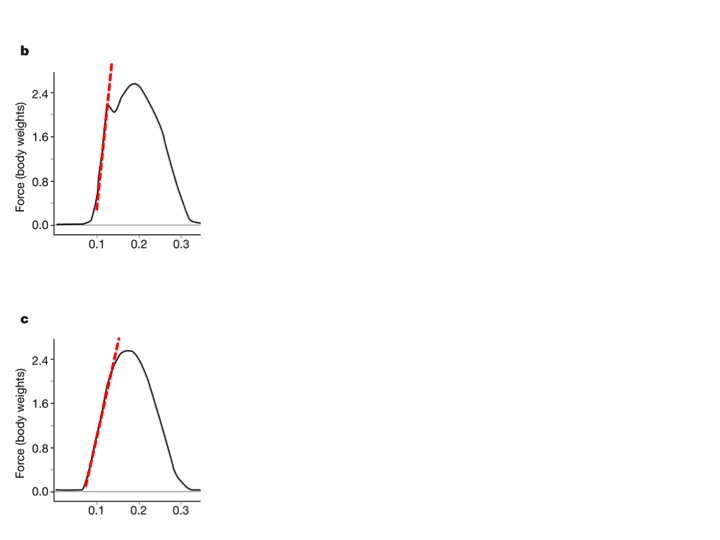
In the lab, loading rate can be objectively measured. Some labs use accelerometers to determine peak values and rates, some use the slope of the ground reaction force. Both have been investigated as viable ways to assess loading rate. We’ll use slope of the ground reaction force (GRF) since it’s a bit more visual to help get the concept across. If you look at the graphs, you’ll see that the one graph has a steeper slope to it than the other. The steeper slope (top graph) means that the forces applied to the runner occur quicker than that of the forces applied to the less steep slope (bottom). Why does this matter?

Imagine running 50 miles a week. Think of the amount of wear and tear that occurs on the body. Now imagine running 50 miles a week with a gait pattern that causes the mechanical loading of the body to occur less quickly. Decreasing the loading rate applied to tissues will minimize tissue stress to the runner, minimizing the effects of the micro-trauma of endurance training. The rate at which structures are loaded has been implicated in both stress fractures and soft tissue dysfunction (1, 2)

Now  – full disclaimer here, there is some discrepancy in the literature on whether or not the “impact peak” actually causes injury. This post is not going to debate the presence of the impact peak itself, only the difference between running with a high loading rate (not good) or a lower loading rate (better). Should everyone go lower and lower? There is a point at which the metabolic cost of lowering the rate of loading to the tissues is more expensive from a metabolic standpoint. Further, there is likely a lower limit to what one’s loading rate can be. These are questions that need to be answered individually with a lab analysis, as it is speed and mass dependent and not one-size-fits-all.

There are 3 primary ways you can affect the rate at which you load the body:

1.Contact pattern
2.Postural alignment
3. Limb stiffness

Tomorrow we’ll discuss how these 3 factors impact the loading rate of a runner….including directly addressing a lot of the hype around fore/mid/rear foot contact styles – Stay tuned!

References:

1. Milner, C.E., R. Ferber, C.D. Pollard, J. Hamill, and I.S. Davis.  February 2006.  Biomechanical factors associated with tibial stress fracture in female runners. Med Sci Sports Exerc.  38(2):323-8.

2. Milner, C.E., J. Hamil, and I. Davis.  July 2007.  Are knee mechanics during early stance related to tibial stress fracture in runners? Clin Biomech.  22(6):697-703.

They said I’ve got pronation….How long do I have doc?

So you went to the “insert giant athletic store here”, and the 16 yr old kid who works part time for the summer, who is the “expert” on running watches you for about 30 seconds, and decides to tell you that you in fact, pronate. Or worse…..maybe you even over-pronate. Never fear though, they say! They’ll just go in the back and grab some of those big mutha shoes to totally stop you from pronating and be your personal savior.

Before you plunk down your hard earned cash, we should probably come to terms with a few things.

  1. What is pronation?
  2. When does it occur?
  3. Can you stop it, or should you stop it?

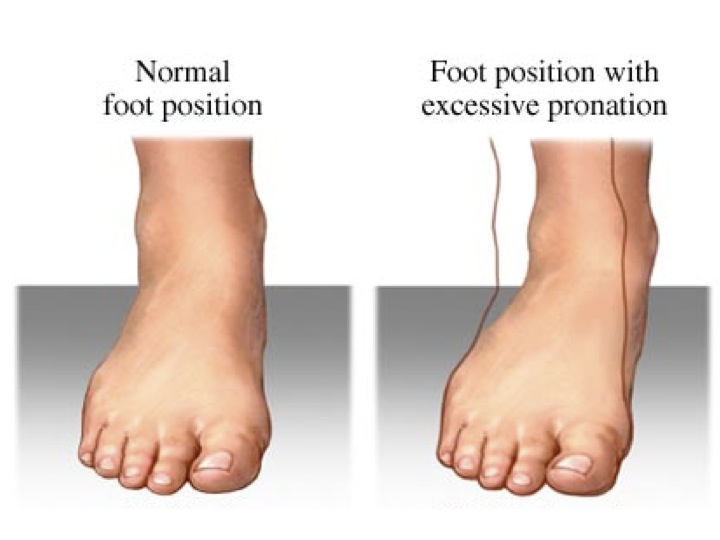
1 – First, let’s re-cap what this pronation stuff is all about. Pronation is not bad; in fact, it’s the body’s natural shock absorption mechanism. When the foot moves into pronation, it becomes like a loose bag of bones. Everyone pronates to some extent. Some more than others.  If you didn’t pronate, you’d have problems with- you guessed it- shock absorption. The opposite of pronation is supination. In supination the bones of the foot become more congruent (increased contact between the surfaces of the joints). This increased contact produces a rigid lever for push off in gait. So we should land in a supinated position, and move to a more pronated position during stance to decrease shock, and then move to a supinated position to achieve a rigid lever for push off.

Let’s re-cap this again using America’s favorite national pastime, Tetris. When the pieces fall from the top of the screen, we can move them about and rotate them freely. They can move. This is how the 26 bones in your foot function in the shock absorption or pronation phase. They should move about to dissipate force. Now imagine those same Tetris pieces once you’ve placed them in the stack. They can’t move right? They become congruent and are locked in place. This is similar to the foot when you are in supination.

2- Now that we understand pronation as something that is not really bad; let’s talk about when it occurs. As evidenced in a study carried out in our lab and published in the Journal of Orthopedic and Sports Physical Therapy, maximum pronation of the foot occurs after the heel has left the ground. Why does this matter?  Remember that 16 yr old kid? He’s going to grab a shoe off the rack that is a motion control shoe –designed or should I say marketed, to stop pronation.  A shoe like this features a higher density material on the inside of the shoe. The claim is that this different density material acts to stop the pronation from taking place, thus fixing your issues. If you’d like to see if your shoe has this, just look at the inner side of the midsole (marsh mellow stuff between the fabric upper and tread). If some of the inside of the shoe is a darker color than the rest, it’s likely a “dual density midsole design”.

OK – so let’s get back to timing of pronation. Shoe companies put this increased density material to “stop the foot from pronating”. Well, we found out that maximum pronation occurs after the heel is off of the ground. So guess what? – All that higher density material in the shoe isn’t even touching the ground to try and stop the foot from moving at the time when the foot is moving the most! Hmmmmm……makes you think doesn’t it?

3- We know what pronation is, and when it occurs, and now we should address the question of stopping pronation. Pronation is necessary. I’ll even say in the right amounts and at the right time, its good. I’ve seen PLENTY of runners who have problems because they don’t pronate enough. However, stopping pronation isn’t really in our best interests. It’s better to learn to stabilize the amount of pronation. The thing is that no shoe can do this- you need to learn to use the muscles in the foot and the muscles in the hip to stabilize the rotational motion that naturally occurs in your legs. Can you do this? How good are you at stabilizing your pronation? A visit to the SPEED Clinic can help you pin point your issues and fix them for good.

Parting thought –please don’t read this and think that we are saying that shoes don’t make a difference. They do. The objective research we do combined with our clinical experience has proven to us that they make a huge difference. We view footwear as part of an intervention to help you perform at your best. Shoes are very different. How much of a shoe you need, or weather you even need a shoe at all (barefoot running anyone?) are all part of a comprehensive assessment here at the University of Virginia.

Adjust your thermostat, adjust your expectations

Wow. If you are on the east coast like we are, we don’t have to tell anyone that its been H.O.T.
“But wait……..don’t the weather gods know I supposed to be training for the ___ championship in __weeks ….not to mention the ___ race I’m doing this winter. My workout today was slow, and I felt bad on my long workout this weekend. I’m getting slower and this heat is killing my training!!!!!”
If you guys want some tips on running in the heat, there are some great words of wisdom on this blog if you scroll down. Let’s re-cap: – hydrate, run in the morning, hydrate, loose fitting and light colored clothing, and hydrate. OK fine – but lets get real on this summer’s weather and why we need to take it into consideration.
Last year in C’ville, we had 7 days above 90 degrees and they were scattered about the summer. Except for a small 2 week heat wave in the middle of the summer, it wasn’t all that hot all the time. You had the luxury of moving workouts a day or 2 ahead or behind in the week based on the heat. This summer, we’ve had 45 days above 90 degrees. We’ve had 7 above 100. And let’s be honest, its not really cooling off all that much at PM or in the AM (Friday night was 96 degrees at 9:00 PM!). Its been so hot that all outdoor high school and collegiate practices would be completely cancelled in weather like this. National and State sports governing bodies have established these regulations to protect the athletes. I know – you are tougher than them and need to get your speed work session in today though…….stay with me.
Dealing with this heat is all about adjusting your expectations. Let’s  re-state this point to be absolutely clear: Trying to train at your same intensity and volume (or increasing it) in this type of weather is NOT a smart thing.

If you don’t agree with me, let’s look at it from your body’s perspective. When you exercise, you ask your body to metabolize fuel stores, regulate energy balance, and produce mechanical work so that you can move from point A to point B. All this effort produces heat. Your body has a lot of internal mechanisms to regulate body temperature, and they work pretty well. But your body has limits as to how rapidly it can cool itself off. Did you know that your body actually begins to compromise its ability to perform at around 72 degrees? Now think about how much challenge a 95 degrees environment places on that body.

Still not convinced? Let’s say that your typical Wednesday morning track work out is 12x 90 second 400 repeats, with 45 seconds between each. Think about how much stress that places on the body under normal conditions. Now let’s consider our weather reality. Its now 10-15 degrees hotter than usual and more humid. Trying to run that same workout under these conditions is significantly more stressful than typical. You may notice that you can’t make the 90 second split without taking more rest between reps. You may even notice that under these conditions, 90 seconds is not even possible. Let’s say that your triathlon training schedule has you doing a 5 hr ride on Sunday AM. However, the heat has slowed your pace down significantly after 2.5 hrs, and all you want to do is jump off the bike into a cool pool. Its OK to back off the workload to match the change in conditions – you’ll STILL GET THE BENEFIT OF THE WORKOUT. Shorten the ride. Increase your rest. Take longer breaks between intervals. Do whatever it takes to be consistent with your training, but realize that extreme weather requires some modifications to ensure we aren’t just pounding ourselves into the ground. Remember- you’re body doesn’t really know exactly how fast its going or how long a rest you are taking; it just knows that you are pushing it harder than you have in the past and with all this heat, it just might push back.

This post is written in memory of a local high school runner who died of heat illness during a summer training run.


Runner’s World asked us: What’s the single biggest problem in running?

When most runners, coaches, running shops think of the single biggest problem that affects runners- the answer usually points to the most feared word in running – “over-pronation.” However, we told Amby Burfoot  (link here) that our years of experience quantifying running mechanics through the use of 3D gait analysis has shown us otherwise.

While it’s true that some of us out there may pronate more than others, it isn’t exactly what we’d call an epidemic problem in America. We’ll estimate that less than 30% of runners truly over-pronate (excess motion in the foot) their feet while running. To find the real answer, we need to move up eyes up and look at the hips.  About 80-90% of runners don’t extend their hips.

What is hip extension anyway?

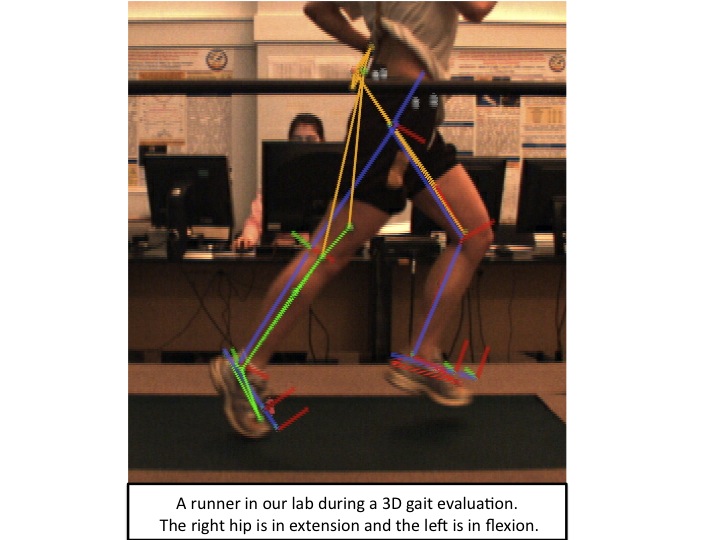
Lifting one knee up to the chest moves the hip into flexion. If you extend the hip the opposite direction (past vertical) that is hip extension. The goal is to do this without extending your back. Stretching your hip flexors to get more motion is the key

So why don’t most runners extend their hips?

We tend to sit. A lot. We sit in class. We sit at work. We sit in our cars. Cyclists, you spend all your time on the bike sitting in hip flexion. When we continually sit in hip flexion, the hip flexor muscles become tight. So tight that the overwhelming majority of runners can’t extend the hips. “Now wait a minute” – you might say –“I see all my friends and their leg does get behind them when they run – so they must be extending their hip right?”

Tight hip flexor muscles cause you to get your leg behind you not from extending your hip – but by arching your lower back. This can cause injury since an arched lumbar spine compromises our ability to use core muscles while we run. This sets us up for a host of leg injuries and also is the most common cause of low back pain in runners. Further, lack of hip extension compromises your running efficiency.  As we increase speed, the bulk of the work supplied to the legs need to come from the hips. Well, if you can’t extend the hips, you are missing out on critical force to move your body forward.

So how do I get hip extension and is it really that simple?

You’ve got improve your range of motion of the hip, and your ability to control the new motion. The best hip stretch is a kneeling hip flexor stretch. Beware though, a lot of the videos on-line show incorrect form for this stretch and you don’t actually wind up extending your hip flexors at all (they stretch the quads).  Check out the July 2010 issue of Runner’s World for an article we helped them put together. It shows correct technique to stretch the hips, and some simple exercises to learn to use your new range of motion.