Tag Archives: stress fracture

Do shoes have feelings ?

Let’s say you are out for a night on the town. Your significant other turns to you and says how do you like my outfit? Unless you answer this question perfectly (still not sure how to answer this even after many years of marriage!) you may notice that your significant other withdraws for a while to cool off. Could be a few minutes, could be for the night, but this time away allows things to mellow and return to a state of bliss yet again. What does this have to do with shoes?

It’s common practice for a lot of runners to have multiple pairs of shoes at one time. This though process behind this has been that running in a shoe breaks down the cushioning properties of the shoe, and it takes time for it to rebound before your next run.

Well, Let’s look at some objective information on this subject. This is not going to turn into a discussion of minimal shoes vs. traditional construction. We are simply going to look at what happens to the properties of the midsole itself. The midsole is the squishy part of the shoe that lies between your foot and the tread. Its commonly made of a chemical compound called ethyl-vinyl acetate (EVA). Shoe manufacturers manipulate properties of the midsole to get their shoe to perform a certain way. Obviously a minimal shoe has less of this midsole material in it then a traditionally constructed shoe, but they both have some type of cushioning material between the foot and the shoe tread.

As you run, you are applying mechanical forces to the shoe itself. These forces physically break down the midsole. In fact, lets look at this at the microscopic level. The following picture is from a study (1) that looked at the state of the midsole at various points in the shoe’s lifespan. In fig A, you are looking at an electron micrograph cross section of a brand new shoe. It’s easy to see the outline of the well defined air pockets in the midsole. This intact formation allows the midsole to perform as it was designed. Fig B shows a cross section of the midsole after 500 kilometers (310 mi). This type of magnification allows you to see that the edges of the former well defined air pockets are now frayed and weakened. Finally, Fig C shows the midsole after 750 Kilometers (466 mi). It is now possible to see that the majority of the air pores are frayed, and in fact some of them have actually deformed enough to create holes. Thus, the structural properties of this midsole material are now very different from what they originally were when new. While your body can repair tissues that have been affected from mechanical stresses in running, your shoes cannot. Resting your shoes by the front door between runs won’t reverse these changes.

While it’s probably a good thing to be nice to your shoes (running in wet environments with no chance to dry out may accelerate breakdown of the midsole), they don’t have feelings. You can pound on them day in and day out  – even 2 runs in the same day. The breakdown of the material in your shoe is cumulative. So what happens to our gait as shoes breakdown?

A 2009 article (2) revealed that running in worn shoes caused the runner to increase their stance time (time spent on the leg) and alter their lower leg range of motion in order to keep forces on the body somewhat constant. What does this mean? As your shoes break down, the body will slightly alter its gait style adapt to the gradual changes that occur in the shoe itself.  When do these gait alterations reach critical mass (causing injury if you don’t buy new shoes)? Shoe breakdown is variable depending on the runner’s mass, running surfaces, and gait style. I know runners who note that they become injured if they put more than 250 miles on their shoes, and I know runners that put well over 1200 miles on a single pair. The old school rule of thumb states 400-500 miles, and is likely a good starting point based on the research stated above.

Happy Running!

  1. Verdejo, R. , Mills NJ. Heel-shoe interactions and the durability of EVA foam running-shoe midsoles. J Biomech. 2004. Sept; 37(9):1379-86.
  2. Kong, PW., Candelaria, NG., Smith, DR. Running in new and worn shoes: a comparison of three types of cushioning footwear. Br J Sports Med 2009 43: 745-749

Loading Rate: Part 2: Forefoot, midfoot, rearfoot……..Who cares?

Yesterday we briefly discussed the idea of loading rate, and why it matters to you as a runner. Today we’ll talk of the 3 primary ways runners can change loading rate, and likely dispel some myths while doing so. If I ruffle some feathers while doing this, don’t get frustrated. Its good to stretch you brain.  Let’s look at what we do know about loading rate, and what is a bit fuzzy.

Methods to decrease loading rate involve a combination of:

  1. A foot contact style closer to the body’s center of mass
  2. Minimizing excessive lumbar extension (which shifts the body’s center of mass posterior in relation to foot contact)
  3. Changing limb stiffness through feedback training.

****Warning – some of this gets a bit tedious, but there has been a lot of request for this information lately, so lets dive in shall we?

Let’s get right to the hot topic. Should you land on you forefoot, midfoot, or rearfoot?

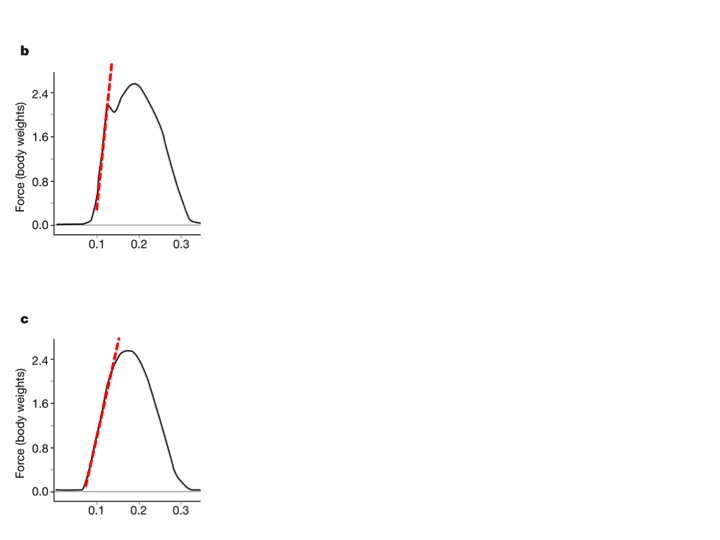
Right below, is a graph of a runner landing with a midfoot gait. You’ll notice a very distinct impact peak (first bump) and a larger active peak (second bump). You’ll also notice that the slope of the first bump (from the x-axis to the top of the first bump) is quite steep.
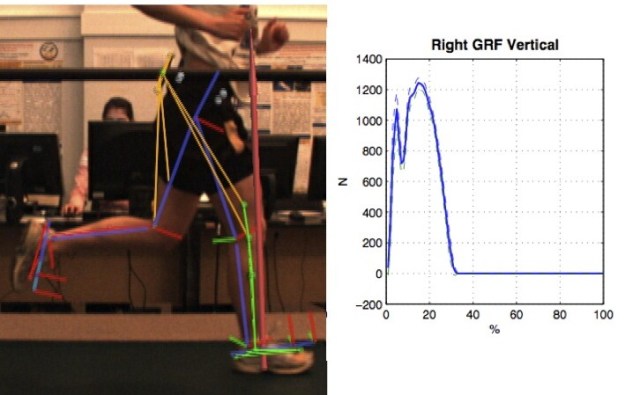
What kind of foot contact pattern made this graph? Nope – not a heel striker – but a midfoot striker. In fact this woman is about as midfoot as possible – her foot came down completely flat down at contact. I know ….this runs counter to a lot you’ve been told right? Hold on – let’s keep going.

Now look at runner #2’s graph. Notice the single mountain (or peak). Notice that the slope of the line from contact to peak is quite less steep than that of Runner #1. A LOWER loading rate! Guess what kind of contact style this runner utilized? A heel-strike. Yes. You read that right. A heel striker had a lower loading rate than a midfoot striker …..in this situation.

What gives? The media tries to make things simple. They say that “mid-foot” or “forefoot” is better than rearfoot. I love reading running forums where people with way too much time on their hands armchair quarterback running styles. They look at a picture or video of a contact pattern of some guy running across the screen and say “wow – nice midfoot strike –that runner is efficient.” They don’t know who the runner is, or what his time was for the race. They just saw a foot strike and proclaimed him efficient. Then they’ll scroll down and see some picture or video of some guy heel striking and proclaim that he/she is an “in-efficient” runner based on the heel strike. This “in-efficient” runner might be an in-efficient runner. Or it might be Meb Keflezighi (a runner who is just a bit faster and more efficient and than most of your reading this post).  You see, these arm chair-quarterbacks aren’t very good at identifying efficient gait. Fancy force plates are. I do this for a living and still need data from my lab to give me the answer because no one can actually see forces. So what have we learned from these fancy force plates?  Its NOT rear-foot or midfoot or forefoot that matters – its where the foot contacts in relation to the body’s center of mass.

As I stated above, I picked some outliers just to make a point. It is true that for MOST runners, adopting a midfoot or forefoot gait style will lead to decreased loading rates. However, its not because the foot lands differently, its because a rear-foot style typically allows you to land with the foot farther in front of the body’s center of mass (over-striding). Switching to a contact style that moves the foot closer to the body’s center of mass usually means that we land closer to the font of the foot. But not always. Let’s look at the elite runners to dig a bit deeper.

To run really fast, it’s very simple. You either increase your stride rate or your stride length. Simple right?

  • Stride rate- this is also referred to as cadence. Cadence ranges in cycling are pretty variable. Cyclists use anywhere from 45 – 140 rpm in competition, depending on the event and terrain. When we look at running, you’ll notice that cadence for middle distance through marathon distance typically ranges from 88-96 rpm. This is a much narrower effective window than cycling. We’ll look more in depth at cadence in a later post, but for right now, its safe to say at the elite level, there isn’t a huge difference in cadence values.
  • Stride length –if cadence values are held fairly consistent, the only other way to run faster is to adopt a longer stride length. The stride length of someone running 4:30 miles is significantly longer than running 7:45 miles. What we see is that a number of the elites land on the rearfoot, but their center of mass is still very high up at the time of contact. When running, you are a projectile in the air with your center of mass following a parabolic curve. So even though the elites often “contact” on their rearfoot, they don’t really have much pressure (force) on it until their center of mass lowers to the ground.  This effect produces a low loading rate with a heel contact, and is exactly what occurred in runner #2 above.

So let’s summarize what we’ve said about contact foot contact style. For most runners, landing closer to the body’s center of mass is an effective tool to lower loading rates. Barefoot running, minimalist running, and increasing cadence (faster cadence means you don’t have time for your foot to reach out far in front of the body) are all effective tools to accomplish the end goal of decreasing loading rate.  This being said, contact style is NOT the only way to decrease loading rate. Its possible to have lower loading rates with multiple foot contact styles, and other factors as well.

***Note: Unless the person is accelerating, it is not possible to have the foot contact directly under the center of mass. At steady state, the foot does (and should) contact in front of the center of mass.

The effect of posture

We said that, in general, a foot contact closer to the center of mass would decrease loading rate. On the flipside, posture can be utilized to alter the center of mass in relation to the foot. Most of us stand, walk, run, etc with poor posture. Take a look at the runner below. The runner is in exactly the same phase of gait, except for a more arched low back on the right than on the left. The posture on the right is typical to most runners. We hang out in the “back seat” with lots of arch in the low back. This change in lumbar position moves our center of mass backwards thus causing our foot to land further in front of the center of mass.  Therefore, keeping a neutral lumbar spine (not arched) is essential to keep our center of mass over our foot when running – and has the effect of minimizing loading rate.

Lastly – gait cueing and limb stiffness. Here’s where things come together, but also show need for additional research. In our lab, when we get someone with high loading rates, we show them their ground reaction force plots in real-time as they run, and ask them to change it. Normally, we don’t tell them how, we ask them to “play” with their graph shape as they run. Most runners figure out how to minimize their loading rates by getting visual cues, or feedback. This is the best way since the runner is aware of the conscious modifications they are doing to alter their loading rates and can see instant feedback to observe success – thus learning! If they don’t “get it”, we guide them through the technique modification so they can see the effects of their form changes as they run. Again – the goal is to get the runner to retain this sensation so they can alter their gait to make long-term changes to decrease tissue stress.  On the simpler side, research has been done that simply told runners to “run soft”. These individuals were found to decrease their loading rates. Gait cueing works. How does it work? People modify their contact style, posture, and their limb stiffness to achieve a desired result. Limb stiffness relates to how compliant the runner maintains the knee to modulate the rise and fall of the center of mass. There is more work to be done here to dig deeper, but this should hopefully answer the bulk of questions for now.

Summary:

What does this mean for you as a runner?

There is mounting evidence that minimizing loading rate has vast implications for a number of injury prevention strategies. There is also mounting work to show links to performance, though this is inconclusive at this time. There is additional work to be done to show how the gait style changes observed with decreased loading rate correspond to improved performance. Another topic for another day……

If you want to try to decrease your loading rate, you need to get your foot to land closer to the body. Barefoot running is a good drill for this since it “forces” you to avoid over-striding.  There is evidence that a properly constructed minimal shoe should also lead to minimal loading rates (although no one can say all minimal shoes since the definition of this market sector is so vague). Keep your torso centered over your lower body and avoid the temptation to run in the “back seat”, especially as you fatigue.

Run Tall! Run Soft!

Yup…. Less (loading rate) = More.

Loading Rate: Part 1: What does it mean for you?

I was at a conference recently where someone asked me –  “With all the fancy equipment and data you’ve got access to, what it the biggest thing you’ve noticed and how has it made you change your personal running style?”

Easy! I’ve learned through the years, that it’s critical to minimize loading rate. Loading rate is the speed at which you apply forces to the body. While running, you aren’t going to change your body mass during a run  (OK –I know you do slightly due to hydration issues, by let’s ignore this for a moment). Your total mass stays relatively the same. However, how you move your body’s mass forward when running does play a major role in the way your body is affected by the forces we see in running.

In the lab, loading rate can be objectively measured. Some labs use accelerometers to determine peak values and rates, some use the slope of the ground reaction force. Both have been investigated as viable ways to assess loading rate. We’ll use slope of the ground reaction force (GRF) since it’s a bit more visual to help get the concept across. If you look at the graphs, you’ll see that the one graph has a steeper slope to it than the other. The steeper slope (top graph) means that the forces applied to the runner occur quicker than that of the forces applied to the less steep slope (bottom). Why does this matter?

Imagine running 50 miles a week. Think of the amount of wear and tear that occurs on the body. Now imagine running 50 miles a week with a gait pattern that causes the mechanical loading of the body to occur less quickly. Decreasing the loading rate applied to tissues will minimize tissue stress to the runner, minimizing the effects of the micro-trauma of endurance training. The rate at which structures are loaded has been implicated in both stress fractures and soft tissue dysfunction (1, 2)

Now  – full disclaimer here, there is some discrepancy in the literature on whether or not the “impact peak” actually causes injury. This post is not going to debate the presence of the impact peak itself, only the difference between running with a high loading rate (not good) or a lower loading rate (better). Should everyone go lower and lower? There is a point at which the metabolic cost of lowering the rate of loading to the tissues is more expensive from a metabolic standpoint. Further, there is likely a lower limit to what one’s loading rate can be. These are questions that need to be answered individually with a lab analysis, as it is speed and mass dependent and not one-size-fits-all.

There are 3 primary ways you can affect the rate at which you load the body:

1.Contact pattern
2.Postural alignment
3. Limb stiffness

Tomorrow we’ll discuss how these 3 factors impact the loading rate of a runner….including directly addressing a lot of the hype around fore/mid/rear foot contact styles – Stay tuned!

References:

1. Milner, C.E., R. Ferber, C.D. Pollard, J. Hamill, and I.S. Davis.  February 2006.  Biomechanical factors associated with tibial stress fracture in female runners. Med Sci Sports Exerc.  38(2):323-8.

2. Milner, C.E., J. Hamil, and I. Davis.  July 2007.  Are knee mechanics during early stance related to tibial stress fracture in runners? Clin Biomech.  22(6):697-703.

Stress Fractures

Stress fractures were first described in 1855 by a Prussian military physician who observed foot pain and swelling in young military recruits. He called the condition “Fussgeschwulst”. I don’t know what the exact translation of this is, but it doesn’t sound good. As stress fractures can translate to missed training and even a missed season for the runner, I recognize that the words “stress fracture” herald disappointment in the clinic. Early diagnosis and proper management will hasten the return to full training.

A stress fracture is the end result of the failure of bone to respond adequately to mechanical loads (ground reaction forces and muscle activity) experienced during exercise. Bone responds to strain by increasing rate of remodeling. In this process, bone cells called osteoclasts resorb bone, which is later replaced by even denser bone by bone cells called osteoblasts. Since there is a lag between the onset of bone resorption and bone production, bone is weakened during this time. If sufficient recovery time is allowed, bone mass eventually increases. If loading continues, however, microdamage can occur, eventually leading to a stress fracture. Simply put, stress fractures occur when we train too hard without adequate recovery.

In most studies of collegiate athletes, track and field accounted for more stress fractures than any other sport. In runners in general, the most common site appears to be the tibia (lower leg), followed by the metatarsals, navicular, and fibula. In track and field athletes specifically, however, navicular stress fractures predominate.

Stress fractures occur most commonly when the runner has experienced a transition in training. Common examples include increasing mileage too quickly and changing a phase of training to more intense training. The use of spikes during training has been proposed as a potential risk factor, but this has not been definitively proven. I see a lot of stress fractures in first time marathoners. Although many good programs for training for a first marathon with relatively low mileage exist, the constant increase in training is a challenge, especially when the long run distance exceeds the amount of running done during the remainder of the week. The runner with a stress fracture may experience only minimal symptoms early on. For example, one may feel a mild ache in the shins or on the top of the foot only after one’s long weekend run. As time goes on, however, the pain becomes more noticeable and occurs sooner. Pain is usually worst during or soon after a run. Rarely does pain associated with a stress fracture improve with running. One can usually identify a particular point which is most tender to touch. Since many stress fractures do not appear on xrays, a more sensitive test such as a bone scan or MRI may be needed to confirm the diagnosis.

Stress fractures may be classified as either non-critical or critical. Non-critical stress fractures include the medial tibia, most metatarsals, and femoral shaft. Medial tibial stress fractures cause pain on the inside of the shin and are often difficult to distinguish from shin splints. Point tenderness and progressive worsening while running are clues that may help distinguish a stress fracture from shin splints. Metatarsal stress fractures usually cause pain on the top of the foot, just above the toes. Femoral shaft stress fractures cause pain in the thigh, and are often diagnosed as a quad strain. The lack of a specific injury, however, should raise the suspicion for a stress fracture. Most non-critical stress fractures will heal with 4-6 weeks of rest (no running). For the medial tibia and metatarsal stress fractures, I will often prescribe a walking boot for a few weeks as in general this makes walking more comfortable and my experience is that runners typically get back to full training sooner if we take this more conservative step early on. During this time the runner may remove the boot for sleeping, showering, driving, and cross-training. I prefer deep water running, but the elliptical and bike are good choices, too. Try to pattern your cross training workouts to replicate what you would normally do on land. The return to run program commences after 4-6 weeks and progresses gradually. I often start the runners on a walk/jog program where they walk a minute/jog a minute for a couple weeks before they begin regular running. During the transition back to full training, cross training supplements the progressive run training.

Critical stress fractures are those that require special attention as they either require an extended time to heal or require limitations on weightbearing. They also carry risk of incomplete healing which could require surgical intervention if not addressed early. Critical stress fractures include the femoral neck, anterior tibia, medial malleolus, navicular, and 5th metatarsal. Femoral neck stress fractures present most commonly as groin pain, very similar to a muscle strain. Stress fractures, however, occur after repetitive activity and there is rarely a history of one particular “strain”. Anterior tibia stress fractures cause pain on the front of the shin. Medial malleolus stress fractures cause pain on the bone on the inside of the ankle. Navicular stress fractures usually cause pain on the top of the foot just in front of the ankle, extending into the midfoot. 5th metatarsal stress fractures cause pain on the proximal aspect of the 5th metatarsal on the outside of the foot. These stress fractures require special measures beyond a simple period of rest (i.e. crutches, casting, or bracing) and therefore pain in these regions should be evaluated sooner than later. If we can identify these before a fracture line develops, healing is usually uneventful. If a true fracture line develops, healing can become more challenging.

Fortunately for runners, most stress fractures are non-critical and will heal without complications. A high level of suspicion should be maintained when experiencing pain in the areas described for the critical stress fractures, especially if one has been increasing the volume or intensity of one’s training. If a few days of rest, ice, and cross training don’t eliminate the symptoms or if one is having pain with walking and other daily activities, evaluation is indicated. If you do experience a stress fracture, be sure to discuss appropriate cross training guidelines with your physician, as in most cases cross training can preserve a critical level of fitness as you recover.

See you on the roads!