Tag Archives: running form

Do runners with a ball “get it” more than runners?

The media at large has done a dis-service to you, the consumer. They love polarizing images. They love the battle between overly built-up clodd-hopper motion control shoes vs. naked feet. They try to instantly declare one “better” than the other. The reality is that the barefooot buzz has been incredible for ALL athletes. No matter which side of this polarizing topic you stand on, it has directed attention on form. And that’s one of the main things really.

Let’s clear out the sewer lines folks. Barefoot is very DIFFERENT from running in shoes. Sure a good number of folks switch their contact style from rearfoot to forefoot when going barefoot, but a lot DON’T. And while the media loves to harp on this one single factor, its like saying only one tree in the entire forrest is important. And that’s just not true.

Its not so much forefooot vs rearfoot here, its more about where the foot is in relation to the body that counts. Striding too far in front of the body results in bad things. Your feet were meant to be beneath you – not flying out in front. Imagine running over ice. Anyone feel safe over-striding on ice? Didn’t think so……But its not just “runners” who are beginning to take notice. Other “running athletes” are asking question too.

Recently, I had a conversation with basketball journalist Steve McPherson. He was asking me about the apparent rise of injuries in basketball, and wanted to know if anything from all this barefoot hoopla translates over to the hoop. Steve did an excellent job with this piece, “What can the NBA learn from barefoot running?” I recommend you take a look, whether you run with barefeet, wrapped feet, or a ball.

20120531-174049.jpg

What can you learn from a frustrated bird?

Here at UVA, I teach a course called Neuro-muscular Basis of Human Movement, and today we are speaking of all things running mechanics. One of my students made an analogy that actually tells us a lot about running. Well, the analogy doesn’t really tell us that much, but a host of really angry and pissed off birds will….. Yes–> those angry birds!

Angry Birds is a simple game ( if it’s so simple, why has our country’s gross national product dropped since its launch????) that forces us to abide by the laws physics. Your goal, of course, is to knock out those smirky smiling pigs at various locations. You learn very quickly that aiming too high blasts your bird up to the clouds, at the expense of sacrificing distance. Aiming too low also compromises distance. Aiming just right produces the greatest distance covered with a pull of the slingshot….. The fancy name for this would be the optimum trajectory

While you don’t have to land on a pig when running, you do try to cover a given amount of distance per stride. In fact, the definition of running economy would be to cover a given distance with as little energy as possible. Too much up and down motion while running wastes a lot of energy. Actually about 80% of the energy required to run comes from raising and lowering the body against gravity. So “aiming too high”- too much vertical rise an fall- is not a smart move.

A lot of people get this. The problem is that they take it to the opposite extreme. They tell us that we need to minimize the rise and fall of our body. Does this play out? Go play angry birds again, and aim your bird dead flat. Pull back all the way and watch your bird take flight….. It won’t go very far. Limiting the up and down motion of the body when running not only ensures you won’t go far with each stride, it also costs a lot of energy! Go for a run and try to keep your head as still as possible- you won’t be able to do this for long- its tough!

So what is best? If you try to get maximum distance per fire on angry birds, you’ll find that about 45 degrees gives you the greatest distance. So does this mean that you should aim for this when running? Well, not exactly. The body isn’t a bird, a cannon ball, or any other type of projectile. It’s an actively controlled spring that actually stores and releases elastic energy to help you move forward. Some amount of vertical rise and fall is actually beneficial to “load the slingshot” and store and release this elastic energy. Exactly how much depends on your body weight, your leg length, and your pace, and your contact time. A sort of nice number is around 4-6 cm of vertical rise and fall of the body typically produces optimal results. In labs like ours at UVA, we study this kind of stuff to tweak your economy.

The take home message is that some rise and fall is necessary, even advantageous, when running.* So when someone tells you that a runner is efficient because their head stays perfectly still when running, maybe you should hand them your smartphone and tell them to play a little game.

* note- excessive rise and fall of your phone, as in when you throw it against the wall after not beating a level for the 37th time, isn’t recommended.

20120405-104247.jpg

South by SouthWest Festival: When Biomechanics Attack

Check out the report WIRED magazine did of my talk with ESPN writer Henry Abbott at SXSW music festival. Likely the only time I’ll get to say I presented at the same conference as Al Gore, Bruce Springsteen, Seth MacFarlane, Jay-Z, and Jeffery Tambor (unfortunately not on the same stage at the same time!)

Nice summary, except they didn’t really get one critical point across. You CAN improve your hip flexibility and your hip strength!

Check out the WIRED article here and check out this link I did for Runner’s World a while ago on improving hip mobility


Are you ready for minimal?

Looking to get into “less” shoe? Don’t understand why you need to make some changes in your body to help this process? Looking for some help moving towards something new? Check out this month’s issue of Running Times to check out an article I wrote with my colleague, Dr Mark Cucuzzella, on a smooth and successful transition to minimal running shoes.

And if you’d like to see the print word come to life, check out the video “are you ready for minimal” by yours truly on the www.runningtimes.com homepage. Also on their youtube channel here.

When the Big Man in Red calls, you have to be ready

Thought I’d share this with you guys, because it’s a bit different than most of the cases I see here in the lab on a daily basis. So the phone rang on today. The caller ID just said “North Pole” – not knowing what to expect, I picked up and surprisingly spoke to Ms Claus! She spoke very frantically. Santa was overheard in the background, and did not sound jolly. One of their athletes was down for the count less than one week before the big day, and they were in serious need of our services. ASAP. Rudolph is suffering from Achilles pain, and can’t fly at race pace. At his current speeds, they’ll be about 8.5 hrs behind Christmas-Eve night delivery schedule. Kids on all sides of the world should all be able to wake up to their loot. Running late is not an option.

Seems like all this global warming has taken its toll on a number of fronts. Yes, its hotter, and more of you are driving Prius’s (or is that Priui???), and sea level is rising – but folks, reality is now staring you in the face…. and its taking your Christmas presents with it. Typically, the reindeer wind up their training volume when the snow starts to fall in the end of October. This year, October saw record high temperatures. Instead of training, the reindeer were sunning themselves at the lake. A typical week in October looks like this:

  • Sunday: light 6 hr hike through the woods
  • Monday: 8-mile Hill repeats (about 4,000 ft per climb) x 12 reps
  • Tuesday: AM Speed work: 10 x 1.5 miles, all negative split. PM workout: easy 5-mile flight
  • Wednesday: Flight training: Circumnavigation of Arctic circle x 3. 1st and 3rd easy, middle rep at tempo pace.
  • Thursday: Weighted sled training: 3.5 metric tons for 6 miles, 2.5 tons for 4 miles, 1.5 miles for 2 miles at 90% VO2
  • Friday: easy run to Canada and back, with 1 hr of fartlek
  • Saturday: Tempo intensity, all flight – equator and back. Goal time is around 2 hrs.

The Elves in the training room had to be pulled out to help with some last minute Xbox orders, and they are understaffed. So Donner and Blitzen volunteered to get Rudolph down here within 2.5 hours The made it in 2:10. For starters, Rudolph is super nice – a bit too much on the Type-A sometimes, but I guess its that kind of work mentality that gets you to lead the sleigh year after year. He said this is the first time he has been injured. He even did weekly jogs sans horseshoes in the early summer after reading “Born to Run”, but he thought it was the sudden ramp up in volume that really got him.

Head Elf stretches Rudolph after last week

So, we did what we normally do. Got some markers on Rudolph and threw him on the treadmill. Results? Well, Rudolph has some serious imbalances going on. Pretty weak stabilization of his right rear ankle, and some inflammation of his bursae seem to be the culprit here. But the real issue was his weak right hip. Failure to drive off with his hip was actually increasing the stress on the achilles. Using data on our force-measuring treadmill, we cued him to use more of his glutes to stabilize his hip. We fit him for some minimal horseshoes to reduce the lever arm on his ankle. Lastly, we gave him some self-mobilizations he could do on the rooftops to keep him supple throughout the night. So how’d it go? Well, here’s hoping that all of you have something special under the tree on Christmas morning…..on time. Happy Holidaze!!!!

one leg under the mistletoe

My good friend, Dr Mark Cucuzzella, did a nice write up from some of our work on the Natural Running Center site here (of which I am an advisory board member).

Why? Well – you can’t change your arch height -and don’t need to. There is no evidence to show that static arch height really makes a difference since passive structural joint position gets throw out the window when doing something active like running. My friend Pete Larson sums this up nicely here on his infamous runblogger.com (which just make Outside magazines list of Top 10 Sports blogs – nice Pete!

Its high time to dismiss the notion that shoes can “stop” pronation don’t you think? Because there is no evidence to show that they do. This entire concept should go the way of pet rocks, stonewashed jeans, and shoulder pads. What’s important are the muscles, and they can be trained to keep your foot position in check as you run.

Maybe you should practice standing on one foot under the mistletoe this weekend? Or maybe just binge on eggnog. Merry christmas everyone !!!

20111216-004506.jpg

Behind the Scenes

If you’ve read our blog in the past, you’ve seen our findings on successful transitions to minimal and barefoot running. Running Times magazine approached myself and Dr Mark Cucuzzella to write a piece for the upcoming April edition. Lots of good wisdom, pics, and video to come……. But that has nothing to do with why this post is cool.

Do you ever wonder what it takes to get those cool cover shots you see on all the mags? Perfect lighting, perfect smiles, perfectly trained runner’s bodies lightless treading through the viewfinder…. Likely with a full hair and make-up team, and a full catered spread for lunch….. Well, I’m here to tell you otherwise. All you need is:

1 fast career runner ( something like 25 years of marathons under 2:45, PR of 2:24)

20111209-233953.jpg

A subaru with a pilot, flash operator, One closed downhill subdivision road, and our fearless cameraman, Joel Wolpert. Here’s Joel at almost 20 mph downhill on my longboard. It’s rain/misting and slick as anything. Notice he’s focused on the shot, not the road. That my friends, is zen.

Here’s to all of you and your inner paparazzi !

20111209-234338.jpg

If you are in this video, call us for help

In this blog, I try to steer clear of the hype and offer real answers to questions, or the best answer available given the existing knowledge base. But sometimes things come along that I can’t resist.

If you are in this video,  or you look like one of their crew, I promise we can help you.

Less From Your Shoes, More From Your Feet

There has been a lot of interest lately in the transition to minimal footwear. Am I going to get hurt? How long does this transition take? Is this really better for me? Will my old shoes take it personally? Last year at this time, there were 6 minimal shoes on the market. This year there are 64. It’s a hot market, and folks are taking notice. While shoes are nice to talk about, let’s not forget that it’s the runner in the shoe that plays an active role in this equation. Shoes don’t run by themselves!

The recent article by Giuliani et. al. has raised some concerns.2 They highlight 2 cases of stress fractures in 2 different runners who transition to minimal footwear. The switch to minimal footwear can be dramatic. You get more “feel” since the squishy midsole is reduced or gone. You get a lower differential from your rear foot to your forefoot. These 2 factors change a) the position of the foot (Heel isn’t higher than the forefoot in full contact) and, b) the demand of the runner to stabilize the foot inside the shoe. In short, with less “stuff” in between you and the ground, you need your body to do a bit more, and get accommodate to a bit more as well.

Ever hear about the experiment with pre-K kids with the cookies? They put a kid in a room with cookie on the table and tell him/her that they can eat the cookie and they’ll get one cookie. BUT, if they don’t eat the cookie, they’ll get 2 cookies later (yea!). The tester walks out of the room and the kids go into panic mode when sitting in front of this stellar, delicious cookie. Most eat the single cookie for instant gratification.  They fail to see the merits of waiting patiently for a better result.

What in the world do cookies have to do with running shoes? A lot. The switch to minimal footwear can pay off in the long run, but you need ensure you’ve got what it takes for a successful transition. Obviously any time you make a change to your body, there is an adaptation period that needs to occur.  A lot of “experts” say that it will take 6 months to a year to fully transition to a minimal shoe. I’d like to think that this is overly cautious, and like to discuss why using the anatomy. We’ve found great success using the following 3 criteria for runners looking to run with “less”.

1. Mobility: Traditional running shoes have about a 10-13mm drop from the heel to the forefoot. This creates a “rocker” effect in the shoe. Take a look at a shoe from the side and you’ll see that the curve from the ball of the foot to the tip of the toe rises up. Since your foot is flat, you need to ensure that you have enough mobility (called dorsiflexion) of the big toe to allow the foot to roll over. Additionally, since the heel is higher in a traditional running shoe (think a small high heel) the heel chords are used to operating in a shortened position. You need to ensure that you’ve got the mobility needed to allow the heel chords to operate form their slightly lengthened position. So what to you test?

    • Ankle mobility (heel chords) – you need to be able to dorsiflex (cock the foot up towards the shin) about 25 degrees. Lack of mobility here means you’ll need to stretch the calf and Achilles.
    • Plantar facsia mobility – with the ankle in about 5 degrees of dorsiflexion, you need to have 30 degrees of dorsiflexion at the big toe. If you don’t have this, you can’t roll over the toes, and will be forced to spin off of the forefoot.

2. Single-leg Standing Balance: normal balance has been identified as standing on single leg for 30 seconds
with a still upper body and full foot contact. Since the midstance phase of running is essentially a single leg squat, it is essential that the runner is able to maintain the foot in contact. A triangle between the inside ball of the foot (1st MTP), end of the big toe (distal phalanx of the 1st ray), and outside ball of the foot (5th MTP) should be seen. When in single leg stance, the muscles in the foot need to be “pro-active” not “re-active”. If you are wobbling your foot back and forth when standing on one foot, you’ve got some room to improve your “proprioception” – or sense of where and what you’re your foot is doing during contact. The most successful way to improve single leg balance is to perform it frequently (15-20 times a day) for small doses (30 seconds each).

3. Ability to isolate the Flexor Hallucis Brevis: a key factor that distinguishes humans from primates is our medial longitudinal arch. This arch is actively stabilized by the flexor hallicus brevius (FHB). While standing, try to drive the big toe (1st MTP) into the ground (plantar flexion) while slightly elevating (dorsiflexing) the lesser toes. Make sure not to roll the ankle in or out. This test enables screening of muscles inside the foot that stabilize the arch. The FHB can be easily distinguished from the longus (FHL), as the FHL crosses another joint in your big toe (1st IP joint), resulting in your big toe curling. Spend some time getting to know your foot. Aim to drive the big toe down while lifting the little toes (without curling the big toe!), and lift the big toe up while driving the little toes down. It’s the best way to work on coordination of muscles that actively stabilize the foot in stance. It’s your foot – control it! If you can do this, it’s a sign that you can keep the rear foot stable on the forefoot when the body sees the greatest amount of pronation (which is just slightly after midstance and AFTER the heel is off of the ground by the way.)1 Midstance is when forces are highest throughout the body- about 2.5x’s your body weight. You need the internal strength to be able to respond to these forces to keep things in alignment.

When your foot “works” it can actively stabilize the transfer of forces through the foot. If you don’t pass these 3 tests, no worry  -get to work on improving your limitations. Pay a visit to your local PT if you need help with specific exercises and stretches to improve.  If you lack mobility, research shows it takes 10-12 weeks to gain significant improvements. So stretching for 2 weeks likely won’t be enough for most folks. Improving tissue length can take some time. If your limitations are in the balance aspect, you’ll be amazed how quickly this improves if you simply practice practice practice. Typically, about 2 weeks yields a significant improvement. Finally, strength gains take about 6-8 weeks to achieve. So if you really have trouble isolating your foot muscles, this could take a bit to get them stronger – but you can always improve the strength of your muscles!  Passing these 3 tests doesn’t mean that you should go run a marathon in your new minimal shoes on day 1, but we’ve seen that folks who master these have little to no problem making the transition. I’ll note here that these tests are not new in my mind. I’d like all runners  – even those who run in traditional shoes – to pass these tests. Its that when the “stuff” under your foot is less, these traits are that much more important.

So invest some time to improve your foot – Because it’s always better to have 2 cookies instead of one!  Shoes make a difference, but it’s the runner in the shoe that you’ve got control over.

References:

Dicharry, JM., Franz, JR., Della Croce, U., Wilder, RP., O’Riley, P., Kerrigan, DC. Differences in Static and Dynamic Measures in Evaluation of Talonavicular Mobility in Gait. J Orthop Sport Phys Ther 2009;39(8):628-634

Giuliani J, Masini B, Alitz C, Owens BD. Barefoot-simulating Footwear Associated With Metatarsal Stress Injury in 2 Runners. Orthopedics. 2011 Jul 7;34(7)

Loading Rate: Part 2: Forefoot, midfoot, rearfoot……..Who cares?

Yesterday we briefly discussed the idea of loading rate, and why it matters to you as a runner. Today we’ll talk of the 3 primary ways runners can change loading rate, and likely dispel some myths while doing so. If I ruffle some feathers while doing this, don’t get frustrated. Its good to stretch you brain.  Let’s look at what we do know about loading rate, and what is a bit fuzzy.

Methods to decrease loading rate involve a combination of:

  1. A foot contact style closer to the body’s center of mass
  2. Minimizing excessive lumbar extension (which shifts the body’s center of mass posterior in relation to foot contact)
  3. Changing limb stiffness through feedback training.

****Warning – some of this gets a bit tedious, but there has been a lot of request for this information lately, so lets dive in shall we?

Let’s get right to the hot topic. Should you land on you forefoot, midfoot, or rearfoot?

Right below, is a graph of a runner landing with a midfoot gait. You’ll notice a very distinct impact peak (first bump) and a larger active peak (second bump). You’ll also notice that the slope of the first bump (from the x-axis to the top of the first bump) is quite steep.
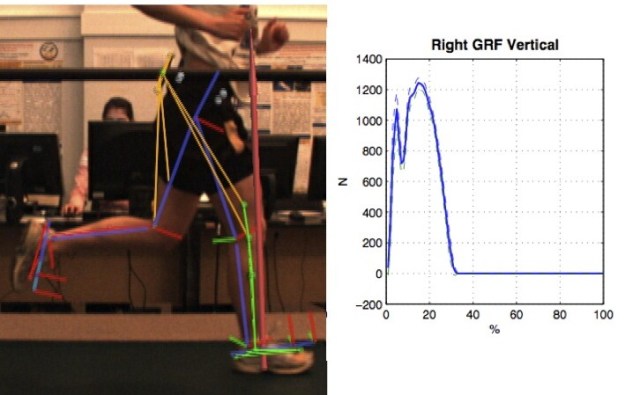
What kind of foot contact pattern made this graph? Nope – not a heel striker – but a midfoot striker. In fact this woman is about as midfoot as possible – her foot came down completely flat down at contact. I know ….this runs counter to a lot you’ve been told right? Hold on – let’s keep going.

Now look at runner #2’s graph. Notice the single mountain (or peak). Notice that the slope of the line from contact to peak is quite less steep than that of Runner #1. A LOWER loading rate! Guess what kind of contact style this runner utilized? A heel-strike. Yes. You read that right. A heel striker had a lower loading rate than a midfoot striker …..in this situation.

What gives? The media tries to make things simple. They say that “mid-foot” or “forefoot” is better than rearfoot. I love reading running forums where people with way too much time on their hands armchair quarterback running styles. They look at a picture or video of a contact pattern of some guy running across the screen and say “wow – nice midfoot strike –that runner is efficient.” They don’t know who the runner is, or what his time was for the race. They just saw a foot strike and proclaimed him efficient. Then they’ll scroll down and see some picture or video of some guy heel striking and proclaim that he/she is an “in-efficient” runner based on the heel strike. This “in-efficient” runner might be an in-efficient runner. Or it might be Meb Keflezighi (a runner who is just a bit faster and more efficient and than most of your reading this post).  You see, these arm chair-quarterbacks aren’t very good at identifying efficient gait. Fancy force plates are. I do this for a living and still need data from my lab to give me the answer because no one can actually see forces. So what have we learned from these fancy force plates?  Its NOT rear-foot or midfoot or forefoot that matters – its where the foot contacts in relation to the body’s center of mass.

As I stated above, I picked some outliers just to make a point. It is true that for MOST runners, adopting a midfoot or forefoot gait style will lead to decreased loading rates. However, its not because the foot lands differently, its because a rear-foot style typically allows you to land with the foot farther in front of the body’s center of mass (over-striding). Switching to a contact style that moves the foot closer to the body’s center of mass usually means that we land closer to the font of the foot. But not always. Let’s look at the elite runners to dig a bit deeper.

To run really fast, it’s very simple. You either increase your stride rate or your stride length. Simple right?

  • Stride rate- this is also referred to as cadence. Cadence ranges in cycling are pretty variable. Cyclists use anywhere from 45 – 140 rpm in competition, depending on the event and terrain. When we look at running, you’ll notice that cadence for middle distance through marathon distance typically ranges from 88-96 rpm. This is a much narrower effective window than cycling. We’ll look more in depth at cadence in a later post, but for right now, its safe to say at the elite level, there isn’t a huge difference in cadence values.
  • Stride length –if cadence values are held fairly consistent, the only other way to run faster is to adopt a longer stride length. The stride length of someone running 4:30 miles is significantly longer than running 7:45 miles. What we see is that a number of the elites land on the rearfoot, but their center of mass is still very high up at the time of contact. When running, you are a projectile in the air with your center of mass following a parabolic curve. So even though the elites often “contact” on their rearfoot, they don’t really have much pressure (force) on it until their center of mass lowers to the ground.  This effect produces a low loading rate with a heel contact, and is exactly what occurred in runner #2 above.

So let’s summarize what we’ve said about contact foot contact style. For most runners, landing closer to the body’s center of mass is an effective tool to lower loading rates. Barefoot running, minimalist running, and increasing cadence (faster cadence means you don’t have time for your foot to reach out far in front of the body) are all effective tools to accomplish the end goal of decreasing loading rate.  This being said, contact style is NOT the only way to decrease loading rate. Its possible to have lower loading rates with multiple foot contact styles, and other factors as well.

***Note: Unless the person is accelerating, it is not possible to have the foot contact directly under the center of mass. At steady state, the foot does (and should) contact in front of the center of mass.

The effect of posture

We said that, in general, a foot contact closer to the center of mass would decrease loading rate. On the flipside, posture can be utilized to alter the center of mass in relation to the foot. Most of us stand, walk, run, etc with poor posture. Take a look at the runner below. The runner is in exactly the same phase of gait, except for a more arched low back on the right than on the left. The posture on the right is typical to most runners. We hang out in the “back seat” with lots of arch in the low back. This change in lumbar position moves our center of mass backwards thus causing our foot to land further in front of the center of mass.  Therefore, keeping a neutral lumbar spine (not arched) is essential to keep our center of mass over our foot when running – and has the effect of minimizing loading rate.

Lastly – gait cueing and limb stiffness. Here’s where things come together, but also show need for additional research. In our lab, when we get someone with high loading rates, we show them their ground reaction force plots in real-time as they run, and ask them to change it. Normally, we don’t tell them how, we ask them to “play” with their graph shape as they run. Most runners figure out how to minimize their loading rates by getting visual cues, or feedback. This is the best way since the runner is aware of the conscious modifications they are doing to alter their loading rates and can see instant feedback to observe success – thus learning! If they don’t “get it”, we guide them through the technique modification so they can see the effects of their form changes as they run. Again – the goal is to get the runner to retain this sensation so they can alter their gait to make long-term changes to decrease tissue stress.  On the simpler side, research has been done that simply told runners to “run soft”. These individuals were found to decrease their loading rates. Gait cueing works. How does it work? People modify their contact style, posture, and their limb stiffness to achieve a desired result. Limb stiffness relates to how compliant the runner maintains the knee to modulate the rise and fall of the center of mass. There is more work to be done here to dig deeper, but this should hopefully answer the bulk of questions for now.

Summary:

What does this mean for you as a runner?

There is mounting evidence that minimizing loading rate has vast implications for a number of injury prevention strategies. There is also mounting work to show links to performance, though this is inconclusive at this time. There is additional work to be done to show how the gait style changes observed with decreased loading rate correspond to improved performance. Another topic for another day……

If you want to try to decrease your loading rate, you need to get your foot to land closer to the body. Barefoot running is a good drill for this since it “forces” you to avoid over-striding.  There is evidence that a properly constructed minimal shoe should also lead to minimal loading rates (although no one can say all minimal shoes since the definition of this market sector is so vague). Keep your torso centered over your lower body and avoid the temptation to run in the “back seat”, especially as you fatigue.

Run Tall! Run Soft!

Yup…. Less (loading rate) = More.