Yesterday’s post got lots of comments; I’d like to post a bit more here to help folks understand this concept a bit deeper. Why does this idea about balance matter at all to runners? Midstance is basically single leg standing balance. However there is a difference between “reactive balance” and “proprioceptive control.”
Let’s define a few terms here:
Strength – relates to the cross-sectional area of a given tissue. This is related to the muscle’s ability to generate force. Bigger muscle, bigger force. Simple.
Proprioception: there are 3 primary things we use for balance.
- Vestibular (inner ear) – If you are standing still, inner fluid is still. If you turn your head suddenly, the inner ear fluid swirls and this information goes to your brain to help determine acceleration and change in position.
- Somatosensory – You “feel” the ground. You have sensory receptors in your skin which allow you to feel something – light and deep pressure, vibration, heat, cold, etc. This sensation goes a long way to improve your tactile feedback to help you remain stable.
- Vision – We use our eyes to orient our head and trunk and let us know which way is “up”.
Note- you do have other reflexes that play a role here, but these are the primary ones that have the greatest effect.
If these 3 systems “agree” then you are using your body as best you can to achieve control in stance. So let’s look at examples of how these can change. If you are on a merry go round, your eyes see you are spinning, your somatosensory feels the body turning, and your vestibular system says you are spinning. Everything is fine. If you stop, your eyes and somatosensory system say you have stopped, but your inner ear fluid is still swirling – signals don’t agree….. and you become dizzy.
So why is it harder to close your eyes in single leg balance? Most folks are visual dominant. They rely highly on their eyes to find their position in space. The problem with this is that it’s “slow.” You need to see information, process it in the visual part of your brain, then send a signal to the part of your brain that control motion (motor cortex) to make a correction. Somatosensory information is very very fast. There is a direct relay between the sensory and motor reflexes both inside and outside the brain – resulting in fast rapid “micro-corrections” of position. Let’s use an example.
If you look at skiers, surfers, skateboarders, white water paddlers – they all have something in common – they need to make positional corrections VERY quickly – faster than they can see visually and adjust. They get good feedback about the position of their body from their hard ski edge (transferred up through a very stiff plastic boot), or the rail of the surf board (transferred through their bare feet). Each and every time they practice their sport they are refining their position sense by “feeling” where the body is. They consistently train and improve their somatosensory system.
Research shows that the somatosensory system is highly trainable. Its best done frequently in small doses. Instead of trying to balance on one leg for 10 min each night, its better to do it 20x’s a day for 30 seconds. Yes, you CAN improve your balance….by practicing. Not your “I’m-rocking-back-and-forth-like-a-weeble-wobble” re-active balance, but your “proactive balance.” Proactive balance means “I know what to do to keep my body stable – I can micro-correct to improve my stability.” Think about spreading your toes out wide to maximize the width of your foot. Try to push your big toe down – not curling, just down as you keep it straight. This will improve your muscles firing inside your foot. I’ll make a deal with you – if you work on your single leg balance every day, you’ll find not only will you be able to stand with eyes closed, but also be able to begin to rotate left and right with your eyes closed. The goal is to reduce your dominance on vision and improve your use and perception of “feel.” It works!
OK – so let’s now look at this with respect to running. I’m going somewhere with this I promise – I’m building a case for you. There is a ton of research that supports the idea that firm surfaces offer better “feel” to the individual and thus better balance control. Soft surfaces mute the feedback to the person and result in poor stability in stance. The goal is to maximize your level of active stability control that your body can produce.
If I am in the clinic working with a patient, I always work them in barefoot, and will use all kinds of rocker/wobble/rolling boards to do this. All of these are FIRM and HARD surfaces. Even though the foot is moving, the contact between the ground and the foot is solid. The person gets good feel for what is happening. I am not a proponent of foam pads to work on balance. Why? Foam pads let you cheat and roll off to the outside of the foot. They don’t mandate that you activate the big toe. They don’t train “pro-active control.”
Let’s take this idea and now apply is to footwear and the entire rationale for you reading this post. What is traditional footwear? – It’s got an elevated heel, a wider lever arm than your foot, and a big marshmellow stuck underneath. This marshmallow allows your weight to shift to the outside of the foot. The heel-higher-than-the-forefoot provides a “rocker” in front of the shoe that you can simply roll off of. It lets you “cheat” by conforming to your foot. A lot of runners have gotten used to this. Their feet have become weaker as the shoe does more of the work.
When we look at minimal footwear or barefoot running, this foam pad is gone completely or reduced significantly. Suddenly, you can’t cheat. You have to actively use the muscles inside the foot to stabilize. The absence or reduced cushioning in the shoe allows you to get better “feel” – why do so many proponents of barefoot and minimalist running claim that they feel “free” or like they’ve “been released”…….? It’s simple – your foot gets more information from the surface you are on when you don’t have a big piece of compressible foam in the between. More information = better muscle activation.
I see a hand up in the audience.
Q: So I’ve been running for years and I still can’t stabilize with my eyes closed. What gives?
A: closing eyes might be slightly overkill, but you know what? – Almost every standardized assessment for balance testing has an eyes-closed component to assess just what we mentioned above (the 3 things that impact proprioception). So if you have good balance with eyes closed, I know that you are good in this regard and not going to ask you to add this into your training program. It allows the examiner to differentiate how well you use different skills that affect balance. If the eyes closed part is the issue, and this is connected to faulty foot and ankle mechanics during running, it give me more information as to what your limiters are as a runner.
Q: So I’ve been running for years, and I still can’t stand on one leg – even with my eyes open. What gives?
A: There is no research to show that your poor balance will result in injury, but there is research to show that those with a number of lower extremity injuries do have poor balance. Further, I’ll be happy to say that those with poor single leg balance almost always have some very interesting finding in our lab – they usually have altered forces around the ankles which results in abnormal stresses to the lower leg and foot. Improving your single leg balance is a way work on prevention. I’d much rather you not get hurt and keep enjoying your runs, than not. Maybe you are one of the lucky ones who has run for years without injury – awesome! However, research shows that 82% of you runners will be hurt at some point. Both personally and professionally, I’d rather see you in the 18% of those who are not.

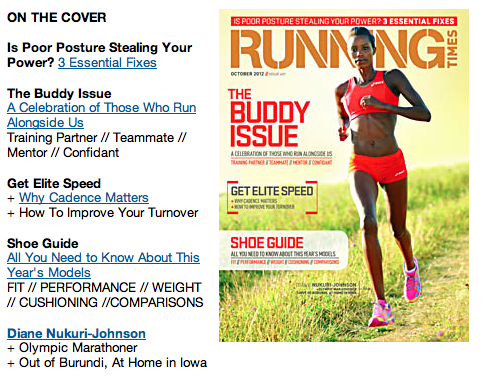 Are your shoulders slumped? Both Mom and your favorite drill sergeant don’t take kindly to poor posture. Outside of looks and respect, posture has a huge effect on your running form. If you ‘d like to know how it impacts you as a runner, and how you can fix it, check out my article in this month’s October edition of Running Times – on news stands, or click here to view it now. Now stand up straight!



 Jay Dicharry's Website, An Athlete's Body