Tag Archives: endurance

What can you learn from a frustrated bird?

Here at UVA, I teach a course called Neuro-muscular Basis of Human Movement, and today we are speaking of all things running mechanics. One of my students made an analogy that actually tells us a lot about running. Well, the analogy doesn’t really tell us that much, but a host of really angry and pissed off birds will….. Yes–> those angry birds!

Angry Birds is a simple game ( if it’s so simple, why has our country’s gross national product dropped since its launch????) that forces us to abide by the laws physics. Your goal, of course, is to knock out those smirky smiling pigs at various locations. You learn very quickly that aiming too high blasts your bird up to the clouds, at the expense of sacrificing distance. Aiming too low also compromises distance. Aiming just right produces the greatest distance covered with a pull of the slingshot….. The fancy name for this would be the optimum trajectory

While you don’t have to land on a pig when running, you do try to cover a given amount of distance per stride. In fact, the definition of running economy would be to cover a given distance with as little energy as possible. Too much up and down motion while running wastes a lot of energy. Actually about 80% of the energy required to run comes from raising and lowering the body against gravity. So “aiming too high”- too much vertical rise an fall- is not a smart move.

A lot of people get this. The problem is that they take it to the opposite extreme. They tell us that we need to minimize the rise and fall of our body. Does this play out? Go play angry birds again, and aim your bird dead flat. Pull back all the way and watch your bird take flight….. It won’t go very far. Limiting the up and down motion of the body when running not only ensures you won’t go far with each stride, it also costs a lot of energy! Go for a run and try to keep your head as still as possible- you won’t be able to do this for long- its tough!

So what is best? If you try to get maximum distance per fire on angry birds, you’ll find that about 45 degrees gives you the greatest distance. So does this mean that you should aim for this when running? Well, not exactly. The body isn’t a bird, a cannon ball, or any other type of projectile. It’s an actively controlled spring that actually stores and releases elastic energy to help you move forward. Some amount of vertical rise and fall is actually beneficial to “load the slingshot” and store and release this elastic energy. Exactly how much depends on your body weight, your leg length, and your pace, and your contact time. A sort of nice number is around 4-6 cm of vertical rise and fall of the body typically produces optimal results. In labs like ours at UVA, we study this kind of stuff to tweak your economy.

The take home message is that some rise and fall is necessary, even advantageous, when running.* So when someone tells you that a runner is efficient because their head stays perfectly still when running, maybe you should hand them your smartphone and tell them to play a little game.

* note- excessive rise and fall of your phone, as in when you throw it against the wall after not beating a level for the 37th time, isn’t recommended.

20120405-104247.jpg

South by SouthWest Festival: When Biomechanics Attack

Check out the report WIRED magazine did of my talk with ESPN writer Henry Abbott at SXSW music festival. Likely the only time I’ll get to say I presented at the same conference as Al Gore, Bruce Springsteen, Seth MacFarlane, Jay-Z, and Jeffery Tambor (unfortunately not on the same stage at the same time!)

Nice summary, except they didn’t really get one critical point across. You CAN improve your hip flexibility and your hip strength!

Check out the WIRED article here and check out this link I did for Runner’s World a while ago on improving hip mobility


Are you ready for minimal?

Looking to get into “less” shoe? Don’t understand why you need to make some changes in your body to help this process? Looking for some help moving towards something new? Check out this month’s issue of Running Times to check out an article I wrote with my colleague, Dr Mark Cucuzzella, on a smooth and successful transition to minimal running shoes.

And if you’d like to see the print word come to life, check out the video “are you ready for minimal” by yours truly on the www.runningtimes.com homepage. Also on their youtube channel here.

When the Big Man in Red calls, you have to be ready

Thought I’d share this with you guys, because it’s a bit different than most of the cases I see here in the lab on a daily basis. So the phone rang on today. The caller ID just said “North Pole” – not knowing what to expect, I picked up and surprisingly spoke to Ms Claus! She spoke very frantically. Santa was overheard in the background, and did not sound jolly. One of their athletes was down for the count less than one week before the big day, and they were in serious need of our services. ASAP. Rudolph is suffering from Achilles pain, and can’t fly at race pace. At his current speeds, they’ll be about 8.5 hrs behind Christmas-Eve night delivery schedule. Kids on all sides of the world should all be able to wake up to their loot. Running late is not an option.

Seems like all this global warming has taken its toll on a number of fronts. Yes, its hotter, and more of you are driving Prius’s (or is that Priui???), and sea level is rising – but folks, reality is now staring you in the face…. and its taking your Christmas presents with it. Typically, the reindeer wind up their training volume when the snow starts to fall in the end of October. This year, October saw record high temperatures. Instead of training, the reindeer were sunning themselves at the lake. A typical week in October looks like this:

  • Sunday: light 6 hr hike through the woods
  • Monday: 8-mile Hill repeats (about 4,000 ft per climb) x 12 reps
  • Tuesday: AM Speed work: 10 x 1.5 miles, all negative split. PM workout: easy 5-mile flight
  • Wednesday: Flight training: Circumnavigation of Arctic circle x 3. 1st and 3rd easy, middle rep at tempo pace.
  • Thursday: Weighted sled training: 3.5 metric tons for 6 miles, 2.5 tons for 4 miles, 1.5 miles for 2 miles at 90% VO2
  • Friday: easy run to Canada and back, with 1 hr of fartlek
  • Saturday: Tempo intensity, all flight – equator and back. Goal time is around 2 hrs.

The Elves in the training room had to be pulled out to help with some last minute Xbox orders, and they are understaffed. So Donner and Blitzen volunteered to get Rudolph down here within 2.5 hours The made it in 2:10. For starters, Rudolph is super nice – a bit too much on the Type-A sometimes, but I guess its that kind of work mentality that gets you to lead the sleigh year after year. He said this is the first time he has been injured. He even did weekly jogs sans horseshoes in the early summer after reading “Born to Run”, but he thought it was the sudden ramp up in volume that really got him.

Head Elf stretches Rudolph after last week

So, we did what we normally do. Got some markers on Rudolph and threw him on the treadmill. Results? Well, Rudolph has some serious imbalances going on. Pretty weak stabilization of his right rear ankle, and some inflammation of his bursae seem to be the culprit here. But the real issue was his weak right hip. Failure to drive off with his hip was actually increasing the stress on the achilles. Using data on our force-measuring treadmill, we cued him to use more of his glutes to stabilize his hip. We fit him for some minimal horseshoes to reduce the lever arm on his ankle. Lastly, we gave him some self-mobilizations he could do on the rooftops to keep him supple throughout the night. So how’d it go? Well, here’s hoping that all of you have something special under the tree on Christmas morning…..on time. Happy Holidaze!!!!

Runner’s World asked us: What’s the single biggest problem in running?

When most runners, coaches, running shops think of the single biggest problem that affects runners- the answer usually points to the most feared word in running – “over-pronation.” However, we told Amby Burfoot  (link here) that our years of experience quantifying running mechanics through the use of 3D gait analysis has shown us otherwise.

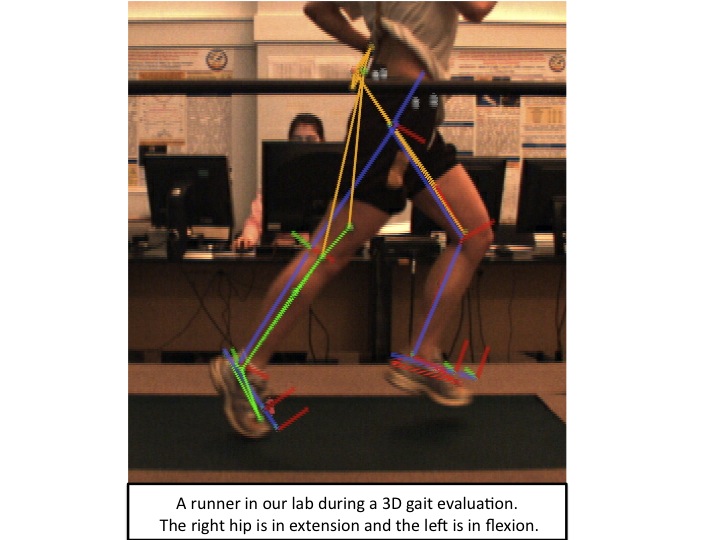
While it’s true that some of us out there may pronate more than others, it isn’t exactly what we’d call an epidemic problem in America. We’ll estimate that less than 30% of runners truly over-pronate (excess motion in the foot) their feet while running. To find the real answer, we need to move up eyes up and look at the hips.  About 80-90% of runners don’t extend their hips.

What is hip extension anyway?

Lifting one knee up to the chest moves the hip into flexion. If you extend the hip the opposite direction (past vertical) that is hip extension. The goal is to do this without extending your back. Stretching your hip flexors to get more motion is the key

So why don’t most runners extend their hips?

We tend to sit. A lot. We sit in class. We sit at work. We sit in our cars. Cyclists, you spend all your time on the bike sitting in hip flexion. When we continually sit in hip flexion, the hip flexor muscles become tight. So tight that the overwhelming majority of runners can’t extend the hips. “Now wait a minute” – you might say –“I see all my friends and their leg does get behind them when they run – so they must be extending their hip right?”

Tight hip flexor muscles cause you to get your leg behind you not from extending your hip – but by arching your lower back. This can cause injury since an arched lumbar spine compromises our ability to use core muscles while we run. This sets us up for a host of leg injuries and also is the most common cause of low back pain in runners. Further, lack of hip extension compromises your running efficiency.  As we increase speed, the bulk of the work supplied to the legs need to come from the hips. Well, if you can’t extend the hips, you are missing out on critical force to move your body forward.

So how do I get hip extension and is it really that simple?

You’ve got improve your range of motion of the hip, and your ability to control the new motion. The best hip stretch is a kneeling hip flexor stretch. Beware though, a lot of the videos on-line show incorrect form for this stretch and you don’t actually wind up extending your hip flexors at all (they stretch the quads).  Check out the July 2010 issue of Runner’s World for an article we helped them put together. It shows correct technique to stretch the hips, and some simple exercises to learn to use your new range of motion.

Cold Weather Training

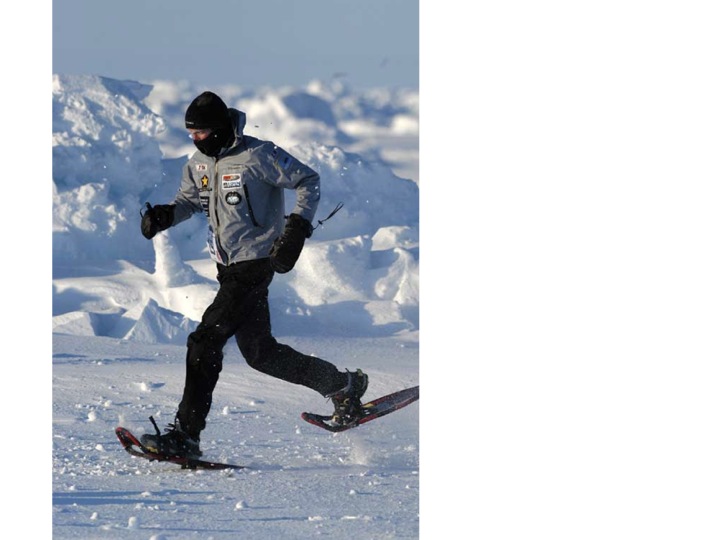
When properly prepared, running in cold weather can be enjoyable. Get caught without proper preparation, however, and one risks hypothermia and frostbite. The cold dry air of winter can also exacerbate symptoms of exercise induced bronchospasm, a relatively common condition in runners. Proper preparation along with a recognition of the early signs of cold related illnesses will help minimize problems associated with exercise in the cold.

While exercising in cold weather, our bodies attempt to maintain our core temperature by shunting blood away from the periphery, thus minimizing heat loss. Mild hypothermia is heralded by goose pimples and shivering as our bodies attempt to raise our metabolic rates to increase our core temperature. Moderate hypothermia will result in muscular fatigue, poor coordination, numbness and disorientation. Severe hypothermia can result ultimately in cardiovascular failure. Treatment of hypothermia requires prompt recognition and treatment as mild hypothermia can progress to a more severe situation if not addressed early. Athletes should be removed from cold, wet, or windy conditions. Wet clothing should be removed, and rewarming commenced with warm blankets and ingestion of warm fluids. If the athlete’s condition does not improve, transportation to a medical facility should be arranged.

Frostbite is actual freezing of tissues secondary to exposure to the extreme cold. It most commonly occurs in the peripheral limbs and on the exposed areas of the face (cheeks, ears, and tip of the nose). Patients with superficial frostbite complain of burning local pain and paresthesias (tingling). The skin may initially be pale, but will become red with warming. Superficial blisters may be present. Superficial frostbite can be treated by local thawing. The most reliable method is direct contact with body heat (such as putting your hands in your underarms). The injured area should not be rubbed as skin sloughing may occur. Thawing should not commence, however, unless it can be ensured that refreezing will not occur. Subsequent freezing and rethawing can result in a more serious injury. Deep frostbite is initially very painful, and then tissues become numb. The affected area appears as a frozen block of hard, white tissue. Areas of gangrene may occur in severe cases. Treatment of deep frostbite includes rapid rewarming in a hot water bath. Since rewarming of deep frostbite is painful and the condition is often associated with infection, transport to a medical facility should be arranged as quickly as possible. Radiant heat (such as from a fire or radiator) should be avoided as burns may occur.

As with so many other conditions in sportsmedicine, our best offense (treatment) is a good defense (preparation!). Following the guidelines below will help minimize risk for cold related illness and will maximize our enjoyment and performance during our training runs:

1. Dress in layers of loose, lightweight clothing. The first layer of clothing (closest to the body) should be made of polyester or polypropylene which will “wick” sweat away from the body. Subsequent layers should be loose and breathable-fleece is a good choice. Cotton should be minimized as it can allow sweat buildup. The outer layer should be wind and water resistant, thus protecting from wind, rain, and snow. When in doubt, add the extra layer. You can always remove a layer if you warm up, but you will regret not having it if you start freezing with several miles to go.

2. Protect your head and extremities. Wearing a hat is essential as up to 50% of body heat can be lost though the head. Gloves are important to prevent exposure to the hands. These, too, can be removed if you get warm, but you’ll regret not having them if needed. Mittens are better on colder days as they will keep the hands even warmer. Sunglasses and sunblock are important to protect the face, especially when there is glare from snow. Guys-remember to insulate the privates, which are prone to cold and frostbite. Forget this once and it will be your only time!

3. Take time to warm up and stretch before increasing intensity during training runs.

4. Remember to stay well hydrated and fed. It is easy to forget that we are sweating in the cold, and therefore we may not recognize the need to hydrate and fuel when running in the cold. Hydration and refueling are important to prevent bonking in addition to helping us maintain body temperature.

5. Plan your courses so that you can ensure staying warm and dry. Avoid courses that take you away from shelter, especially on wet windy days. Consider several shorter loops which will allow you to add or remove layers of clothing more easily or even seek shelter indoors if necessary.

6. Runners with exercise induced bronchospasm should attempt to warm air such as with a scarf or mask. A prolonged warmup prior to hard running can help minimize symptoms. Carry your inhaler if you use one, should it become necessary.

Following the above guidelines will help minimize problems associated with cold weather exercise and allow you to get the most out of your training.

Stay warm. I’ll see you on the roads!