Category Archives: Uncategorized

The 2011 Take-a-Friend Challenge: a New Year’s resolution NOT about you

At this time of year, we all look towards a resolution to make us better. We look for new challenges. Maybe you’ve done your first marathon or ironman, maybe you PR’d this past season. Either way, you are probably looking ahead to what challenge you can give yourself in the upcoming year. Well, let me throw another type of challenge out there. This challenge will not improve your bike split in a triathlon. It will not provide an explosive kick for you as you surge towards the finish chute. It will not help you lose 3 lbs to improve your power-to-weight ratio for hilly terrain. Then why am I reading this????

As athletes, we tend to look at what things we can do to make ourselves better for the upcoming season.  This year, I’ll ask you what you can do to help someone else to become a better athlete this season. At the risk of sounding like a public service announcement, let me elaborate. On Christmas day, I got into a game of pick up soccer with my cousins. Ages 2.5 to 20. Friendly game, for sure. Handicapped teams. None of these details are important. What is important is what follows the game. After all of us were sweat soaked through our clothes and walked back inside, one of my older cousins turned to me and said – “If I did that for the past 2 hrs you’d have to cart me off in a wheelchair and I’d be in bed for 2 days.” My other cousin overheard this, turned to me and said – yea-  “me too.” Now these cousins are not who a lot of you are imagining. They are not overweight. They are not old. They are about 40. But their idea of exercise has changed over the years. To them, playing pick up soccer was simply outside of what they thought their body could do. “Pushing the envelope” for these folks is a phrase which well…..doesn’t exist.  This whole thing just bugged me. Pick-up soccer with kid 2.5 yrs to 20 yrs is not the World Cup. I mean, they should be able to play pick-up soccer or whatever they want, whenever they want. The fact that they can’t, or even think they can’t, is a sign of a much bigger problem.

Which brings me to my public service announcement. People think we’ve got an obesity problem in this country. We don’t. What we have is an inactivity problem. You exercise because you love it, sure. But also because its part of your lifestyle. You can’t imagine a month, a week, or for some of you, even a day where you don’t exercise. Well, the majority of the population can’t imagine a day where they DO exercise. And since they don’t have a goal of a race or workout to shoot for, then never make it off the couch.

OK – so this is where you come in. You are going to get them off the couch.  That’s my challenge to you.  Call up a friend (or a parent!) who doesn’t run, ride, swim, ski, or play basketball or soccer, or whatever. Invite them to go do something. Anything. Just like meeting your early morning workout partner keeps you from skipping those AM sessions, “buddying-Up” with a newbie gives them some motivation.  Take ‘em outside. Let them breathe the same fresh air you breathe. Let them see how it awakens your insides. If they don’t have all the equipment they need, loan it to them. Pretty much everyone reading this has a garage full of toys. Give them any advice you’ve learned along the way. Doesn’t matter if you aren’t a pro. Anything you tell them is better than the nothing they know now. Talk about how good exercise is for the body. Or don’t. You are simply inviting them to go do something athletic because if you don’t, no one else will.

Outcome? Well, lets look at it this way. Worst-case scenario. They got out and elevated their heart rate, you got time to spend with a friend or family member that you normally wouldn’t have gotten to see, and they get really sore. Hint: this “work-out” needs to be at their pace – not yours. It may just be a hike somewhere. But let’s mention the best-case scenario. You show them some new sport or activity. They get hooked. They wind up being your newest training partner. Or better yet, they smoke you at the next race. And your new year’s resolution for 2012 just might wind up to beat them!
They said I’ve got pronation….How long do I have doc?

So you went to the “insert giant athletic store here”, and the 16 yr old kid who works part time for the summer, who is the “expert” on running watches you for about 30 seconds, and decides to tell you that you in fact, pronate. Or worse…..maybe you even over-pronate. Never fear though, they say! They’ll just go in the back and grab some of those big mutha shoes to totally stop you from pronating and be your personal savior.

Before you plunk down your hard earned cash, we should probably come to terms with a few things.

  1. What is pronation?
  2. When does it occur?
  3. Can you stop it, or should you stop it?

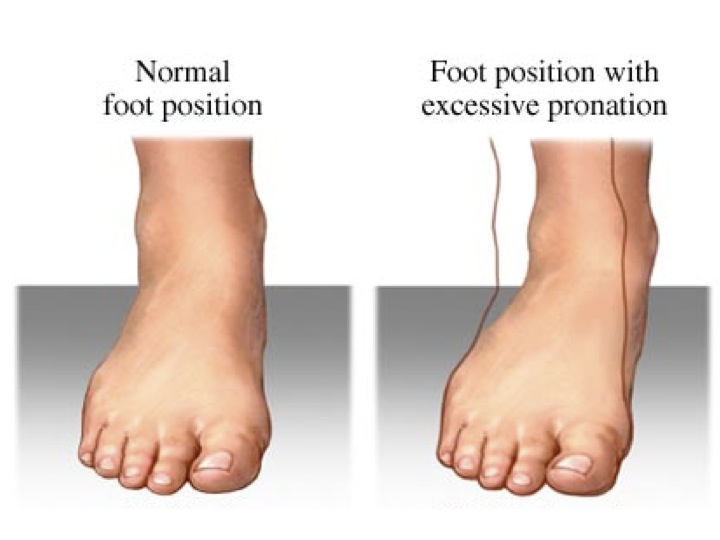
1 – First, let’s re-cap what this pronation stuff is all about. Pronation is not bad; in fact, it’s the body’s natural shock absorption mechanism. When the foot moves into pronation, it becomes like a loose bag of bones. Everyone pronates to some extent. Some more than others.  If you didn’t pronate, you’d have problems with- you guessed it- shock absorption. The opposite of pronation is supination. In supination the bones of the foot become more congruent (increased contact between the surfaces of the joints). This increased contact produces a rigid lever for push off in gait. So we should land in a supinated position, and move to a more pronated position during stance to decrease shock, and then move to a supinated position to achieve a rigid lever for push off.

Let’s re-cap this again using America’s favorite national pastime, Tetris. When the pieces fall from the top of the screen, we can move them about and rotate them freely. They can move. This is how the 26 bones in your foot function in the shock absorption or pronation phase. They should move about to dissipate force. Now imagine those same Tetris pieces once you’ve placed them in the stack. They can’t move right? They become congruent and are locked in place. This is similar to the foot when you are in supination.

2- Now that we understand pronation as something that is not really bad; let’s talk about when it occurs. As evidenced in a study carried out in our lab and published in the Journal of Orthopedic and Sports Physical Therapy, maximum pronation of the foot occurs after the heel has left the ground. Why does this matter?  Remember that 16 yr old kid? He’s going to grab a shoe off the rack that is a motion control shoe –designed or should I say marketed, to stop pronation.  A shoe like this features a higher density material on the inside of the shoe. The claim is that this different density material acts to stop the pronation from taking place, thus fixing your issues. If you’d like to see if your shoe has this, just look at the inner side of the midsole (marsh mellow stuff between the fabric upper and tread). If some of the inside of the shoe is a darker color than the rest, it’s likely a “dual density midsole design”.

OK – so let’s get back to timing of pronation. Shoe companies put this increased density material to “stop the foot from pronating”. Well, we found out that maximum pronation occurs after the heel is off of the ground. So guess what? – All that higher density material in the shoe isn’t even touching the ground to try and stop the foot from moving at the time when the foot is moving the most! Hmmmmm……makes you think doesn’t it?

3- We know what pronation is, and when it occurs, and now we should address the question of stopping pronation. Pronation is necessary. I’ll even say in the right amounts and at the right time, its good. I’ve seen PLENTY of runners who have problems because they don’t pronate enough. However, stopping pronation isn’t really in our best interests. It’s better to learn to stabilize the amount of pronation. The thing is that no shoe can do this- you need to learn to use the muscles in the foot and the muscles in the hip to stabilize the rotational motion that naturally occurs in your legs. Can you do this? How good are you at stabilizing your pronation? A visit to the SPEED Clinic can help you pin point your issues and fix them for good.

Parting thought –please don’t read this and think that we are saying that shoes don’t make a difference. They do. The objective research we do combined with our clinical experience has proven to us that they make a huge difference. We view footwear as part of an intervention to help you perform at your best. Shoes are very different. How much of a shoe you need, or weather you even need a shoe at all (barefoot running anyone?) are all part of a comprehensive assessment here at the University of Virginia.

Adjust your thermostat, adjust your expectations

Wow. If you are on the east coast like we are, we don’t have to tell anyone that its been H.O.T.
“But wait……..don’t the weather gods know I supposed to be training for the ___ championship in __weeks ….not to mention the ___ race I’m doing this winter. My workout today was slow, and I felt bad on my long workout this weekend. I’m getting slower and this heat is killing my training!!!!!”
If you guys want some tips on running in the heat, there are some great words of wisdom on this blog if you scroll down. Let’s re-cap: – hydrate, run in the morning, hydrate, loose fitting and light colored clothing, and hydrate. OK fine – but lets get real on this summer’s weather and why we need to take it into consideration.
Last year in C’ville, we had 7 days above 90 degrees and they were scattered about the summer. Except for a small 2 week heat wave in the middle of the summer, it wasn’t all that hot all the time. You had the luxury of moving workouts a day or 2 ahead or behind in the week based on the heat. This summer, we’ve had 45 days above 90 degrees. We’ve had 7 above 100. And let’s be honest, its not really cooling off all that much at PM or in the AM (Friday night was 96 degrees at 9:00 PM!). Its been so hot that all outdoor high school and collegiate practices would be completely cancelled in weather like this. National and State sports governing bodies have established these regulations to protect the athletes. I know – you are tougher than them and need to get your speed work session in today though…….stay with me.
Dealing with this heat is all about adjusting your expectations. Let’s  re-state this point to be absolutely clear: Trying to train at your same intensity and volume (or increasing it) in this type of weather is NOT a smart thing.

If you don’t agree with me, let’s look at it from your body’s perspective. When you exercise, you ask your body to metabolize fuel stores, regulate energy balance, and produce mechanical work so that you can move from point A to point B. All this effort produces heat. Your body has a lot of internal mechanisms to regulate body temperature, and they work pretty well. But your body has limits as to how rapidly it can cool itself off. Did you know that your body actually begins to compromise its ability to perform at around 72 degrees? Now think about how much challenge a 95 degrees environment places on that body.

Still not convinced? Let’s say that your typical Wednesday morning track work out is 12x 90 second 400 repeats, with 45 seconds between each. Think about how much stress that places on the body under normal conditions. Now let’s consider our weather reality. Its now 10-15 degrees hotter than usual and more humid. Trying to run that same workout under these conditions is significantly more stressful than typical. You may notice that you can’t make the 90 second split without taking more rest between reps. You may even notice that under these conditions, 90 seconds is not even possible. Let’s say that your triathlon training schedule has you doing a 5 hr ride on Sunday AM. However, the heat has slowed your pace down significantly after 2.5 hrs, and all you want to do is jump off the bike into a cool pool. Its OK to back off the workload to match the change in conditions – you’ll STILL GET THE BENEFIT OF THE WORKOUT. Shorten the ride. Increase your rest. Take longer breaks between intervals. Do whatever it takes to be consistent with your training, but realize that extreme weather requires some modifications to ensure we aren’t just pounding ourselves into the ground. Remember- you’re body doesn’t really know exactly how fast its going or how long a rest you are taking; it just knows that you are pushing it harder than you have in the past and with all this heat, it just might push back.

This post is written in memory of a local high school runner who died of heat illness during a summer training run.


Runner’s World asked us: What’s the single biggest problem in running?

When most runners, coaches, running shops think of the single biggest problem that affects runners- the answer usually points to the most feared word in running – “over-pronation.” However, we told Amby Burfoot  (link here) that our years of experience quantifying running mechanics through the use of 3D gait analysis has shown us otherwise.

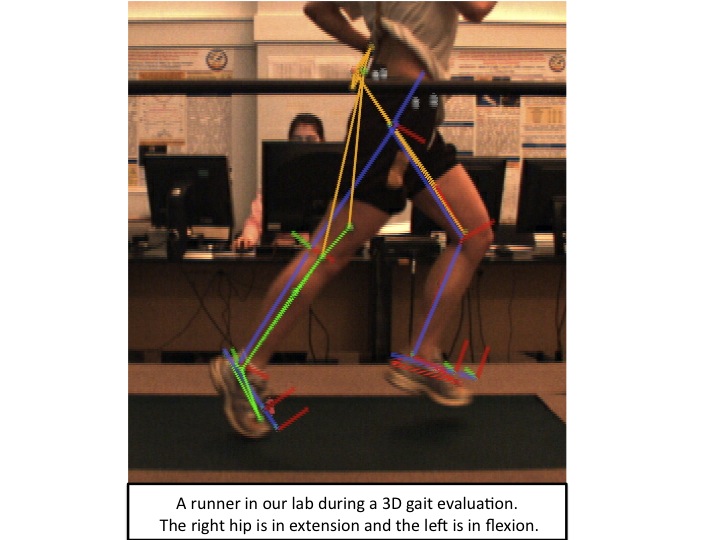
While it’s true that some of us out there may pronate more than others, it isn’t exactly what we’d call an epidemic problem in America. We’ll estimate that less than 30% of runners truly over-pronate (excess motion in the foot) their feet while running. To find the real answer, we need to move up eyes up and look at the hips.  About 80-90% of runners don’t extend their hips.

What is hip extension anyway?

Lifting one knee up to the chest moves the hip into flexion. If you extend the hip the opposite direction (past vertical) that is hip extension. The goal is to do this without extending your back. Stretching your hip flexors to get more motion is the key

So why don’t most runners extend their hips?

We tend to sit. A lot. We sit in class. We sit at work. We sit in our cars. Cyclists, you spend all your time on the bike sitting in hip flexion. When we continually sit in hip flexion, the hip flexor muscles become tight. So tight that the overwhelming majority of runners can’t extend the hips. “Now wait a minute” – you might say –“I see all my friends and their leg does get behind them when they run – so they must be extending their hip right?”

Tight hip flexor muscles cause you to get your leg behind you not from extending your hip – but by arching your lower back. This can cause injury since an arched lumbar spine compromises our ability to use core muscles while we run. This sets us up for a host of leg injuries and also is the most common cause of low back pain in runners. Further, lack of hip extension compromises your running efficiency.  As we increase speed, the bulk of the work supplied to the legs need to come from the hips. Well, if you can’t extend the hips, you are missing out on critical force to move your body forward.

So how do I get hip extension and is it really that simple?

You’ve got improve your range of motion of the hip, and your ability to control the new motion. The best hip stretch is a kneeling hip flexor stretch. Beware though, a lot of the videos on-line show incorrect form for this stretch and you don’t actually wind up extending your hip flexors at all (they stretch the quads).  Check out the July 2010 issue of Runner’s World for an article we helped them put together. It shows correct technique to stretch the hips, and some simple exercises to learn to use your new range of motion.

Deep Thoughts: Do your muscles really have a memory?

You can run quarters on the track in 80 seconds. Maybe you can even do them in 60 seconds. Maybe you hit a PR for sustained power on the bike. You can drive your golf ball 250 yards down the fairway. Does this mean you are really performing at your potential?

Every time we practice a movement, we are reinforcing a particular movement in our brain. This is commonly referred to as “muscle memory”. Training technique is an often overlooked aspect in endurance world. Each joint in your body has an axis around which it moves, with muscles controlling the movement. These tissues are engineered to move a specific way. If we learn good muscle memory, we continually re-enforce good habits – and come competition day – we perform at our potential.

Competition to you might be a round of golf with friends on Sunday or qualifying for the 10,000 meter at the Olympics. At every level, focusing on your form can improve your performance.  Our body and mind strive to get the job done – at all costs. Often, this can mean we learn an incorrect strategy to get the job done. And even if your form is better than most, we all suffer form alterations when we fatigue. When these form changes occur, we have a decrease in efficiency. Since we are performing “different” than we normally do, we put more strain through our body’s tissues and are more likely to become injured. Understanding the stages of motor learning will shed some light on why we need to work on our form in the first place:

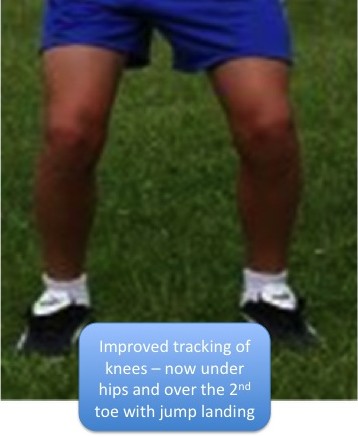
  1. Unconscious Incompetence – this means we have no idea that we are doing something with incorrect form. Most of us fall in this category. Look at the picture of the woman landing from a jump. The joints of the lower body are designed so that the knee tracks over the second toe when we land from a jump. The goal is to preserve proper alignment when we move. This athlete has no idea that her knees crashing to the inside are a problem. She doesn’t know that it significantly increases her risk for an ACL tear, patellofemoral syndrome, hip impingement, or a host of other issues. She doesn’t know that this landing technique will hurt her running, jumping, and cutting performance.
  2. Conscious Incompetence – We reviewed this athlete’s form issues with her. We showed her that the jump landing technique she uses can lead to injury and compromises her performance. She is now aware of it and understands the issue. This is the point where specific corrective exercises, cues, and drills are prescribed to her to correct this muscle memory. The more she practices these correctly, the more she re-enforces correct motion – however this stage requires a lot of conscious thought to perform the movement correctly . Because of the increased cognition or thought that this stage requires, the athlete may in fact be less efficient at their particular sport because they are “thinking” so much about the way in which they move. This is why drills often seem challenging.
  3. Conscious Competence – The athlete understands that there was an issue, knows correct technique, and now is able to perform correctly without thinking about it. She has removed the stresses from a flawed technique, and can perform correctly in sports-specific drills and in competition. The is the stage we want to be at! Think about some of the best performances you’ve ever done. What were you thinking about? Most successful athletes can’t even remember what they were focusing on. They were in “the zone” and just let their bodies perform using the skills they learned through a lot of practice.

In our quest to improve, we often focus on adding intensity or training volume thinking it to be the magic fix to take us to the next level. We’ve often heard the phrase “train smarter, not harder.” Adding time and focus to alter your technique pays off in spades. So let’s expand that saying to “move smarter, not harder”. The focus of the biomechanical analysis done in the SPEED Clinic @ the UVA Center for Endurance Sport is identify your unique compensations and make those muscles smarter!

Is stretching right for you?

Should I stretch? Should I stretch before or after? Will stretching make me a better athlete? Will stretching make me a more confident public speaker? We get these questions a lot. Don’t worry, we are happy to help and the confusion is not your fault. Seems every media outlet out there wants the BIG STORY. The headlines read  “best new stretch”, “best way to stretch”, or maybe even “stretching is killing you” –they really want you to by their magazine! So should you stretch or not? Is it OK to be tight? Is it a benefit? Is it possible to be too flexible?

Muscles, tendons, and ligaments shorten and lengthen as our joints move. Therefore, the amount of mobility you need in these tissues is pretty simple to define. You need enough for the tasks and sports you do, and nothing more. Is it really that simple? Yes – and let’s look at what happens when structures around our joints are too tight.

  1. Tightness in the muscles, tendons, and ligaments around a joint causes increased strain in the tissues. Think about a rubber band. You can stretch a rubber band back and forth from slack to fairly taught all day and it will be OK. Think about how much tension is in the rubber band as you shorten and lengthen it. Now imagine pulling he rubber band taught to 80% and then pulling it as far as you can. Do this for a while and look at the rubber band. If it hasn’t popped yet, you’ll notice that the rubber band actually begins to fray a bit – the increased tension inside the band causes damage. This increased tightness inside soft tissues limits our ability to withstand chronic strain inside our muscles – and leads to muscle strain and tears.
  2. The attachment points of your muscles, tendons, and ligaments form a bag of connective tissue around each and every joint called a capsule. Tightness in these structures can change the way the joint moves. Think about door pivoting open and closed on its hinge  – there is an axis on which the door moves. The door has no problem opening and shutting. Now imagine a force trying the twist the door as it opens and closes. This twisting force tries to move the door in a way that the hinges are not set up to pivot around. If you keep trying to open and shut the door, something will fail (the hinges will loosen, the door will warp)  – the point is that trying to move a joint in a manner that does not use its normal axis will cause pre-mature wear on structures. Tight soft tissues change the axis of mobility through the joint and cause excess wear on he surfaces of the joints  – the is the mechanism for the development of arthritis.

So now that we know the problems associated with tight tissues, all of us should stretch right?…. because the magazines say that stretching causes you to be more agile, stronger, recover faster, and warm up the tissues? Not a single one of these claims has ever been substantiated. You need “enough” mobility around a joint for the sports you perform. A runner and a gymnast have entirely different needs for mobility. Having more flexibility than needed for your sport has never been proven to be an advantage. In fact, we see just as many injuries to people that are hyper-mobile (have tissues that are too loose) as people who are tight.

Stretching a muscle is tearing tissue. Do I advocate stretching? Breaking down the structural integrity of our body is not something we should do unless its needed. Would you tear holes in your clothes for the fun of it? When an individual needs to stretch areas of their body that compromise their ability to perform, stretching is 100% part of their plan. But if there is no restriction on soft tissue mobility, there is no evidence that stretching will provide any benefit at all. In our next post, we’ll tackle the different types of stretching. For now, “enough” is enough.

Weight Lifting Benefits for Endurance Athletes

Can Hanz and Franz help you out? The seemingly endless debate of weight training for endurance athletes will carry on for decades. I do not plan to solve this in a single super-human blog posting today, but lets take a stab at this form an injury stand point, and hopefully give you some food for thought to modify your training program.

As an endurance athlete, your muscles receive a LOTS of high volume loads

  • Cross sectional area is important to disperse load. There’s the old question – “what puts more force per square area on the ground – an elephant or a woman in high heels?” – answer – the high-heeled woman. Don’t worry, I’m not calling her fat! The elephant weighs a ton….or tons, but has 4 very wide contact points to disperse his weight. The lady weighs a small fraction of the elephant’s total weight, yet the small stiletto heel and small forefoot disperse this weight through a very small area. What does this have to do with muscles and tendons?
    As you train, your body’s tissues are under a lot of stress. As you sweat along to your iPod, they generate tremendous amounts of force to move your body through space. Small muscle and tendon thickness means that there are greater peak stresses inside these tissues. A larger thickness (cross-sectional area) of these same tissues means that peak strain inside the tissue would be less.
  • Cross sectional area decreases with age. Along with bigger ears and longer noses, we lose muscle mass with age. Sorry – don’t shoot the messenger, it just happens.  This is not the end of the world though as studies have shown that even men in their 80’s can increase lean body mass (muscle mass) through strength training.
  • The way to increase cross sectional area is through strength training. “But wait- I am an endurance athlete – I am strong! – I train 25 hours a week on the roads, pools, and running paths!” No doubt you are ahead of the curve Mr./Ms Endurance Athlete, but there is a difference. Endurance training is primarily high volume low load training. This is not the specific stimulus to get increases in cross-sectional area within our muscles. The correct stimulus to increase the thickness of muscle and tendon tissue is to lift heavy. You are looking to lift a weight 5-7 times for 1-3 sets with a weight such that you can barely complete the number of reps in each set.  Endurance athletes are frequently told to focus on lifting for muscular endurance (high reps, low weight) – this type of lifting program does not target increasing tissue thickness (called muscular hypertrophy).

So what is our take home message from today? Is it that we should all begin lifting heavy starting today? Obviously not. The take home message is this. Increasing the thickness of your musculoskeletal system will help disperse the loads our body sees with chronic training volume. Younger athletes normally develop these characteristics. As we move into our 20’s and 30’s, some amount of true strength training is likely beneficial as part of your training throughout the season. As we move into our 40’s, soft tissue density decreases. This means we can’t deal as well with training stresses and may be more likely to develop strains and injury. That’s all for now – time to hit the gym.

Plantar Fasciitis

Plantar fasciitis is one of the most common injuries in runners, recreational and competitive alike. Although it can be frustrating to experience, there is good news for plantar fasciitis sufferers: it gets better! This frustration is perhaps best illustrated by the bumper sticker available at the Ragged Mountain Running Shop that reads, “I survived plantar fasciitis!” Mark and Cynthia don’t dispense stickers proclaiming the survival of stress fractures or runner’s knee. Perhaps the mystery regarding the healing of these injuries are more widely understood. Implementing a comprehensive approach to plantar fasciitis will help ensure a more speedy recovery and return to full training.

The plantar fascia is a broad band of tissue that starts at the heel, then widens as it extends through the foot to attach near the toes. The fascia supports the arch and foot musculature. The fascia is most commonly injured near its insertion at the heel. There are good reasons for this: the fascia is stressed with impact loading at every heel strike, then is stretched as we go through the gait cycle. The area near the heel also has less blood supply than other regions, thus limiting its healing capacity. Pain occurs on the bottom of the foot near the heel and is particularly noticeable first thing in the morning as well as during and after running. As symptoms worsen, the runner may also have pain after sitting for a long period of time or sometimes with every step! The term fasciitis is perhaps a bit of a misnomer as it implies that inflammation is the cause. Inflammation is just part of the package. In addition to inflammation, scar tissue and even tearing can occur. This explains why anti-inflammatories alone rarely prove curative.

Treatment includes measures to control pain and inflammation, minimize overload forces, and to promote tissue healing. Proper shoe wear is essential. Anti-inflammatories are useful (as long as there is no reason not to take them ie allergies to anti-inflammatories or aspirin, pregnancy, or if you have a history of stomach ulcers, or kidney or liver disease). In chronic or especially painful cases, I may prescribe a short course of oral steroids first. Stretching of the calf muscles and plantar fascia is performed. Remember to perform the calf stretch with the knee bent as well as straight as these 2 positions emphasize different muscles. The fascia is stretched by extending the toes against a wall or the floor. Strengthening the foot and ankle muscles is important. Useful exercises include towel scrunches, picking up marbles, and “short foot” exercises, where the runner stands on one foot while maintaining the arch of the foot. Several devices are marketed to assist with plantar fasciitis. I have found good success recommending the counterforce arch brace designed by my sportsmedicine mentor, Robert Nirschl, MD, MS and available through running shops or direct from Medical Sports, Inc. Other useful devices include gel heel cushions and over the counter orthotics. If symptoms persist beyond 6 weeks of this level of treatment, formal physical therapy can be useful to apply modalities such as iontophoresis (delivering anti-inflammatory medication with an electric stimulator) or ultrasound, manual therapy to ensure proper joint motion, and expanding one’s exercise regimen. A night splint designed to apply a light stretch while sleeping can be useful. In select instances, custom orthotics may be indicated to control specific biomechanical contributors. In longterm or particularly painful cases, steroid injections can be applied to help facilitate the rehab process. Since steroid serves only to control inflammation, injections should not be viewed as treatment in and of themselves. Additionally, since steroids can potentially weaken the local tissues, I recommend refraining from running for 10-14 days after this type of injection.

In rare instances, surgery may be indicated, but is recommended only after the runner has failed to respond to the conservative treatment for several months. Alternative therapies also exist: shock wave therapy, magnets, and accupuncture. Although these may prove to be more useful, we simply have limited experience and research regarding these treatments. They can also be costly, and therefore are not as widely used.

There are other, less common causes of heel pain in runners including a bruised heel pad, stress fracture and nerve entrapments. Imaging studies such as xrays, bone scan, or MRI and nerve testing may be recommended if the runner is not responding to treatment or if initial presentation suggests a different cause.

Most runners may continue to train while plantar fasciitis is being treated, as long as the pain is considered mild and is not forcing a change in the gait. If pain is more than mild, back things down a level. Don’t run, however, if pain forces you to limp or change your gait. If you have to alter your training schedule, substitute cross training to maintain fitness. I recommend water running, the elliptical, or biking. Train at similar intensities and durations that you would for your land training.

Be patient, yet diligent with the rehabilitation program. And once resolved, you can proudly display that sticker!

Call Me Coach

I ran into the parents of one of my former patients today. She told me that her son said to tell me hi…. and thanks. You see we worked together, her son and I, following his injury last year. She said after we worked together and got him back to training for pole vaulting, he was able to finish out the season and got a full scholarship to college. She told me that he wanted to give me his state trophy – said I was the one who got him back to training to win it.

Now I don’t take credit one second for any of this. That kid had talent and an inner drive that would plow through a brick wall. Plus – more than anything else, he loved his sport. Hearing stuff like this – that’s what I live for. To even think that any part of what I did helped this kid get a scholarship and help in his dream – that why I get up every day to go to work.

Am I his coach? Well let’s look at this….. Webster’s defines coach as:

from the concept that the tutor conveys the student through his examinations] a : a private tutor b : one who instructs or trains a performer or a team of performers; specifically : one who instructs players in the fundamentals of a competitive sport and directs team strategy

These days, we think of what we do for a living as more mission statement than job. Our sole role being here is to aid you, as an athlete, in the pursuit of your goal. To reach your limits- and combine them with science to help you blow past them. Yes, we do have a really fancy lab and cutting edge this and that, but you have to look at the big picture. The big picture is not a number. This big picture is you. Your big picture. Your goals.

Open your mind to what we have to offer. We break you down. Individually. We figure out the limiting factor, and then we build you back again – stronger. You’ll leave here with a plan. A plan focused around your goals. You know those goals you are always thinking about? – that is why you are taking time to read this. You know you’re looking for an edge. We can teach you to use it.

Think of the SPEED clinic as your resource. Think of us as your coaches. Its what we love to do.

Keep pushing the limits-

Stress Fractures

Stress fractures were first described in 1855 by a Prussian military physician who observed foot pain and swelling in young military recruits. He called the condition “Fussgeschwulst”. I don’t know what the exact translation of this is, but it doesn’t sound good. As stress fractures can translate to missed training and even a missed season for the runner, I recognize that the words “stress fracture” herald disappointment in the clinic. Early diagnosis and proper management will hasten the return to full training.

A stress fracture is the end result of the failure of bone to respond adequately to mechanical loads (ground reaction forces and muscle activity) experienced during exercise. Bone responds to strain by increasing rate of remodeling. In this process, bone cells called osteoclasts resorb bone, which is later replaced by even denser bone by bone cells called osteoblasts. Since there is a lag between the onset of bone resorption and bone production, bone is weakened during this time. If sufficient recovery time is allowed, bone mass eventually increases. If loading continues, however, microdamage can occur, eventually leading to a stress fracture. Simply put, stress fractures occur when we train too hard without adequate recovery.

In most studies of collegiate athletes, track and field accounted for more stress fractures than any other sport. In runners in general, the most common site appears to be the tibia (lower leg), followed by the metatarsals, navicular, and fibula. In track and field athletes specifically, however, navicular stress fractures predominate.

Stress fractures occur most commonly when the runner has experienced a transition in training. Common examples include increasing mileage too quickly and changing a phase of training to more intense training. The use of spikes during training has been proposed as a potential risk factor, but this has not been definitively proven. I see a lot of stress fractures in first time marathoners. Although many good programs for training for a first marathon with relatively low mileage exist, the constant increase in training is a challenge, especially when the long run distance exceeds the amount of running done during the remainder of the week. The runner with a stress fracture may experience only minimal symptoms early on. For example, one may feel a mild ache in the shins or on the top of the foot only after one’s long weekend run. As time goes on, however, the pain becomes more noticeable and occurs sooner. Pain is usually worst during or soon after a run. Rarely does pain associated with a stress fracture improve with running. One can usually identify a particular point which is most tender to touch. Since many stress fractures do not appear on xrays, a more sensitive test such as a bone scan or MRI may be needed to confirm the diagnosis.

Stress fractures may be classified as either non-critical or critical. Non-critical stress fractures include the medial tibia, most metatarsals, and femoral shaft. Medial tibial stress fractures cause pain on the inside of the shin and are often difficult to distinguish from shin splints. Point tenderness and progressive worsening while running are clues that may help distinguish a stress fracture from shin splints. Metatarsal stress fractures usually cause pain on the top of the foot, just above the toes. Femoral shaft stress fractures cause pain in the thigh, and are often diagnosed as a quad strain. The lack of a specific injury, however, should raise the suspicion for a stress fracture. Most non-critical stress fractures will heal with 4-6 weeks of rest (no running). For the medial tibia and metatarsal stress fractures, I will often prescribe a walking boot for a few weeks as in general this makes walking more comfortable and my experience is that runners typically get back to full training sooner if we take this more conservative step early on. During this time the runner may remove the boot for sleeping, showering, driving, and cross-training. I prefer deep water running, but the elliptical and bike are good choices, too. Try to pattern your cross training workouts to replicate what you would normally do on land. The return to run program commences after 4-6 weeks and progresses gradually. I often start the runners on a walk/jog program where they walk a minute/jog a minute for a couple weeks before they begin regular running. During the transition back to full training, cross training supplements the progressive run training.

Critical stress fractures are those that require special attention as they either require an extended time to heal or require limitations on weightbearing. They also carry risk of incomplete healing which could require surgical intervention if not addressed early. Critical stress fractures include the femoral neck, anterior tibia, medial malleolus, navicular, and 5th metatarsal. Femoral neck stress fractures present most commonly as groin pain, very similar to a muscle strain. Stress fractures, however, occur after repetitive activity and there is rarely a history of one particular “strain”. Anterior tibia stress fractures cause pain on the front of the shin. Medial malleolus stress fractures cause pain on the bone on the inside of the ankle. Navicular stress fractures usually cause pain on the top of the foot just in front of the ankle, extending into the midfoot. 5th metatarsal stress fractures cause pain on the proximal aspect of the 5th metatarsal on the outside of the foot. These stress fractures require special measures beyond a simple period of rest (i.e. crutches, casting, or bracing) and therefore pain in these regions should be evaluated sooner than later. If we can identify these before a fracture line develops, healing is usually uneventful. If a true fracture line develops, healing can become more challenging.

Fortunately for runners, most stress fractures are non-critical and will heal without complications. A high level of suspicion should be maintained when experiencing pain in the areas described for the critical stress fractures, especially if one has been increasing the volume or intensity of one’s training. If a few days of rest, ice, and cross training don’t eliminate the symptoms or if one is having pain with walking and other daily activities, evaluation is indicated. If you do experience a stress fracture, be sure to discuss appropriate cross training guidelines with your physician, as in most cases cross training can preserve a critical level of fitness as you recover.

See you on the roads!